
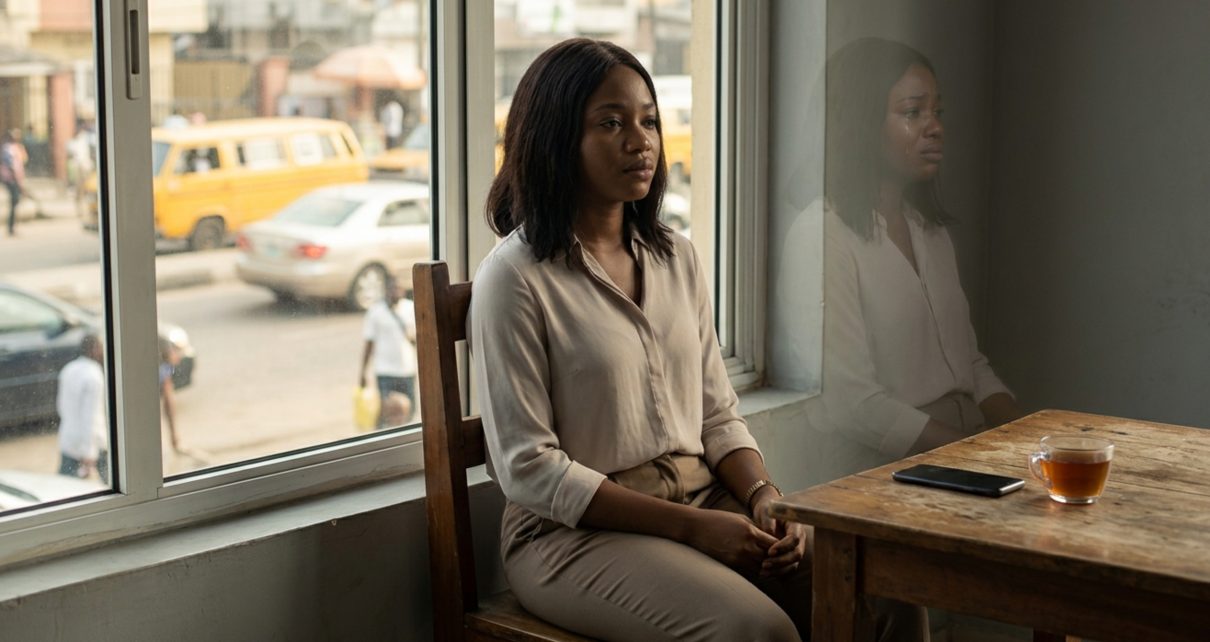

Last week, I introduced you to Tolani, whose story quietly mirrors the lived reality of many young adults navigating uncertainty, pressure, and emotional overwhelm in our fast-paced urban spaces. She had left school abruptly, her routine disrupted, her sense of direction shaken. What followed was not just anxiety, but something deeper—an exhausting cycle of trying to outrun her own inner world.
This week, we return to her story (click for last week’s story).
A Fragile Sense of Improvement
On the surface, things had improved. She had managed to keep going to the gym, forcing herself out of bed even on the heaviest days. There were moments of relief—brief pockets where she felt almost like herself again. But then, without warning, she would slip back into a low place. Not always anxious, she explained—just… low. Drained. Tearful. Unable to bring herself to do even the things she knew might help.
What stood out most was not just the anxiety itself, but her relationship with the anxiety.
She did what many people do—she tried not to think about it. When she felt better, she avoided reflecting on it. When she felt worse, she avoided talking about it. In both states, the strategy was the same: push it away, stay busy, distract, pretend.
It is a familiar pattern.
From a psychological standpoint, what we are seeing here is not simply anxiety as a condition, but anxiety as a cycle—one that is sustained by avoidance, self-judgement, and misunderstanding of what is happening internally. The body, in moments of perceived threat, releases stress hormones designed to protect us. But when the “threat” is not physical—when it is tied to thoughts, fears, or uncertainty—those same biological responses become overwhelming rather than helpful.
The mind then attempts to make sense of the body’s alarm. It searches for danger, creates scenarios, anticipates the worst. The individual becomes anxious not just about life, but about the anxiety itself. This is where the cycle tightens.
The Inner Battle
What complicates this further is the internal narrative. Tolani described feeling frustrated with herself, even ashamed. At one point, she admitted that if she saw someone else behaving the way she does when anxious, she might judge them harshly. Yet, when gently challenged, she recognised that this was not entirely true. Her compassion for others did not extend inward.
This is where many people get stuck.
They are not just battling anxiety; they are battling themselves.
In our cultural context, this struggle is often intensified. Many of us were raised in environments where emotional expression was either minimised or discouraged. Strength was equated with silence. Coping meant carrying on, “managing,” or pushing through without complaint. Conversations around mental health were limited and, in some homes, completely absent.
So we learned to function without understanding.
We learned to suppress without processing.
We learned to appear fine without actually being fine.
In family systems especially, there can be an unspoken expectation to hold things together—to not burden others, to not “overthink,” to not appear weak. For young adults trying to find their place in the world, this creates a quiet tension. They are navigating identity, purpose, financial pressure, and social comparison, all while lacking the language or permission to fully engage with their emotional experience.
It is no surprise, then, that avoidance becomes the default.
But avoidance, as we see in this case, does not resolve anxiety. It sustains it.
What Begins to Shift
What begins to shift the pattern is not force, but awareness.
In her journey, one small but significant shift emerged. She began to understand that her anxiety was not random or uncontrollable. There was a process behind it—a biological and psychological sequence that could be interrupted. This understanding did not remove the discomfort, but it reduced the fear around it.
She also noticed something important: when she engaged in certain activities—exercise, structured tasks, even temporary work—her symptoms eased. Not because the anxiety had disappeared, but because her system had something to anchor to. A sense of purpose, routine, and movement created stability.
This is what we often refer to as psychological scaffolding.
It is not about eliminating anxiety overnight. It is about building supportive structures around it—consistent habits, self-awareness, and healthier responses that gradually reduce its intensity and frequency.
Another key shift was the recognition that doing nothing is not a neutral choice. It still leads to anxiety. The difference is that one path—avoidance—keeps her stuck, while the other—taking small, uncomfortable steps forward—offers the possibility of growth.
Many people wait to feel ready before they act. But readiness often comes after movement, not before it.
Part of her resistance was also tied to identity. Admitting she was struggling felt like admitting something was wrong with her. There is a difference between identifying with anxiety and acknowledging its presence. One limits you; the other empowers you.
When you can say, “This is something I am experiencing,” rather than “This is who I am,” you create space for change.
A Gentler Way Forward
There is also a need to address the inner critic—the voice that demands perfection, confidence, and emotional control at all times. In her case, the expectation was to always be fun, composed, and unaffected. Anything outside of that was seen as failure.
But no one sustains that version of themselves indefinitely.
What supports healing, instead, is a different posture—one that combines honesty with gentleness. The willingness to say, “This is hard,” without immediately following it with self-criticism. The courage to take small steps forward, even when the outcome is uncertain.
Over time, these small steps matter. They build capacity. They rebuild trust in oneself. They challenge the belief that one is powerless.
For families and individuals reading this, the takeaway is not simply to “do more” or “try harder.” It is to begin with understanding. To recognise that anxiety is not a personal failure, but a learned response that can be unlearned with the right tools and support.
It is also to create environments—at home, in relationships, within communities—where emotional conversations are not shut down or dismissed. Where vulnerability is not met with judgement, but with curiosity and care.
Because healing rarely happens in isolation.
As her story continues, what is becoming clear is this: the turning point is not the disappearance of anxiety. It is the decision to stop running from it.
And perhaps that is the question to sit with—
What might begin to change if you allowed yourself to face what you have been trying so hard to avoid?
- Itunuoluwa Onifade is a developmental psychologist and a family life therapist.


