Top 10 Tech Training Institutes in Lagos
By Joy Mfon Essien
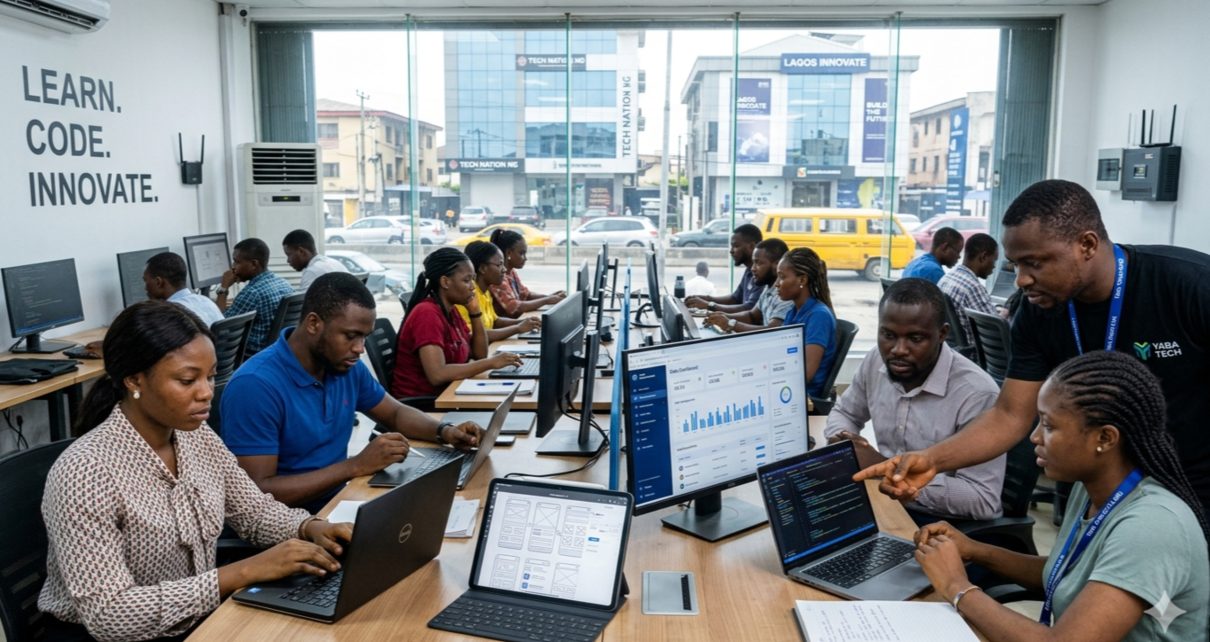
Lagos no longer treats tech training as a side hustle for the ambitious few. In 2026, it has become a serious urban industry of its own, feeding talent into start-ups, banks, global remote teams, creative businesses, and a widening digital services economy. What used to be a patchwork of coding schools and bootcamps has matured into a more competitive ecosystem of specialist academies, hybrid learning hubs, and career accelerators. Across Yaba, Ikeja, Surulere, Lekki, and Victoria Island, the real promise is no longer just learning a skill. It is gaining the kind of practical, AI-aware, work-ready competence that can open doors in a changing job market.
The tech training landscape in Lagos is now defined by a high-intensity, work-ready culture that bridges the gap between traditional education and the global digital economy. As of 2026, the ecosystem has matured from simple coding bootcamps into specialised hubs focused on higher-level integration, including Generative AI, cybersecurity, cloud systems, data analysis, product thinking, and digital creativity.
Here is an overview of the landscape across the city’s major tech corridors.
Yaba Still Sets the Tone
Yaba remains the spiritual heart of the Lagos tech scene, shaped by its proximity to the University of Lagos and its dense concentration of innovation hubs.
Univelcity, located on Montgomery Road, is known for a project-based approach. Its curriculum spans full-stack development and data science, with a strong focus on “zero to hero” pipelines that connect graduates directly with hiring partners.
Perxels is a specialised school with a strong emphasis on UI/UX design. It offers physical training spaces in Yaba where students work on complex case studies to build professional portfolios.
Decagon is a rigorous software engineering institute that operates a “learn-to-earn” model. It is widely regarded for its partnerships with major institutions such as Sterling Bank and Mastercard, helping position graduates for employment.
The Island Tracks Professional Upskilling
On the Island, especially in Lekki and Victoria Island, many training centres cater to professionals looking to upskill, as well as career switchers seeking globally recognised certifications.
Aptech Lekki is a veteran in the space, offering internationally recognised certifications. It has expanded heavily into advanced software engineering and AI and machine learning, often creating pathways to international degrees.
Torilo Academy, based in VGC, Lekki, focuses on beginner-friendly entry points into both the creative and technical economy, with courses in product management, digital marketing, and Generative AI.
AltSchool Africa, though largely online, maintains a strong presence in the Lagos professional community. It has helped popularise “nano-diplomas” — shorter, self-paced programmes designed around specific skills such as data analytics or the creative economy.
What Is Changing in 2026
Several shifts now define the Lagos tech training market.
First, AI is no longer treated as a novelty. Most serious institutes have moved beyond teaching about AI to teaching with AI. Students are being trained to use AI tools for programming support, content analysis, workflow automation, debugging, documentation, and productivity.
Second, the hybrid model is deepening. While learning from home remains popular, many Lagosians still prefer physical hubs because of more reliable power, faster internet, and the value of community. Centres such as Anchorsoft Academy lean into this, treating in-person teamwork as a serious part of the learning experience.
Third, the skills map is widening. The market is no longer dominated only by Python, JavaScript, and software engineering. There is a noticeable rise in the creative tech economy, with more programmes now covering areas such as product design, music marketing, digital publishing, and content strategy.
This is now a highly competitive space, and employability sits at the centre of it. Many institutes host demo days where students present final projects to recruiters, founders, and hiring partners. In that sense, these centres are becoming as much about visibility and networking as they are about classroom instruction.
How We Arrived at the Results
A good tech training institute in 2026 is no longer just about teaching people how to code. It is about shaping AI-enabled problem-solvers who can function in a fast-moving labour market.
If you are evaluating an institute, whether for your own development or as part of broader research into the Lagos tech ecosystem, these are the four gold-standard pillars to look out for.
Human + AI Integration
By 2026, teaching a programming language in isolation is no longer enough. A strong institute now integrates agentic AI and AI copilots into the learning process itself.
Prompt engineering is now foundational. The better schools do not just teach Python or JavaScript; they teach students how to use AI to debug, refactor, document, and accelerate their work.
At the same time, the real intellectual focus should move beyond syntax. Since AI can increasingly handle repetitive code tasks, the curriculum should place greater emphasis on architecture, system design, critical reasoning, product logic, and ethical oversight, including knowing when not to rely on AI.
Proof of Competency
A reputable school must move beyond issuing completion certificates and focus instead on producing verifiable evidence of competence.
That means real-world capstone projects. Students should not spend months building generic to-do-list apps that look like everyone else’s. The strongest institutes work on practical solutions to real business problems, such as a logistics dashboard for a Lagos delivery company or an automated support tool for a retail pharmacy.
Micro-credentialling is also emerging as a mark of seriousness. Instead of one vague certificate, the better schools now issue digital credentials or skill-specific badges tied to clearly defined competencies.
Work-Ready Outcomes
The strongest test of any training institute is whether it helps learners move into actual work.
A school’s job placement pipeline matters. Does it have demo days? Do recruiters from banks, start-ups, or established firms show up? Does it have a visible alumni trail?
Soft skills matter just as much. In 2026, technical skills may get you noticed, but communication, collaboration, emotional intelligence, and professional storytelling often determine who gets hired.
Post-graduation support is another key signal. The best schools offer mentorship, alumni access, portfolio reviews, and longer-term guidance rather than disappearing once the course is over.
High-Impact Methodology
The current learning environment rewards active, dialogue-based training far more than long, passive lectures.
The best schools blend in-person community, which is vital for mentorship and networking, with flexible online modules that allow students to learn at their own pace.
Some of the most forward-looking institutes now use AI analytics to monitor student progress, identify where a learner is falling behind, and recommend personalised support before the problem becomes serious.
The Listings
Utiva
Utiva has evolved significantly from its early days as a training bootcamp. As of 2026, it functions more like a broader talent ecosystem, bridging the gap between skill acquisition and actual work for global companies.
One of its biggest shifts is its move into the Employer of Record space. In practical terms, this means Utiva does not stop at training. It also helps international companies, especially in Europe and North America, hire, pay, and manage African talent.
That gives its advanced learners a distinct advantage. They are not simply graduates; they become part of a pre-vetted talent pool that global recruiters can access for remote roles.
Its curriculum is organised into focused schools. The Product School covers product management, product marketing, and strategy. The Data School focuses on data analytics, data science, and AI leadership. The Design School centres on UI/UX and design thinking. More recently, it has expanded into cybersecurity and cloud computing in response to growing demand.
A standout feature in 2026 is its Mini-MBA for tech talent, aimed at strengthening the business and workplace side of technical careers. This includes strategic communication, cross-cultural leadership, and business storytelling.
Aptech Computer Education Ogba
The Aptech centre in Ogba remains one of the established anchors of the mainland tech corridor. While Yaba tends to symbolise start-up energy and experimentation, the Ogba-Ikeja axis is often preferred by learners who want a more structured, certification-heavy route.
Aptech Ogba follows a traditional classroom model, which appeals to students who prefer fixed schedules and face-to-face instruction over self-paced online learning.
Its flagship ACCP programme, Aptech Certified Computer Professional, is a multi-year pathway designed to take students from beginner level to professional competence, often in areas such as full-stack development with Java, .NET, or open-source stacks.
Another major attraction is its global degree pathway. Through partnerships with international universities such as Middlesex University, students can sometimes complete part of their studies in Lagos and then transfer abroad to finish a UK degree.
The centre’s location is also strategic. It is accessible to learners from Ikeja, Agege, Berger, and surrounding mainland districts, and its proximity to Computer Village places students close to an existing hardware and software business ecosystem.
In terms of learning environment, the centre maintains a professional, corporate-style feel. It is also known for providing the kind of steady power and internet access that are especially important in Lagos. Its instructors usually go through internal certification processes, helping to maintain standardised teaching quality.
Like other serious players, Aptech Ogba has expanded its curriculum in line with 2026 trends. This now includes data science, AI, cybersecurity, ethical hacking, network security, and cloud training for AWS and Microsoft Azure.
Tech Studio Academy
Tech Studio Academy is a prominent Nigerian tech training provider with a strong presence in Surulere and Ogba. It specialises in intensive bootcamp-style learning aimed at helping students move into the tech industry within three to six months.
Its core programmes include software development, often focused on JavaScript, React, and Node.js; product design and UI/UX; data science; and digital marketing, covering areas such as SEO, content strategy, and social media management.
What stands out is the academy’s hands-on curriculum. Learners build portfolios while they train, rather than waiting until the end to produce proof of work.
It also offers job placement support through career coaching, CV reviews, interview preparation, and links to hiring partners. For mainland learners, especially those in Surulere, the physical centre offers a structured environment with relatively stable power and internet.
Moat Academy
Moat Academy is a highly regarded software engineering bootcamp based in Ikeja, Lagos. It is designed for beginners and career switchers who want to bridge the gap between university learning and industry expectations, particularly in full-stack development.
As of April 2026, it remains fully active, with upcoming cohorts and a curriculum updated to reflect current tools, including AI-assisted productivity.
It usually offers two main tracks: a 13-week full-time intensive programme known as The Classic, and a 21-weekend option designed for working professionals.
Moat has built a strong reputation for placing alumni in firms such as Interswitch, Moniepoint, and Stanbic IBTC. It also increasingly frames software development not just as a path for job-seekers, but as a multiplier skill for founders and entrepreneurs.
Torilo Academy
Torilo Academy has become a visible player in Nigeria’s tech and digital-skills training space, with a hands-on, project-based curriculum and a clear emphasis on employability.
Its programmes are beginner-friendly and span design, development, marketing, product management, data analysis, and cybersecurity. This includes UI/UX design, full-stack software development, AI engineering, SEO, paid advertising, content marketing, and ethical hacking.
A notable feature of its 2026 offering is the integration of Generative AI into different tracks. Rather than teaching AI as a separate subject, it increasingly teaches learners how to use AI within their own field, whether that is design, marketing, or product work.
Torilo also places strong emphasis on recorded lessons, portfolio development, and practical job placement support.
Anchorsoft Academy
Anchorsoft Academy is a top-tier software engineering and technical training centre in Lagos, known for a project-based bootcamp style that serves both beginners and more experienced developers.
It has built much of its strength around web development, with a strong focus on the PERN stack, PostgreSQL, Express, React, and Node.js, as well as Python and Django.
More recently, it has expanded into advanced areas such as agentic AI coding and cloud deployment. Alongside software engineering, it also offers training in UI/UX design, QA software testing, and data analysis.
Anchorsoft is widely praised for its hands-on approach, with students building production-ready applications instead of merely following tutorials. It also offers several learning formats, including on-site classes around Ikeja and Allen Avenue, virtual school, and private mentorship. Career support is built around global job readiness and remote-work opportunities.
Univelcity
Univelcity remains one of the most recognisable names in Yaba’s tech ecosystem. Located in the heart of what many still call the Silicon Valley of Nigeria, it is designed more as a talent accelerator than a conventional school.
Its programmes cover product design, software engineering, data science and AI, and product management. Students can choose between on-site learning in Yaba, flexible online formats, and tailored corporate training for workforce upskilling.
Its strongest differentiator remains project-based learning. Rather than focusing on theory alone, Univelcity pushes students to build real-world portfolios that can be shown to employers.
Its community advantage also matters. Being located in Yaba gives students direct proximity to start-ups, tech events, founders, and the wider energy of the local innovation economy. Beyond technical training, it also places emphasis on communication, collaboration, and problem-solving.
Decagon Institute
Decagon Institute is widely seen as one of Nigeria’s most elite software engineering bootcamps. It is known for a tough entry process and an intensive six-month fellowship model, often compared with the kind of talent acceleration once associated with Andela’s junior developer pipeline.
Its Software Engineering Fellowship covers full-stack development across tracks such as Java, Node.js, Python, .NET, iOS, and Android.
It also offers a Master’s pathway for learners who want to move into graduate programmes in engineering management or cybersecurity through partnerships with American universities.
Decagon is generally not aimed at complete beginners. It is better suited to people with some foundational logic or coding experience who want to reach a higher professional standard.
Its financing model has also been a major part of its identity, with pay-after-job and student-loan options alongside self-funding. Graduates, often known as Decadevs, are placed in partner companies that have included names such as Interswitch, Microsoft, and Flutterwave.
Although it has historical ties to the Yaba-Jibowu tech community, its main residential training operation is now centred around Orchid Road, Lekki, supporting a more immersive live-and-work model.
GOMYCODE
GOMYCODE is a major tech education brand that has established a visible presence in Nigeria’s start-up ecosystem, especially in Yaba, Ikeja, and Lekki. Its strength lies in a blended-learning model that combines self-paced online theory with physical mentorship and collaboration.
Its learning spaces, which it calls hackerspaces, are designed to feel more like community hubs than formal classrooms. Students use an internal platform for theory, then gather physically for practical work, feedback, and networking.
Its curriculum spans full-stack development, data science, digital marketing, and UI/UX design. Beyond technical training, GOMYCODE also focuses on employability through soft-skills coaching, portfolio development, and links to internship and job opportunities.
For many learners, the appeal is not just the course content but the atmosphere. GOMYCODE often feels more like a community of young innovators than a conventional school, which can be valuable for both confidence and networking.
Lagos Data School
Lagos Data School has built a strong reputation for practical, job-ready technical training. Although its name suggests a narrow focus, it has expanded into a broader set of tech and business-oriented courses.
Its flagship offering remains data analytics, with training in Excel, SQL, Power BI, Tableau, and Python, often framed around business scenarios relevant to Lagos and the wider Nigerian economy.
It also offers full-stack web development, digital marketing, business analysis, and graphic design. This wider curriculum reflects the growing overlap between technical, creative, and commercial skills in the labour market.
The school is located at 12 Abiodun Shobajo Street, Agidingbi, Ikeja, making it accessible to mainland learners from places such as Yaba and Surulere.
It offers physical classes, live online instruction, and weekend sessions for working professionals. Each course typically ends with a capstone project, whether that is a live dashboard, predictive model, or another portfolio-ready output. Career support is also built in, with dedicated guidance on portfolios and CVs to align learners with employer expectations.
How to Choose the Right Institute
Choosing a tech training institute is a serious investment of both time and money. In a market moving as quickly as Nigeria’s, the real issue is not whether a school sounds impressive, but whether it fits your actual career direction.
Start with curriculum relevance. Technology changes faster than formal academic calendars, so a suitable school should be teaching current tools and methods, not outdated frameworks. It should also be strongly project-based. If you are spending most of your time listening rather than building, that is a warning sign.
Mentorship also matters. Very large classes often produce a false sense of progress. The better schools offer small class sizes, access to mentors, and room for one-to-one feedback.
Format is another key factor. If you are already working, a weekend or hybrid programme may make more sense. If you need stronger structure, a physical hub with stable power and internet may give you a real advantage.
Then there is return on investment. The strongest institutes provide more than classes. They offer CV workshops, interview preparation, demo days, alumni visibility, and a credible pathway into work.
There are also clear red flags to avoid. No serious school can guarantee a job. Outdated equipment is a bad sign in any physical centre. Hidden costs, including exam fees, software licences, and equipment charges, should always be clarified before enrolment.
Final Thoughts
Choosing an institute in 2026 means looking beyond course outlines and asking what kind of ecosystem the school actually provides. In the current Nigerian tech market, a certificate is often secondary. Recruiters want evidence of work, proof of thought, and signs that a learner can solve real problems.
That is why the portfolio matters so much. Ask to see GitHub repositories, design files, capstone outputs, and alumni success stories. If every student project looks the same, the school may be training people to imitate rather than think.
A few names continue to come up in quality discussions, including AltSchool Africa, Utiva, and other specialist providers such as Bizmarrow Technologies and Neo Cloud Technologies outside Lagos. But even then, the best choice depends on your own direction.
And that is perhaps the most important point of all. A suitable institute should not simply teach you how to use a tool. It should teach you how to solve a problem, adapt to change, and become useful in a fast-moving economy.


