By Nkanu Egbe
The numbers alone tell a sobering story. Nigeria’s digital media ecosystem recorded a 26.2 per cent decline in readership traffic in 2025, reflecting a major structural shift in news consumption driven by artificial intelligence. Total traffic across Nigerian digital media platforms fell from over 1.04 billion visits in 2024 to 769 million in 2025 — one of the most significant structural changes in the country’s media landscape in recent years. Meanwhile, rising operational costs, declining advertising revenues, reduced donor funding, and fluctuating exchange rates continue to threaten media sustainability across the industry. And looming over it all is a technology — artificial intelligence — that is simultaneously a tool, a disruptor, and an existential question mark for every newsroom in the country.
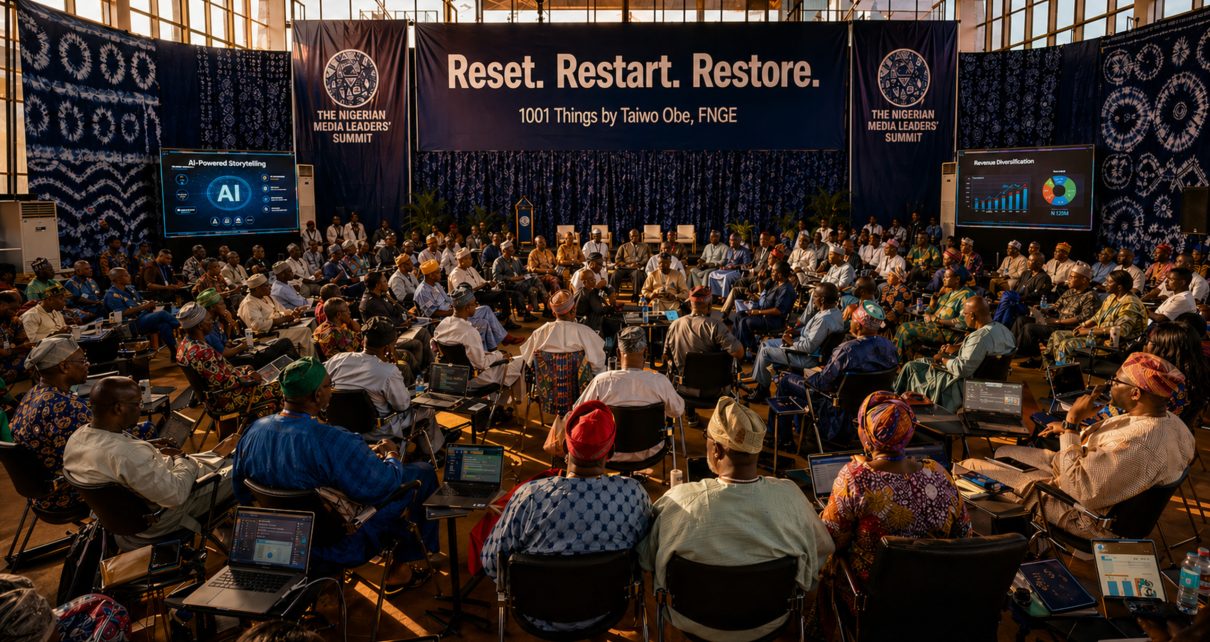
It is into this landscape that over 60 of Nigeria’s most senior media leaders will walk when they convene in Abeokuta, Ogun State, on 11–12 May 2026, for the 4th Nigerian Media Leaders’ Summit. Organised by The Journalism Clinic and its founder Taiwo Obe, the summit carries a theme — Reset. Restart. Restore. — that reads less like a conference slogan and more like a diagnosis. The industry, it seems, has decided that the time for lamenting has passed.
That instinct is not new for this summit series. The first Media Leaders’ Summit, held in 2019, was convened for Nigerian newsroom managers to explore how to reshape the industry for revenue and relevance in the digital age. A major outcome of the 2024 edition was the formation of the Innovative Media Partners Cooperative Multi-purpose Society (IMPCMS) — a tangible, structural response born directly out of the summit floor. The 4th edition, then, arrives with a track record and a sharper sense of urgency: trust, credibility, and influence now matter more than ever in a media environment being rapidly reshaped by forces beyond any single organisation’s control.
What this summit does — and what this analysis will examine — is ask whether Nigeria’s media leaders are ready not just to diagnose the crisis, but to act their way out of it.
Why Now? The State of Nigerian Media
To understand why the theme Reset. Restart. Restore. carries the weight it does, one only needs to look at what Nigerian media has endured — and is still enduring.
The Economics Are Brutal
The financial foundations of Nigerian media have been eroding for years, but the pace has accelerated sharply. Media owners are navigating the compounding impact of reduced advertising budgets as companies cut costs, even as the costs of diesel, broadcast equipment, newsprint, printing, and distribution have risen sharply, squeezing profitability from both ends. The naira’s prolonged weakness has made the situation especially punishing for outlets that rely on imported equipment and materials. The National Bureau of Statistics reported a headline inflation rate of 32% in February 2024, exacerbating production costs, squeezing profit margins for media companies, and leading to layoffs — with salary arrears for journalists reaching months or even years at some organisations.
Print has been hardest hit. In 2023, print advertising accounted for less than 10 per cent of total advertising revenue in the country, forcing newspapers to seek alternative income streams. Some outlets have responded by reducing pagination, pulling out of cities where sales were weak, or abandoning certain publishing days altogether — survival tactics that signal retreat, not strategy.
Digital has not proven to be the rescue many hoped for. While digital media platforms are growing, they generate lower ad revenues compared to legacy platforms such as TV and print, and far less than their Western counterparts. Nigerian news media rely heavily on advertising for online monetisation, but changes to Google’s search algorithms have further strained their financial stability. And now, AI is compounding the problem: AI-powered search overviews are increasingly answering user queries directly, reducing the need to visit publisher websites — while still relying on those same publishers as primary sources. Publishers are, in effect, being harvested without being compensated.
The Funding Safety Net Is Fraying
For many Nigerian media organisations, particularly those doing investigative and public interest journalism, international donor funding has long served as a critical lifeline. That lifeline is now under acute strain. Investigative journalism has become increasingly reliant on organisations such as Internews and the National Endowment for Democracy, and recent United States funding cuts have had a severe impact on journalists in fellowship programmes and media outlets that depend on these grants — resulting in fewer investigative reports and reduced capacity for in-depth journalism. Meanwhile, Meta’s plans to discontinue its fact-checking programme in the United States have raised alarm bells for the Nigerian Fact-Checking Alliance, whose members are heavily reliant on that funding, with fears of widespread job losses and unchecked misinformation if the programme ends outside the US.
The Operating Environment Is Hostile
Beyond the economics, Nigerian journalists are working in an environment of growing physical and legal peril. Nigeria dropped 10 spots to 122nd in the 2025 World Press Freedom Index released by Reporters Without Borders, which links the decline to growing threats to editorial independence and a concentration of media ownership in the hands of private groups close to those in power. A survey by Media Rights Agenda found that government officials are responsible for 74 per cent of attacks on journalists in the country, with the Nigeria Police Force accounting for nearly half of all violations. Nigeria’s Cybercrimes Act has increasingly been weaponised against journalists reporting on government misconduct, creating a chilling effect that reaches well beyond those directly targeted.
The Structural Shift Underneath It All
Underlying all of this is a deeper transformation in how Nigerians consume information. Nigeria’s digital media ecosystem recorded a 26.2 per cent decline in readership traffic in 2025 — not because audiences have lost interest in news, but because AI-powered tools are increasingly delivering answers without requiring users to visit publisher websites. The old click-driven model of digital media — already fragile — is breaking down faster than most newsrooms have been able to respond.
Taken together, these pressures describe an industry that is not merely facing a difficult cycle, but a structural reckoning. The old business models are not coming back. New ones have not yet arrived in sufficient scale or form. It is precisely this gap — between a media landscape that no longer works as it used to and one that has not yet figured out what comes next — that the 4th Nigerian Media Leaders’ Summit is being convened to address.
Reading the Theme: Reset. Restart. Restore.
Conference themes can be cosmetic — aspirational language draped over routine programming. Reset. Restart. Restore. is something different. Each word is load-bearing, and together they form what amounts to a frank self-assessment of where Nigerian media stands — and what it will take to move forward.
Reset: Acknowledging What Is Broken
The first word is the hardest. To call for a reset is to concede that the current configuration is not working, that the settings need to change before anything else can. For an industry historically reluctant to openly scrutinise its own business models, this is a meaningful admission.
The business models that sustained journalism for more than 100 years are disappearing. Print revenues have declined. Radio and TV face new and aggressive competitors. Digital platforms now control advertising. Audiences have migrated to mobile, on-demand, personalised content. These are not temporary fluctuations. They are structural changes, and they demand a structural response. A reset, in this context, means letting go of inherited assumptions about how media organisations should earn revenue, attract audiences, and justify their relevance — and being willing to start that reasoning from scratch.
The summit deliberately pushes delegates to rethink long-held structures in Nigerian media. Rather than routine dialogue, organisers are steering conversations toward practical reinvention, with a clear focus on unlocking shared value across media owners, employees, advertisers, suppliers, and audiences. That framing — shared value across the entire media ecosystem, not just within individual organisations — is itself a departure from how these conversations have typically been held.
Restart: Committing to New Models and New Mindsets
A reset without a restart is merely an ending. The second word of the theme signals that the summit’s ambition goes beyond diagnosis. It is asking participants to actually begin again — to commit to new approaches in the room and carry them back into their newsrooms and boardrooms.
Innovation, credibility, and revenue sustainability are described as three interconnected pillars: innovation without credibility is hollow, credibility without revenue is unsustainable, and revenue without innovation is temporary. This is the triangle Nigerian media must now navigate. A restart means investing in it deliberately rather than hoping circumstances improve.
The summit’s programming reflects this intent. Facilitators include a digital strategist focused on AI integration, social media monetisation, and Web3 opportunities, alongside a media and executive leadership expert leading sessions on innovation, organisational transformation, and leadership alignment within media institutions. These are not abstract topics. They are the operational questions that media executives across the country are grappling with daily, and bringing specialists in to engage them directly signals a summit that understands the practical weight of what it is asking leaders to do.
Restore: Rebuilding Trust and Viability
The third word may be the most profound. Restore implies that something of value once existed and has since been diminished. For Nigerian media, that something is dual: the commercial viability that once made journalism a sustainable enterprise, and the public trust that once made it an indispensable institution.
Nigeria’s media landscape is not declining so much as evolving into a more complex, AI-mediated ecosystem where trust, credibility, and influence matter more than ever. That observation cuts both ways. On one hand, it is genuinely encouraging — audiences have not abandoned the need for credible journalism. On the other, it places the burden squarely on media organisations to be worthy of that trust, even as economic pressures tempt some toward sensationalism, political dependency, or editorial compromise.
Restoration, then, is not nostalgia for a golden age. It is a recognition that a media industry without credibility or commercial sustainability cannot serve its democratic function — and that rebuilding both simultaneously is the defining challenge of this moment.
The Principle That Holds It Together
What unifies all three words is the summit’s guiding principle: No Lamentations, Only Decisions. This is a cultural instruction as much as a programme note. Nigerian media gatherings have not always been short on diagnosis. The complaints are well-rehearsed: the naira is weak, advertisers have migrated to digital, the government is hostile, donors are pulling back. All of it is true. None of it, on its own, is a strategy.
Organisers are deliberately structuring conversations to produce outcomes that are not only reflective but also implementation-driven. The syndicate group format — where participants break into smaller working groups to develop actionable responses to specific challenges — is designed precisely to convert conversation into commitment. The measure of this summit will not be the quality of the speeches. It will be what delegates do when they leave Abeokuta.
That, ultimately, is what Reset. Restart. Restore. is asking of the Nigerian media industry: not to feel better about its situation, but to act differently within it.
What the Format Tells Us
A summit’s architecture is often more revealing than its agenda. The questions a convener chooses to ask, and how they are structured, signal what kind of outcomes they are genuinely pursuing. Judged by its design, the 4th Nigerian Media Leaders’ Summit is not content with producing a communiqué.
The 1001 Things Session: Provoking Possibility
The summit opens not with a panel of experts but with a single, expansive session led by the convener himself. Titled 1001 Things, the session is expected to challenge delegates to interrogate possibilities within the sector, while driving the development of an “Agenda for Renewal” — a practical roadmap for media transformation. The title alone is instructive. It does not promise solutions. It promises scale of imagination — the deliberate suggestion that the range of what is possible for Nigerian media is far wider than the industry has been willing to consider.
This is a meaningful design choice. Many industry gatherings begin by narrowing the frame — identifying the two or three problems that will be discussed over two days. 1001 Things does the opposite. It begins by expanding the frame, asking participants to resist the pull toward familiar complaints and instead survey the full landscape of what reinvention could look like. It is, in effect, a permission structure: you are allowed to think bigger than your current circumstances.
The Syndicate Groups: From Diagnosis to Prescription
Once the frame has been opened, the summit shifts to its working format: syndicate groups. Participants break into smaller clusters to examine specific challenges confronting the media landscape and develop actionable responses. This is where the real work happens — or should happen.
Organisers are deliberately structuring conversations to produce outcomes that are not only reflective but also implementation-driven. The syndicate model is suited to this precisely because it disperses the intellectual labour. Rather than sixty leaders listening to the same presentations and arriving at the same broad conclusions, working groups allow different sets of expertise to engage different sets of problems simultaneously — and to go deeper than a plenary session ever could.
Delegates are expected to confront key questions around sustainability, innovation, content value, and revenue transformation in Nigerian media. These are not abstract strategic topics. They are the daily operational dilemmas facing editors, publishers, and broadcast executives across the country — questions of how to pay journalists, how to attract advertisers, how to monetise digital audiences, and how to compete for attention in an environment where the rules keep changing.
The Facilitators: Depth Over Decoration
The choice of facilitators further reinforces the summit’s action orientation. Let’s imagine: We may have a digital strategist focused on AI integration, social media monetisation, and Web3 opportunities, a media and executive leadership expert drawing from decades of cross-sector experience, a visual storyteller with expertise in storytelling evolution, and a tourism advocate offering perspectives on narrative diversity and national identity — not generalist keynote speakers parachuted in for credibility, but practitioners with specific competencies matched to specific gaps in the industry’s current thinking.
This matters because one of the persistent failures of industry gatherings is the mismatch between the sophistication of the problems and the generality of the prescribed responses. The 4th summit appears to be taking seriously the idea that the right expertise in the room changes the quality of what the room can decide.
Why the IMPCMS Precedent Changes Everything
The most compelling argument for the summit’s format, however, is not theoretical. It is historical. The clearest evidence that this gathering produces real outcomes rather than good intentions came out of the 2nd edition in 2024, when a presentation titled Where’s the Money prompted participants to take collective action. The Innovative Media Partners Cooperative Multipurpose Society (IMPCMS) was formed directly as a result of that summit — and crucially, it did not remain a paper institution. It was formally inaugurated by the Lagos State Ministry of Commerce, Cooperatives, Trade and Investment on October 25, 2024, completing all registration formalities and opening a bank account by mid-2025. The inauguration drew recognition from government officials who commended the initiative, stating that it demonstrated the power of collective action.
That arc — from a summit floor conversation to a formally registered cooperative with elected officers and a functioning bank account — is not an accident. It is what happens when a gathering is designed with enough rigour and follow-through to convert ideas into institutions. It is also the bar against which the 4th edition will be measured.
The No Lamentations, Only Decisions principle is therefore not merely motivational language. It is a standard, set by the summit’s own track record, that this year’s delegates will be expected to meet.
Grounds For Optimism
Optimism about Nigerian media requires justification. The pressures documented in Section II are real and ongoing. But pessimism, too, requires justification — and the evidence for irreversible decline is weaker than the industry’s mood sometimes suggests. There are genuine reasons to believe that the 4th Nigerian Media Leaders’ Summit arrives at a moment when the conditions for meaningful change are more favourable than they may appear.
The Industry Has Already Proved It Can Self-Organise
The most compelling argument for optimism is not theoretical. It already happened. As established in the previous section, the 2nd edition of this very summit produced the Innovative Media Partners Cooperative Multipurpose Society — a formally registered, government-inaugurated institution with elected officers, a functioning bank account, and active membership. Its inaugural meeting on October 25, 2024 was described as birthing a new era of collaboration and empowerment among media professionals, and it has since grown into a genuine vehicle for collective economic action within the industry.
This matters enormously. One of the most persistent critiques of industry gatherings is that they generate energy but not structures — that the relationships formed in conference rooms dissolve when participants return to their competitive realities. The IMPCMS is direct evidence that this summit series is capable of the harder thing: converting shared intent into shared institutions. If the 4th edition produces even one comparable outcome, it will have earned its place in the industry’s history.
Proof Points Already Exist Within Nigerian Media
Optimism is also justified by what some Nigerian media organisations have already accomplished, independent of any summit. Premium Times has built a comprehensive sustainability model incorporating donations, membership programmes, book publishing, data-driven initiatives, philanthropic contributions, strategic alliances, compliance services, commercial advertising, event management, and capacity-building training into its revenue framework. Platforms like Stears and The Republic are pioneering paid newsletters and premium content, demonstrating that Nigerian audiences will pay for journalism they value.
These are not foreign models being imported into an inhospitable environment. They are Nigerian solutions, built by Nigerian journalists, serving Nigerian audiences. Their existence proves that the path out of the current crisis does not require waiting for external conditions to improve. It requires the will and ingenuity to build differently — precisely what the summit is designed to provoke.
The Continent Is Moving in the Same Direction
Nigerian media does not operate in isolation, and the continental mood is instructive. Across African media, the emerging consensus is that the industry’s future is stable and potentially successful if business models are sustainable, innovative, and inclusive — and that the next decade calls for robust collaboration with shared knowledge and strategic resourcing. Nigeria, as Africa’s most populous nation and one of its most dynamic media markets, is not a passive observer of this continental conversation. It is, or should be, one of its leading voices.
PwC’s Africa Entertainment and Media Outlook projects that unlocking the continent’s media potential will require bold decisions and collaborative execution, noting that the trends are clear but that realising the opportunity demands that stakeholders move from insight to action. That phrase — from insight to action — could be the 4th summit’s unofficial motto. The insight has accumulated across years of conferences, research, and painful experience. What remains is the decision to act on it, collectively and with urgency.
AI is a Threat — But also an Opening
The same technological force disrupting Nigerian media’s existing revenue streams is simultaneously creating new possibilities that did not exist a decade ago. AI adoption is already gaining traction in Nigerian newsrooms, with tools being deployed for copy-editing, content illustration, content strategy, and ad targeting. Organisations like Dataphyte have introduced tools that enable newsrooms to analyse complex datasets and produce data-driven stories efficiently.
Despite the disruptions, the view from within the industry is that this moment offers the most exciting era in the profession — because technology has expanded reach, innovation has collapsed long-standing barriers, and new opportunities now exist for organisations prepared to reinvent themselves. That is not naive boosterism. It is a sober recognition that disruption, by definition, creates space. The organisations that understand the new landscape before their competitors do will occupy positions of strength that were simply not available to them under the old order.
Leadership Buy-In Signals Seriousness
Finally, there is the matter of who is in the room. The calibre of participants at a summit of this kind is itself a signal. Past editions have drawn newspaper publishers, editors-in-chief, TV and radio chief executives, general managers, directors of programmes, and editors from across the country — people who do not attend gatherings they do not believe will produce something worth their time. The returning participants, in particular, carry a form of institutional memory: they know what past editions produced, they have seen the IMPCMS come to life, and they are returning because the model has earned their confidence.
For Africa’s media houses, 2026 represents a definitive tipping point, as the triple threat of revenue model collapse, platform dependency, and the relentless surge of generative AI has moved from a distant concern to an immediate operational reality. Tipping points cut both ways. They can tip toward collapse, or they can tip toward reinvention. The question is whether enough leaders are in enough rooms, making enough of the right decisions, with enough urgency. In Abeokuta this May, sixty of Nigeria’s most senior media minds will have the opportunity to push the balance toward the latter.
That, in itself, is a reason to pay attention.
What Policymakers Should Take Note Of
Nigerian media leaders do not enter the Abeokuta summit in a policy vacuum—they step into a regulatory thicket where laws meant to curb cyber threats have become instruments of journalistic peril. The Cybercrimes (Prohibition, Prevention, Etc.) Act, even after 2024 reforms, continues its grim tally: at least 25 journalists prosecuted under its provisions by late 2025, with three more detained since August on vague charges of “grossly offensive” messaging that somehow always seems to ensnare critical coverage of power. Nigeria’s 122nd ranking on the 2025 World Press Freedom Index—a 10-spot plunge tied to editorial threats and ownership concentration—underscores the hostility, where police account for half of journalist attacks and draconian statutes cast long shadows over newsrooms already battered by economic gales.
Policymakers’ Enabling—or Entrapping—Role
What policymakers might miss amid these summit conversations is how profoundly government can tilt the scales—not just through restraint, but through deliberate empowerment. President Tinubu’s April 2026 broadcast agenda, directing ARCON and NBC to enforce advertising debt collection and craft standard operating practices for the sector, arrives as both lifeline and lancet: zero-tolerance on unpaid obligations could inject billions into starving broadcasters, yet without grace periods or incentives, it risks accelerating closures in an industry where print ad share has shriveled below 10 percent and digital traffic plunged 26.2 percent last year. Forward-thinking reforms beckon—tax holidays on newsprint imports and broadcast gear, as urged by industry voices drawing from South African and U.S. models; eased forex access to blunt the naira’s lash on equipment costs; an independent media development fund to buoy investigative work as donor taps tighten. These are not subsidies for sentiment, but scaffolding for an ecosystem where innovation in AI workflows and audience trust can flourish without the boot of bureaucratic overreach.
The Democratic Calculus
Media viability—the quiet ambition beneath “Reset. Restart. Restore.”—is no parochial plea; it is democracy’s pressure valve. A free press starved of revenue and shackled by Section 24 prosecutions cannot hold power to account, cannot counter AI-harvested misinformation or platform monopolies that siphon ad dollars while publishers toil unpaid. Policymakers convening in Abuja would do well to dispatch observers to Abeokuta, not as approvers but as learners: the syndicate groups forging renewal agendas may well prescribe exactly these policy pivots. Ignore them, and the structural reckoning documented here accelerates—toward a media landscape too frail to sustain the public discourse Nigeria’s democracy demands. Heed them, and the summit becomes not just an industry pivot, but a national safeguard.
Watching for Results
The true measure of the 4th Nigerian Media Leaders’ Summit will not be found in the eloquence of its speeches or the intensity of its debates, but in the institutions and actions it births—or fails to—when delegates disperse from Abeokuta. The bar is already set by the IMPCMS precedent: a 2024 floor conversation that hardened into a government-inaugurated cooperative with officers, accounts, and momentum by mid-2025, defying the gravitational pull of talk without traction. Concrete validation demands no less this time—an Agenda for Renewal emerging from the 1001 Things provocation and syndicate deliberations; binding pacts on shared revenue vehicles or AI ethics that channel disruption into dominance; perhaps even a Media Futures Fund seeded by collective pledges to back the next Premium Times or Stears.
Accountability Beyond Applause
“No Lamentations, Only Decisions” is not a slogan to be applauded in May and archived by June—it is a covenant with an industry and a public awaiting proof that Nigeria’s media leaders can self-rescue. Returning participants, those institutional memory-keepers who witnessed IMPCMS rise from summit ash, carry special obligation: their presence signals confidence in the model, but their silence post-event would erode it. Watchdogs—the NUJ, Guild of Editors, fact-checking alliances—must track deliverables with forensic persistence, publishing scorecards by year-end on commitments kept or abandoned, turning moral pressure into structural accountability.
The Stakes, Restated
A summit that delivers will have achieved something rarer than reinvention: vindication. It will prove that Nigeria’s media—bloodied by economics, lawfare, and algorithms—retains the agency to author its next chapter, not merely lament the one closing. Fail, and the structural gap charted from Section II onward widens into an abyss where trust erodes, democracy’s watchdog starves, and audiences accustomed to AI answers drift further from publishers who never adapted. Sixty leaders. Two days. One verdict: whether Nigerian media tips toward restored relevance or resigned irrelevance. The world beyond Abeokuta’s walls will be watching—and so should we.


