By Nkanu Egbe
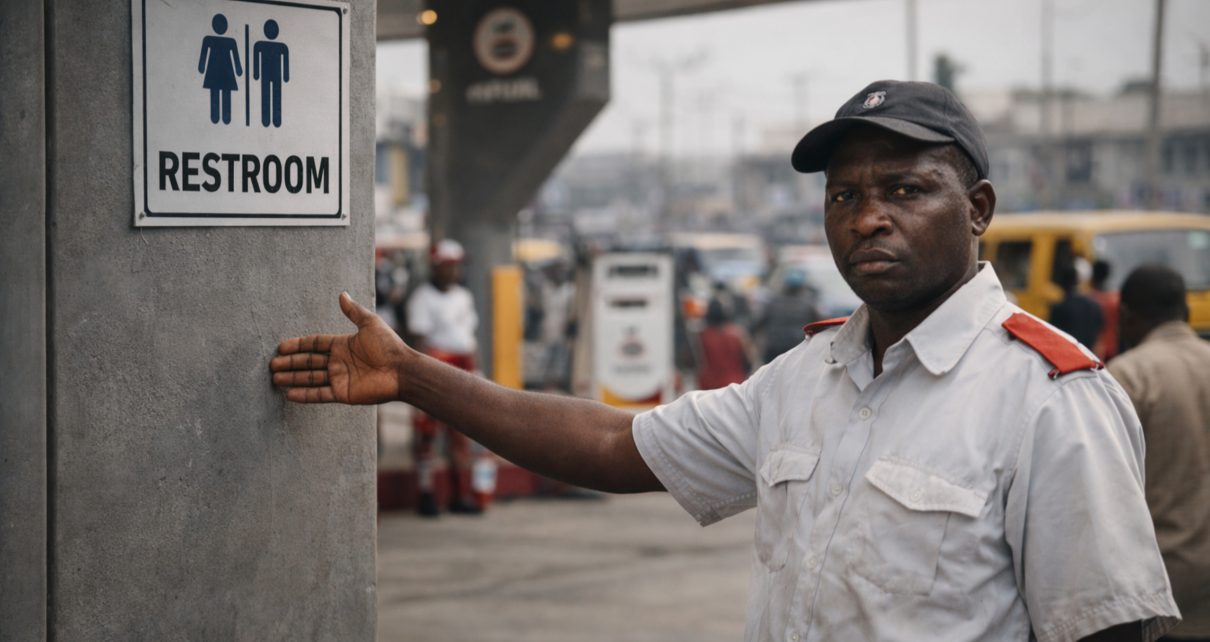
In the sprawling, high-energy corridors of Lagos, the gap between state-mandated environmental standards and the harsh reality of urban infrastructure has never been more visible. This week, the Lagos State Government, via the Ministry of the Environment and Water Resources, issued a directive that acts as both a plea and a provocation: for banks, filling stations, and high-traffic private establishments to open their restroom facilities to the general public.
To understand the full implications of this directive, let us apply a “4+1” analytical framework—a methodology designed to strip away the noise of press releases and interrogate the actual viability of urban policy. This analysis explores the situation through four distinct lenses:
- The Macro View (Public Health): Assessing the systemic health imperative and the true scale of the infrastructure deficit.
- The Operational View (SME/Corporate): Examining the financial and security burdens placed on the private sector.
- The Regulatory View (Governance): Analysing the feasibility of “soft mandates” in the absence of formal enforcement.
- The Spatial View (Urban Design): Critiquing whether we are relying on private proxies when the city requires systemic, high-volume public utility design.
Finally, we offer the “+1” (The Strategic Recommendation): a proposed path toward a collaborative “Clean Lagos” certification that aligns private interests with the public good. As we approach the upcoming environmental sanitation exercise, the question is no longer just about who is keeping our streets clean; it is about whether Lagos’s private sector is willing—or incentivised—to become the backbone of its public infrastructure.
1. The Public Health Imperative: A Metric of Survival
In a megacity where urban density is an ever-present pressure, open defecation is not merely an environmental eyesore; it is a critical vector for public health catastrophe. The correlation between the lack of accessible sanitation and the resurgence of waterborne diseases—specifically cholera and typhoid—is well-documented in tropical urban centers. When basic waste management infrastructure fails to keep pace with rapid population growth, the contamination of local water tables and surface run-off becomes an inevitability, creating a cycle of infection that disproportionately affects the city’s most vulnerable transit populations and informal workers.
The Data Gap: Availability vs. Accessibility The Lagos State Government currently reports approximately 1,710 functional public toilets across the metropolis. When viewed through the lens of a population estimated to exceed 20 million, the math is stark: this infrastructure provides a theoretical ratio of one facility for every 11,000+ residents.
However, the real crisis lies in the distinction between availability and accessibility. A public toilet located within a gated facility, a locked park, or a high-income enclave serves little purpose for the street trader in Mushin or the daily commuter navigating the Ikorodu Road corridor. For the vast majority of Lagosians who spend their day on the move, these 1,710 facilities are effectively invisible. We are witnessing a clear case of “sanitation desertification” in high-traffic zones, where the sheer volume of human activity utterly overwhelms the designated infrastructure.
The Pivot: Acknowledging Saturation The government’s formal appeal to banks and filling stations is more than a request for civic cooperation; it is a tacit admission that the state-led infrastructure model has reached its saturation point. The government can no longer build its way out of this deficit using traditional public procurement alone. By calling upon the private sector to bridge this gap, the state is acknowledging that the existing public utility framework is insufficient to support the daily hygiene requirements of a megacity of this scale. The appeal effectively signals that in the race against urban blight, the state’s infrastructure is no longer the sole line of defense—the private sector is now being drafted into the frontline of public sanitation.
2. The SME/Corporate Reality: The Operational Burden
For the Lagos SME owner, the government’s directive hits a nerve that sits at the intersection of civic duty and balance-sheet survival. While the policy appears straightforward in a boardroom, the operational ground reality is significantly more complex. To understand the reluctance of banks, filling stations, and eatery managers to open their doors, we must look at the specific friction points that govern their daily operations.
The Friction Point: Security, Hygiene, and the “Vandalism Tax” The primary resistance from the private sector is not necessarily a lack of empathy; it is a defensive posture born of hard experience. For a bank, a restroom is not just a utility—it is an entry point into a secured zone. Allowing unregulated public access introduces a significant security variable that many branch managers are loath to accept.
Beyond security, there is the “vandalism tax.” In a city where public infrastructure is often prone to abuse, private facilities that are opened to the public frequently suffer from rapid degradation. When a business makes the choice to open its toilets, it immediately inherits the risk of broken fixtures, plumbing blockages, and the misuse of facilities for illicit activities. Furthermore, hygiene is the frontline of brand reputation; if a restaurant or service outlet is perceived as having an unsanitary restroom, that perception—fair or not—bleeds into the public’s assessment of their core service quality.
The Financial Burden: The Hidden Cost of “Civic Service” The cost of maintaining a public-accessible restroom is often invisible to the user but highly tangible to the operator. It is not merely about water availability; it is a recurring operational expense that includes:
- Utility Inflation: In areas where municipal water is erratic, businesses rely on boreholes (requiring electricity/diesel) or expensive private water tankers. Every flush is a financial transaction.
- Human Capital: A high-traffic restroom requires near-constant cleaning to remain passable. This necessitates dedicated sanitation staff, further increasing the wage bill.
- Consumables: The rapid depletion of soap, tissue, and cleaning detergents—which are subject to rising inflationary pressures—turns a “small courtesy” into a consistent monthly drain on overheads.
The Paradox of Success The irony of this policy is that the businesses most capable of absorbing this traffic are the ones most wary of it. A high-traffic filling station on the Lekki-Epe Expressway or a major bank branch in Victoria Island is the ideal candidate for a public restroom—they have the footfall, the central location, and the visibility. Yet, these are precisely the entities that manage the highest risks and the strictest operational protocols.
When the state targets these high-traffic hubs, it is asking them to essentially function as public utilities without the benefit of public funding. The challenge for the administration, therefore, is to determine how it can transform these businesses from “reluctant gatekeepers” into “willing partners,” without leaving them to foot the entire bill for a service the city desperately needs.
3. Governance & Policy Feasibility: The Regulatory View
The Lagos State Government’s latest directive operates in a gray zone of regulatory communication. By framing this as an “appeal” or an “urge,” the administration is skillfully deploying a “soft mandate.” This strategy allows the state to set public expectations and test the pulse of the private sector without immediately invoking the full weight of legislative enforcement. However, for the business community, this ambiguity creates a persistent concern: when does a polite request become a regulatory requirement, and what are the penalties for non-compliance?
The “Soft Mandate” and the Transition to Enforcement The terminology used—”urging” and “appealing”—is not accidental. It provides the state with a low-stakes entry point into a sensitive issue. By avoiding coercive language initially, the government avoids an immediate backlash from trade unions and business associations. However, in the context of Lagos governance, such requests have historically functioned as precursors to formal regulation. If compliance is low, these appeals often transition rapidly into circulars, then to mandatory requirements enforced by the Lagos State Waste Management Authority (LAWMA) or sanitation task forces. The business community is currently in a “wait-and-see” phase, watching to determine if the state intends to codify this request into law or if it remains a non-binding moral imperative.
The Enforcement Reality: The Stick Without the Carrot The state’s historical strategy for sanitation relies heavily on the “stick”—environmental sanitation laws that empower the state to arrest and prosecute offenders. This punitive approach creates an adversarial dynamic. If the government expects banks and filling stations to provide a public service, it must address the “carrot.” Currently, the policy lacks a framework for systemic support. Without incentives—such as tax rebates, waste disposal subsidies, or simplified regulatory compliance processes—the policy risks having no “teeth.” Businesses are unlikely to absorb the costs of public sanitation purely on good faith; without a tangible incentive structure, this directive may be ignored by all but the most CSR-focused corporations, rendering the policy ineffective at scale.
The PPP Gap: Public Infrastructure by Proxy At its core, this directive challenges the definition of a Public-Private Partnership (PPP). A true PPP implies a shared distribution of risks and rewards. However, this request currently looks more like a transfer of burden, where the government is effectively asking the private sector to fill a deficit in public infrastructure that the state has failed to address.
When the government tasks a bank or a filling station with providing a public restroom, it is outsourcing a fundamental state responsibility. The critique here is one of equity: if the private sector is to subsidise public sanitation, they should not be asked to do so unilaterally. The government must provide, at a minimum, the “soft infrastructure”—such as technical support, waste management pickup frequency for these specific sites, and administrative recognition—to ensure that the burden on the business is offset by the value they are providing to the city. Without this reciprocity, the policy risks being viewed not as a partnership, but as an offloading of the state’s failure onto those already driving the city’s economy.
4. Urban Design & Future Infrastructure: The Spatial View
To rely indefinitely on the “goodwill” of private establishments to solve a systemic sanitation deficit is to mistake a stop-gap measure for a sustainable urban strategy. While urging banks and filling stations to open their facilities provides immediate, localized relief, it fails the test of scalability and equitable access. True urban health for a megacity like Lagos requires a pivot toward a decentralised, high-volume public utility design that can integrate into the fabric of the city without relying on existing private commercial footprints.
Beyond the “Appeal”: The Case for Decentralisation The current model of relying on private-sector restrooms is geographically limiting—it ties sanitation access to areas where businesses have chosen to operate, often neglecting the transit corridors, informal markets, and high-density residential hubs where the need is most acute. A structural urban design approach must prioritize a “hub-and-spoke” sanitation model. This involves embedding high-capacity public toilet clusters directly into the city’s transport master plan, particularly at BRT terminals, major bus stops (e.g., Oshodi, Mile 2), and market perimeters. By detaching sanitation from the commercial agenda of private businesses, the state can ensure that the infrastructure is located where the people actually are, rather than where businesses find it profitable to be.
Smart Infrastructure: The Future of Public Hygiene If the state intends to modernize Lagos, it must look toward the integration of “Smart Public Toilets”—a model increasingly adopted by global megacities to bypass the challenges of vandalism and human-intensive maintenance. These units, designed for high-traffic, low-oversight environments, offer several distinct advantages:
- Vandal-Resistant Engineering: Unlike standard porcelain fixtures, smart units utilize heavy-duty stainless steel or industrial-grade composite materials, minimising the risk of breakage and ensuring durability against wear and tear.
- Self-Sanitising Systems: These facilities employ automated floor wash-down systems, sensor-activated soap and water dispensers, and ultraviolet (UV) sterilisation cycles that trigger after every use. This creates a predictable hygiene standard that does not rely on the consistent availability of an on-site attendant.
- Data-Driven Maintenance: By integrating IoT (Internet of Things) sensors, facility managers can track real-time usage metrics and inventory levels (water, soap, paper). This moves maintenance from a reactive, complaints-based system to a proactive, schedule-based operation, significantly reducing the “degradation cycle” that plagues current public facilities.
Ultimately, the goal for Lagos should be to transition from a policy of asking the private sector to share their resources, to a policy of building robust public infrastructure that the city can rely on independently. Relying on businesses for public sanitation is a temporary patch; building a network of smart, vandal-proof, and self-sustaining units is the only way to safeguard the city’s long-term public health.
+1. The Strategic Recommendation: A Path Toward the “Clean Lagos” Certification
If the government’s appeal is to move beyond a mere suggestion and become a genuine success, the administration must shift its narrative from coercive enforcement to collaborative partnership. The goal should be to transform the “burden” of public sanitation into a verifiable asset for the private sector. To achieve this, Lagos State should consider the introduction of a “Clean Lagos” Certification—a tiered incentive framework that rewards participating businesses for their contribution to the city’s public health infrastructure.
Tax and Levy Rebates: Turning Compliance into Credit The most effective way to secure buy-in from the private sector is to align the government’s needs with the business’s bottom line. The state should formalise a system where businesses that open their restrooms for public use receive quantifiable tax or levy credits. This could take the form of a small percentage reduction in annual environmental development levies or trade permits for compliant branches. By formalising this, the government moves from a vague request to a structured contract, providing businesses with a tangible financial reason to absorb the operational costs of public restroom access.
Branding and Publicity: The “Lagos-Friendly” Premium Beyond financial relief, the state can leverage the power of public perception. Businesses that opt into the “Clean Lagos” certification should be entitled to official government recognition, such as a “Lagos-Friendly Business” window decal or digital badge. In a city where brand reputation is paramount, this status would serve as a powerful differentiator. It tells the public that these establishments are not just profit centres, but community stakeholders. This branding initiative, supported by a government-led awareness campaign, would drive foot traffic and customer loyalty, positioning participating businesses as the preferred choice for the socially conscious Lagos consumer.
Government-Subsidised Operations: Lowering the Barrier to Entry For many SMEs, the barrier to participation is not just desire, but capacity—specifically, the cost of cleaning materials, water supply, and waste disposal. The government should launch a pilot programme where participating high-traffic zones receive subsidised support. This could involve:
- Waste Management Credits: Providing free or discounted LAWMA pickups for these specific facilities.
- Bulk Consumable Support: Facilitating a partnership with private suppliers to provide discounted soaps, tissue, and detergents to certified businesses.
- Operational Grants: Providing small-scale technical support for plumbing upgrades in areas where the infrastructure is currently inadequate to handle increased volume.
The Bottom Line The “Clean Lagos” Certification model acknowledges that the private sector is already providing a vital service to the city; it simply asks the state to acknowledge and incentivise that service. By building a bridge of mutual benefit, the government can transform a potential source of conflict into a sustainable, collaborative urban strategy. This is not just about keeping the streets clean; it is about building a city where the state and the private sector act as partners in public health, rather than adversaries in the battle for urban order.


