
There are stories that pass through Lagos like breeze—light, loud, and quickly forgotten. And then there are stories that arrive heavily, refusing to be joked away, even in a beer parlour.
This was one of those stories.
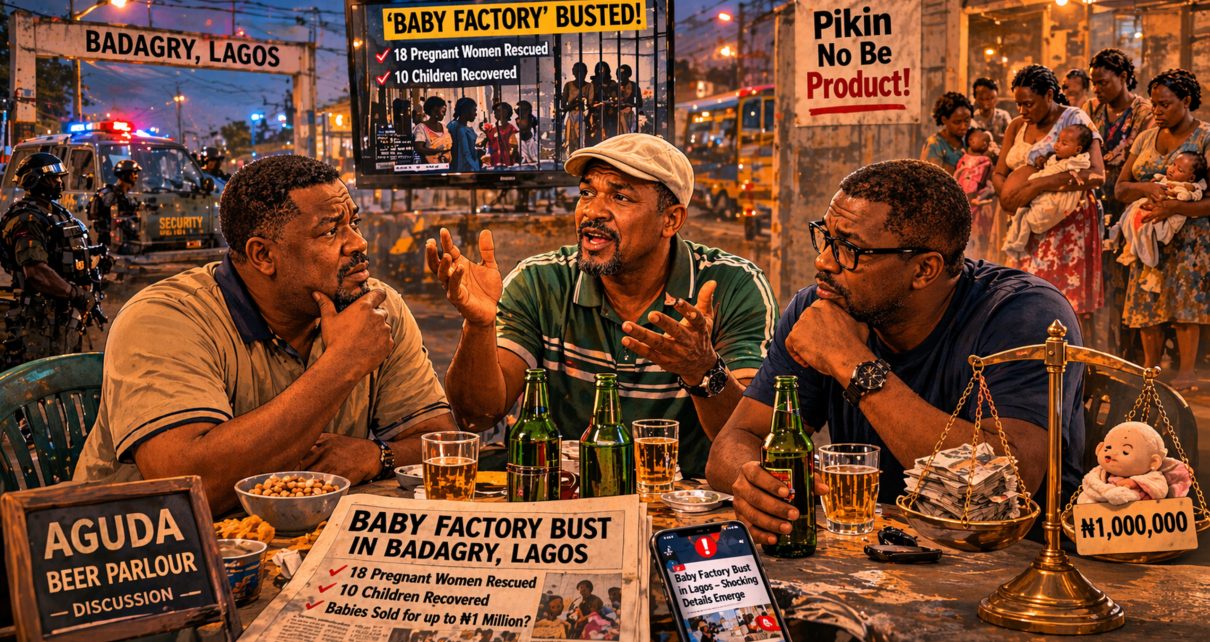
News filtered in that security operatives had uncovered an illegal “baby factory” in Badagry. Eighteen pregnant women. Ten children. A system where newborns were allegedly sold—priced, negotiated, and delivered like commodities.
Even in Aguda, where humour is often the first response to discomfort, the laughter took longer to arrive.
Chiboy spoke first, unusually quiet.
“You mean say person go carry belle nine months… then dem go sell the pikin?”
John shook his head slowly.
“No be say dem go sell… na say dem don turn am business.”
That distinction, though subtle, carried weight.
This was not a one-off tragedy. It was a system.
Across parts of Nigeria, so-called “baby factories” have been uncovered over the years—facilities where vulnerable women are recruited, coerced, or deceived into carrying pregnancies. The babies are then sold, often to individuals seeking children outside formal adoption processes, or worse, into exploitative networks.
The drivers are depressingly familiar: poverty, lack of access to healthcare, weak regulatory enforcement, and the social stigma attached to infertility.
I leaned forward, choosing my words carefully.
“This is human trafficking,” I said. “Not just crime—organised exploitation.”
Chiboy frowned.
“But how e take reach this level? No be one person go run that kind place.”
Exactly.
Operations of this scale rarely exist in isolation. They require coordination, protection, and—most troubling—demand.
John tapped the table lightly.
“Demand na im be the matter. If nobody dey buy, nobody go sell.”
That uncomfortable truth settled in.
Every illegal market survives because someone, somewhere, is willing to pay.
In Nigeria, the desire for children—particularly biological children—is powerful. Cultural expectations, family pressure, and societal norms often make adoption complicated and emotionally charged. In that vacuum, illegal alternatives find space.
Chiboy shook his head.
“So instead of proper adoption, people go dey buy human being?”
“Yes,” I replied. “Because the legal system can be slow, bureaucratic, and sometimes mistrusted.”
John sighed.
“So the system fail… and bad people take over.”
It is a pattern that repeats across sectors. Where systems are weak, informal—and often illegal—solutions emerge.
But the story does not end with demand and supply.
The women themselves are part of the tragedy.
Some are lured with promises of jobs. Others are coerced. Some are simply desperate—economically or socially vulnerable, with limited options.
Chiboy spoke again, more firmly this time.
“Make we no lie—poverty dey push people enter all these things.”
Poverty, yes—but also exploitation of that poverty.
The difference matters.
John leaned forward.
“And the children nko? From day one, dem don turn transaction.”
That is perhaps the most disturbing element.
Identity begins in secrecy. Origins are obscured. Legal protections are absent. The long-term consequences—for those children and for society—are profound.
Chiboy raised another question.
“Where government dey all this time? That place no just start yesterday.”
Enforcement often comes late—after the system has already been operating for months or years.
Regulation is reactive. Crime is adaptive.
I responded.
“Law enforcement acts when intelligence becomes actionable. But prevention requires stronger social systems—healthcare, education, legal adoption frameworks.”
John nodded.
“And awareness. People need to know say dis thing no be shortcut—na crime.”
Precisely.
Because one of the most dangerous aspects of such operations is how they can be normalised—quietly justified as “helping” infertile couples or “providing opportunity” for struggling women.
But exploitation, no matter how it is framed, remains exploitation.
The beer parlour fell into an unusual silence.
Even Chiboy, who rarely runs out of commentary, seemed measured.
Finally, he spoke.
“This one no even funny. No angle to laugh.”
Not every story invites humour.
Some demand reflection.
As we prepared to leave, John delivered the final thought of the evening.
“If society reach where pikin dey get price tag… we need to ask ourselves serious questions.”
I adjusted my cap and gave the closing line.
“When life becomes a commodity,” I said, “it is not just the victims that are at risk—it is the values of the entire society.”
Because in the end, this is not just about crime.
It is about what we are becoming.
Na so we see am.


