By Nkanu Egbe
Lagos is no longer talking about agriculture as a rural support activity; it is now presenting food as a major urban economy, with the state framing itself as a systems hub rather than just a consumer market. That shift matters because Lagos says its food economy is worth ₦16.14 trillion, and the government is using infrastructure, finance, logistics, and private investment to turn that scale into a coordinated growth model.
At the centre of that message is Commissioner for Agriculture and Food Systems, Abisola Olusanya, who anchored the 2026 ministerial briefing at Bagauda Kaltho Press Centre, Alausa, where she said Lagos is moving away from isolated agricultural interventions toward a connected food systems economy. The clearest proof point so far is the state’s food hub network, which has crossed ₦3.8 billion in transactions, showing that structured markets can work in a city long dominated by informal supply chains.
The bigger question is not whether Lagos can announce more projects, but whether it can convert its huge food demand into stable supply, lower waste, and better access for ordinary households. That is why the current food strategy reads less like an agriculture programme and more like a bid to build the infrastructure of a future megacity food economy.
Food hubs in operation
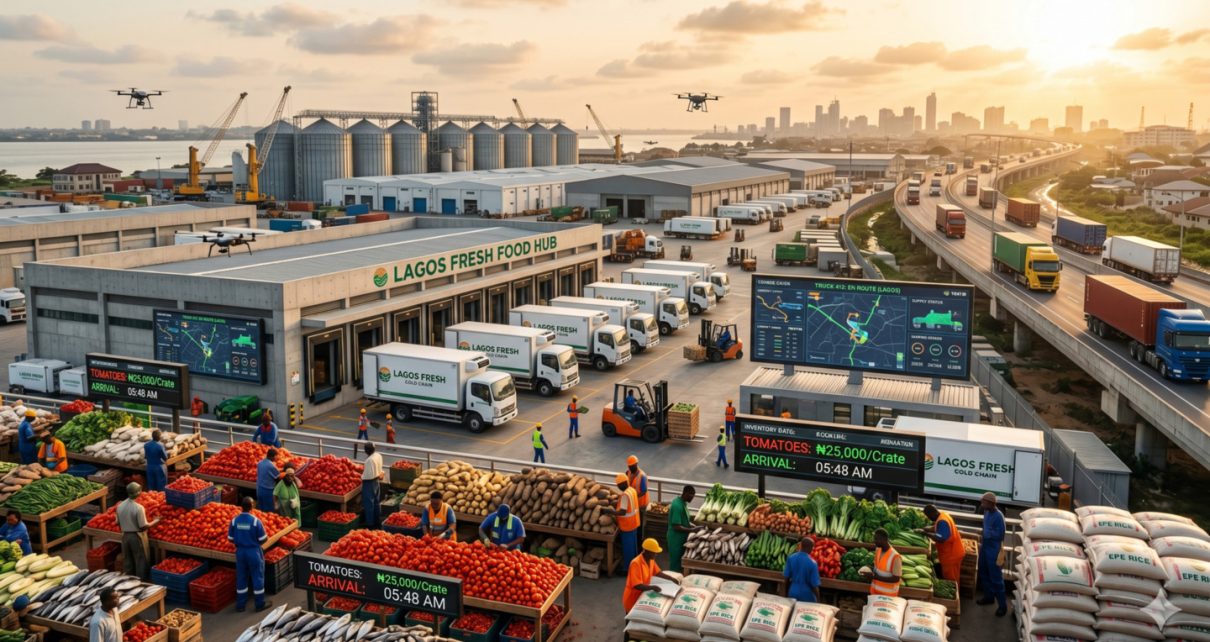
The clearest early sign of Lagos’s food systems strategy is the performance of its structured food hubs, especially the Idi-Oro market model in Mushin. The state says the Lagos Fresh Food Hub there has generated an additional ₦1.2 billion from 76 market days since May 2025, bringing the combined transaction value at the hub network to more than ₦3.8 billion.
That figure matters because it shows Lagos is no longer testing food reform only on paper; it is already moving produce through a managed market system with measurable turnover. More than 850 vendors have been registered, and the initiative has created over 7,000 direct and indirect jobs through trading, logistics, food handling, and related services.
Just as important, the Mushin hub is not being treated as a one-off success. Lagos has identified additional mid-level hub sites at Ikorodu, FESTAC Town, and Lekki Phase 1, signalling that the government wants to replicate a model of structured agro-markets across the state rather than rely on scattered informal trading points.
For the estimated millions of Lagos residents who still depend on informal food chains daily, the policy shift is significant but not yet complete. The real question is whether these hubs can scale beyond pilot success and begin reshaping how food is aggregated, priced, stored, and distributed across a megacity where convenience, speed, and affordability matter as much as supply itself.
The big picture
Lagos is trying to turn its sheer food demand into a coordinated economic system rather than leaving supply to chance. The state says its annual food economy is worth about ₦16.14 trillion, and it is now pushing infrastructure, logistics, finance, and market reform to capture more of that value locally.
This is a significant shift because the administration is no longer talking about agriculture as isolated projects. Instead, it is framing food as a full value chain — from production and storage to transport, processing, retail, and digital trading — all tied to one larger food systems strategy.
The scale of the opportunity is enormous, but so is the pressure. Lagos’s food demand has been projected to keep rising with population growth, and that means the state must do more than announce ambition; it has to stabilise supply, reduce losses, and improve affordability for millions of households.
Flagship projects
Lagos’s food strategy rests on a cluster of large projects designed to solve the practical bottlenecks of supply, storage, and processing. The flagship is the Lagos Central Food Security Systems and Logistics Hub in Epe, which the state says will handle more than 1,500 trucks daily and support the movement of about 1.5 million metric tonnes of food annually when completed.
The hub is more than a warehouse. It is being positioned as a full logistics ecosystem with aggregation, storage, processing, and distribution functions, and Lagos says the first phase will be commissioned in 2026. That timeline matters because the project is meant to be the backbone of the state’s food security architecture, not just another construction site.
Imota remains the clearest processing example of what Lagos is trying to scale. The rice mill produced more than 500,000 bags of Eko Rice in the last year, but that is still far below its annual capacity of 2.8 million bags, which means supply-chain reliability remains a major constraint. In other words, the state has built capacity on paper, but the operating environment still needs much stronger paddy supply and logistics to close the gap.
The aquaculture project follows the same logic. The Lagos Aquaculture Centre of Excellence is projected to produce 50 million fingerlings annually, alongside 2,000 tonnes of table fish and 20,000 tonnes of processed fish, giving Lagos a more localised fish supply chain. Together, these projects show a deliberate attempt to move Lagos from market dependence towards food production and processing systems it can control more directly.
Finance and private sector
Lagos is backing its food strategy with money, guarantees, and market incentives rather than relying only on public infrastructure. The most important instrument is the ₦500 billion Produce for Lagos Offtake Guarantee Fund, which is designed to give farmers, aggregators, logistics operators, and bulk buyers greater confidence that there will be a market for their produce.
The logic is straightforward: if Lagos wants a more reliable food system, it has to reduce the risk faced by private operators at every stage of the chain. That is why the state is pairing the fund with structured market platforms, designed to connect producers to buyers and improve the flow of goods into the city.
Lagos has also used targeted grant support to nurture smaller players in the sector. Through Agrithon 2025, the government announced a ₦150 million grant pool for at least 35 agrifood startups and teams, while the Ounje Eko Farmers’ Subsidy Programme offered a 25 per cent subsidy on feeds, tractor services, and fertilisers to ease production costs.
Taken together, these instruments show a state trying to de-risk food business in stages: first by supporting production, then by securing buyers, and finally by building a more predictable urban market. That mix is important because in a city as large as Lagos, food policy has to work not just for farmers, but also for investors, traders, and consumers under constant price pressure.
Human capital
Lagos is pairing infrastructure with people development, which is essential if the food systems plan is to move beyond headlines. In the latest review period, the ministry says more than 25,300 farmers, fisherfolk, processors, livestock operators, market participants, women, and youths received training, adding to more than 100,000 earlier beneficiaries.
The Lagos Agripreneurship Programme is a major part of that effort. It has been designed to train young people across poultry, aquaculture, vegetable production, and piggery, with the broader goal of building a new generation of agribusiness operators rather than treating agriculture as last-resort work.
That approach matters in a city where the agricultural workforce must compete with trade, transport, services, and digital work for young talent. Lagos is therefore using training, mentorship, and access to finance to make food production look more commercial and more attractive to younger people.
The state also says more than 66,949 beneficiaries received grants, inputs, advisory support, and related assistance under different intervention programmes within the period under review. Taken together, the numbers suggest a deliberate effort to build the labour force and entrepreneurial layer needed to sustain the state’s larger food economy ambitions.
Critical analysis
The most obvious weakness in Lagos’s food push is the gap between installed capacity and actual performance. The Imota Rice Mill is designed for 2.8 million 50kg bags a year, but the latest reported output of just over 500,000 bags means it is operating at roughly 18 per cent capacity, which is far below what a flagship project of this scale should deliver.
That gap is not just a technical problem; it is a supply-chain problem. Imota’s performance depends on a steady paddy pipeline, yet Lagos still has to secure land, improve cultivation, and organise transport strongly enough to keep the mill running near capacity. Without that, the state risks investing in infrastructure that looks impressive but does not fully translate into food availability or lower prices.
The second major pressure point is post-harvest loss. Nigeria continues to lose a large share of food after harvest because of weak storage, poor logistics, and limited cold-chain infrastructure, with recent reports placing national losses at between N3.5 trillion and N5 trillion in 2025. In Lagos, where food moves through dense and costly supply routes, that makes the Epe logistics hub less of an optional project and more of an urgent corrective.
Population growth intensifies the problem. Lagos has already projected that its food demand could rise to about ₦7.96 trillion annually by 2030 as the population moves towards 24 million, which means the current food system may struggle unless production and logistics expand in tandem. The implication is stark: housing, transport, and food will keep competing for land and attention in a city where demand is rising faster than the system’s ability to absorb it.
There is also a credibility test on delivery timelines. The Epe hub has been presented as a transformational project for years, and while officials now say the first phase will be ready in 2026, delays naturally invite public scepticism. For Lagos, the real political risk is not over-promising ambition; it is under-delivering on a project that is supposed to anchor the entire food systems narrative.
Regional significance
Lagos is presenting its food systems drive as something bigger than a state-level intervention. Officials say the Epe logistics hub is already being treated as a model for other Nigerian states and, potentially, West African cities, which gives the project a regional policy value beyond Lagos itself.
That wider ambition comes from Lagos’s scale. As Nigeria’s largest food market, with an estimated annual food economy of ₦16.14 trillion, the state believes that any successful redesign of its food chain could influence how urban food distribution is planned across the region. The hub is also being positioned as a foundation for satellite food centres across Lagos’s local councils, tying rural and peri-urban supply to urban consumption.
The economic implications are equally broad. A well-functioning hub could generate better market data, support traders, and create more predictable routes for producers, logistics operators, and processors to access Lagos’s demand. In that sense, Lagos is not only trying to feed itself; it is trying to become a reference point for how a megacity in Africa can organise food flows at scale.
Cautious optimism, firm accountability
Lagos is building a genuine food economy architecture, not just launching isolated agricultural schemes. The state now has a clearer policy stack — structured food hubs, large-scale logistics infrastructure, land cultivation, processing assets, finance instruments, and training programmes — all aimed at capturing value from a food market it says is worth ₦16.14 trillion.
The strongest evidence so far is the ₦3.8 billion recorded at the food hubs, which shows that the model is already working at a practical level. But the real test lies ahead: whether the Epe hub is delivered on schedule, whether Imota moves closer to its full rice-milling capacity, and whether Lagos can cut the post-harvest losses that still drain huge value from the system.
The right editorial stance is cautious optimism. Lagos deserves credit for thinking at the scale of its population and food demand, but it should also be held accountable for timelines, operating efficiency, and measurable improvements in affordability, access, and waste reduction.


