By Nkanu Egbe
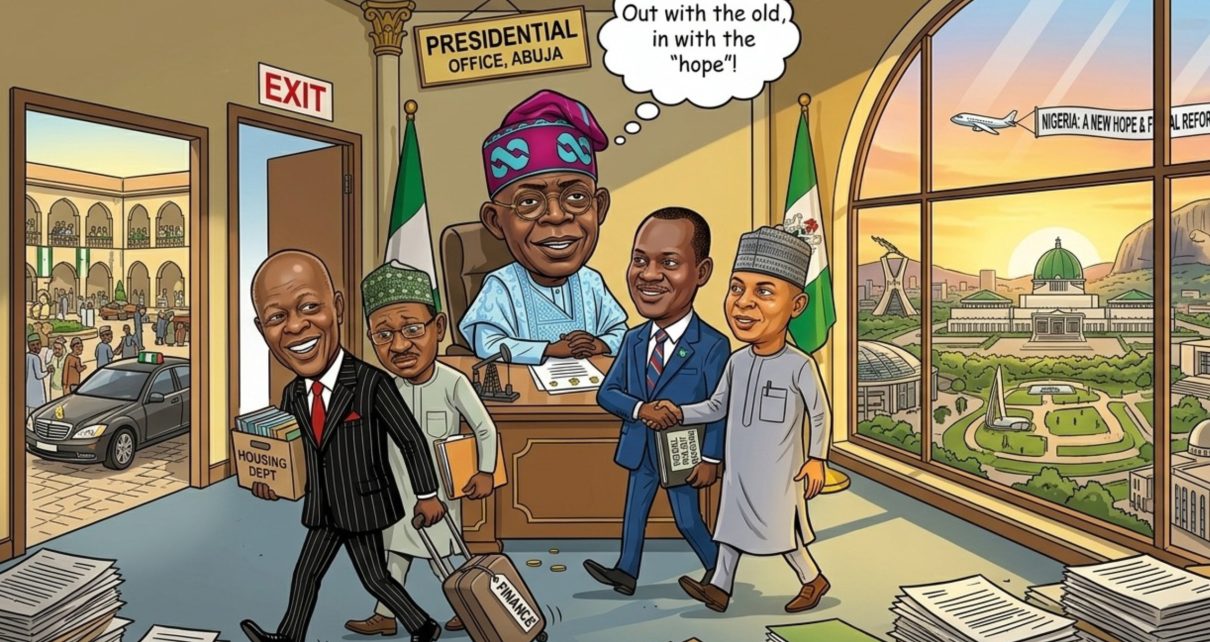
In a surprise move just days after the IMF’s Spring Meetings delivered stark warnings on Nigeria’s fiscal woes, President Bola Tinubu on April 21, 2026, executed a targeted cabinet reshuffle, sacking Wale Edun as Minister of Finance and Coordinating Minister of the Economy. Stepping into the hot seat is Taiwo Oyedele, the tax reform maestro elevated from his junior Minister of State role just last month. The shake-up also hit Housing and Urban Development, ousting Ahmed Musa Dangiwa for nominee Muttaqha Rabe Darma, with all handovers due by Thursday’s close.
Officially billed to “strengthen cohesion and synergy” for the Renewed Hope Agenda, this comes amid whispers of Edun’s health struggles and mounting economic pressures—inflation hovering near 34%, a battered naira, and IMF pleas for bolder tax hikes. Is this a savvy pivot to technical firepower, or a desperate signal of reform fatigue? As Nigeria navigates debt distress and revenue droughts, Tinubu’s latest gambit could redefine the economic battlefield ahead of 2027 polls.
Timeline of the Reshuffle
President Tinubu’s announcement unfolded swiftly, minimising disruption:
– March 2026: Taiwo Oyedele joins as Minister of State for Finance, bringing PwC tax expertise and leadership of the Presidential Fiscal Policy and Tax Reforms Committee.
– April 21, 2026: Tinubu directs the sackings via the Office of the Secretary to the Government of the Federation (OSGF); Oyedele elevated to full Finance Minister role.
– April 23 deadline: Handover processes must conclude by close of business.
Key Players:
| Role | Outgoing | Incoming | Background Highlights |
| Finance & Economy Coordinating | Wale Edun | Taiwo Oyedele | Edun: CBN vet, drove subsidy removal. Oyedele: Tax simplification advocate (60+ taxes to 8). |
| Housing & Urban Development | Ahmed Musa Dangiwa | Muttaqha Rabe Darma (nominee) | Dangiwa: Shelter Afrique head. Darma: Fresh face, details pending Senate screening. |
This lean reshuffle—sparing most ministries—signals surgical intervention, not overhaul. OSGF circular mandates seamless transition, eyeing continuity in fiscal reforms amid global lender scrutiny.
Rationale: Synergy or Smoke Screen?
The administration’s line is straightforward: this reshuffle “strengthens cohesion and synergy in governance” to turbocharge the Renewed Hope Agenda, per the OSGF statement. It promises sharper economic delivery—vital as Nigeria grapples with a fiscal deficit projected at 5.8% of GDP and tax-to-GDP ratio languishing at 10%.
Yet, beneath the official gloss, cracks emerge. Media reports from Sahara Reporters and Punch paint Edun’s exit as health-driven; insiders claim the 65-year-old had sought to step down months ago for recovery from undisclosed ailments, exacerbated by reform backlash. “It’s less about performance, more personal,” one source alleged, though the presidency dismisses this as speculation.
Timing amplifies suspicions: The April 21 announcement follows IMF Spring Meetings where Nigeria faced heat over subsidy relapse risks and slow revenue mobilisation. Inflation at 33.7% (NBS, March 2026), naira at ₦1,600/$ black market, and debt servicing eating 60% of revenue underscore the pressure cooker.
Critics like PDP’s Deji Adeyanju call it “window dressing,” arguing true synergy demands sacking underperformers across board. Still, elevating Oyedele hints at substance—doubling down on his tax blueprint amid IMF demands for 18% tax-to-GDP by 2028.
Is this proactive realignment or reactive patch? Markets dipped 1.2% on news, betting on continuity over chaos.
Economic Strategy Implications: From Edun’s Fire to Oyedele’s Scalpel
Wale Edun’s tenure was a high-wire act of shock therapy. Appointed in August 2023 amid Tinubu’s “bold reforms” pledge, the former CBN director masterminded the May 2023 fuel subsidy axe—saving ₦4.38trn in 2024 per NEITI—but unleashed inflation from 22% to 34.2% peaks (NBS, Q1 2026). His playbook blended FX unification (naira floated to ₦1,600/$ parallel rate) with debt restructures, yet revenue lagged: non-oil taxes hit just ₦5.7trn in 2025 against ₦10trn targets. IMF Spring Meetings last week scorched the approach as “inconsistent,” urging subsidy permanence and tax expansion.
Enter Taiwo Oyedele, whose elevation feels predestined. As Chairman of the Presidential Committee on Fiscal Policy and Tax Reforms (2023–2025), he drafted the landmark Tax Reform Bills—merging 62 taxes into eight (e.g., single VAT property levy)—passed in diluted form by December 2025. His PwC pedigree shines in data: under his committee, states like Lagos piloted digital VAT, boosting collections 25%. Now substantive Finance Minister, Oyedele inherits a war chest for Phase 2: enforcing the reforms amid 60% debt-service-to-revenue ratio (DMO, 2026).
Projected Trajectories:
| Key Metric | Edun Legacy (2023–2026) | Oyedele Projections (2026–2027) | Risks/Drivers |
| Tax-to-GDP Ratio | 10.2% (World Bank) | 15–18% (IMF target) | Evasion if not digitised |
| Inflation (CPI) | 33.7% (Mar 2026, NBS) | 20–25% stabilisation | Food prices, FX volatility |
| GDP Growth | 2.98% (2025 actual) | 4.5% avg. (CBN MPC) | Oil output rebound to 1.7mbpd |
| Fiscal Deficit/GDP | 5.8% | <4% via ₦20trn revenue goal | Subsidy creep |
Optimists see Oyedele as Nigeria’s Rishi Sunak analogue—technocrat turning fiscal ship amid global squeezes. His March State Minister stint tested waters: early wins in fintech taxes added ₦200bn. Paired with CBN’s Cardoso, this duo could clinch IMF’s $3bn EFF, funding infra like the Lagos-Calabar highway.
Pessimists invoke Ghana 2022: aggressive taxes sparked riots, default. NESG warns Oyedele’s “excise on luxury” could boomerang on middle-class voters, while oil price dips (Brent at $72/bbl) limit buffers. Business lobbies like MAN applaud continuity but demand SME exemptions.
Ultimately, this reshuffle bets Tinubu’s legacy on fiscal precision over populist palliatives—will it deliver Renewed Hope, or renewed hardship?
Political and Governance Angles: Loyalty Test Amid 2027 Shadow
This reshuffle marks Tinubu’s third since inauguration—following the 2024 mega-swap (38 ministers pruned to 25) and January 2026 tweaks—revealing a presidency unafraid of mid-term surgery. Edun, a core “Emilokan” ally from Lagos finance circles, exits not with fanfare but a quiet health narrative, raising eyebrows in APC circles where loyalty is currency.
Intra-Party Dynamics:
– Rewards for Reformers: Oyedele’s jump from State Minister rewards his technocratic loyalty; as FCT tax chief under El-Rufai, he bridges North-South competence.
– Housing Ripple: Dangiwa’s ouster—former Shelter Afrique CEO credited with 50,000 housing units—signals purge of underdeliverers. Darma, a Bauchi technocrat with NEPZA experience, fits Tinubu’s “competence over zoning” pivot, balancing Northern interests.
Opposition pounces: ADC’s Atiku Abubakar (formerly PDP) tweeted, “Reshuffle or scapegoating? Edun pays for Tinubu’s subsidy sins.” ADC’s Peter Obi (formerly Labour Party) echoed, “Health excuse masks policy failure—where’s accountability?” Civil society like BudgIT slams the “cabinet musical chairs” for ignoring corruption probes.
Stakeholder Echoes:
– Business: NECA’s Segun Ajayi-Kadir hails Oyedele as “revenue realist,” but MAN urges tax holidays for manufacturers reeling from 35% duties.
– Markets: NGX dipped 1.4% April 22; analysts at Stanbic IBTC forecast naira rally to ₦1,450/$ on reform signals.
– Governors: Northern bloc (e.g., Buni of Yobe) backs Darma; Southerners like Sanwo-Olu praise Oyedele privately, eyeing Lagos revenue model nationally.
Governance lens: OSGF’s tight handover deadline underscores efficiency drive, but Senate confirmation looms for Darma—potentially delayed by recess. This tests Tinubu’s iron grip post-2025 off-cycle wins, where APC swept most states.
As 2027 looms, the subtext is clear: economic pain demands scapegoats and saviors. Oyedele buys time, but failure risks APC defections akin to 2019 PDP implosion. Tinubu wields the knife surgically—question is, does it cut through voter cynicism?
Broader Impacts and Outlook: Winners, Losers, and the 2027 Reckoning
This reshuffle ripples far beyond ministries, striking at Nigeria’s fragile economic ecosystem and social contract. Historically, finance minister changes have been seismic: Obasanjo’s 2003 Okonjo-Iweala appointment slashed debt via Paris Club; Jonathan’s 2014 shift failed to stem oil crash chaos. Tinubu’s gamble echoes Buhari’s 2015 Kemi Adeosun saga—initial market cheers, then credibility erosion. Data underscores stakes: households already spend 60% on food (NBS HACE 2025), while 40% youth unemployment fuels unrest.
Immediate Winners & Losers:
| Stakeholder Group | Impact | Historical Parallel |
| Markets/Investors | NGX +2% rebound potential; FDI via IMF signal | 2023 subsidy cut rally (ASI +15%) |
| SMEs (80% employers) | Tax simplification win, but VAT hikes crush margins | Ghana 2023 riots post-tax push |
| Workers/Unions | NLC threatens strike over “tax terrorism” | 2012 fuel protests (deaths: 10+) |
| States | ₦2trn VAT share boost if digitized | Lagos IGR model (₦800bn, 2025) |
| Debt Profile | $3bn EFF unlock; Eurobond roadshows Q3 | 2020 $1.25bn raise (yield 8.4%) |
Sectoral Shockwaves:
– Agriculture (25% GDP): Oyedele’s excise exemptions could revive palm oil, but input costs (fertilizer +40%) persist post-2024 floods.
– Tech/Fintech: Digital tax clarity accelerates AfCFTA e-commerce; Flutterwave, Paystack eye ₦500bn remittances.
– Real Economy: Housing swap ties to 3m-unit Renewed Hope Cities plan—Darma inherits Dangiwa’s 12,000-unit delivery (vs. 100,000 target).
Three-Year Scenarios (2026–2028):
1. Bull Case (35% probability): Oyedele hits 15% tax-to-GDP by 2027, mirroring Rwanda’s 16% climb. Inflation dips to 18%; GDP accelerates to 5.2%. IMF $5bn package funds rail revival. APC gains 2027 momentum.
2. Base Case (50%): Patchy wins—revenue +12%, but naira volatility (₦1,400–1,800/$) and subsidy creep cap growth at 3.8%. Social contract strains; selective protests in Aba, Kano.
3. Bear Case (15%): Tax evasion hits 40%; revenue misses by ₦5trn. Debt default risk spikes (spread +300bps). 2027 becomes referendum on “Tinubunomics”—ADC/PDP coalition surges.
Social Contract Test: Since #EndBadGovernance (Aug 2024, 50+ deaths), trust erosion demands results. Oyedele’s April 25 fiscal roadmap—promising SME grants—must deliver by Q3 or face replication of 2018 #NotTooYoungToRun backlash.
Global Context: Post-Trump tariff wars, Nigeria’s $72/bbl oil lifeline thins. BRICS aspirations hinge on fiscal credibility; China’s $2bn swap extension (Feb 2026) buys time, but at 7% concessional rates.
Verdict: This pivot could cement Tinubu’s reformer mantle or accelerate “state capture” narratives. Watch April 30 Senate hearings and May MPC for directional cues. Nigeria’s choice: fiscal adulthood or populist procrastination?
Pragmatic Pivot or High-Stakes Gamble?
Tinubu’s April 21 reshuffle—sacking Edun for Oyedele, Dangiwa for Darma—crystallizes a presidency at economic crossroads. Officially a “synergy boost” for Renewed Hope, it masks health exits and IMF pressures, betting technocratic tax surgery over Edun’s blunt reforms. Historical echoes (Obasanjo’s 2003 reset vs. Jonathan’s 2014 fumble) suggest potential, but data screams risk: 33.7% inflation, 10.2% tax-to-GDP, and 2027 polls looming.
Oyedele’s mandate is laser-focused: hit 15% tax-to-GDP by 2027, stabilize naira below ₦1,400/$, and unlock $3bn IMF cash without riots. Success cements Tinubu as reformer; failure invites ADC/PDP resurgence and debt spiral. This isn’t tinkering—it’s legacy-defining, testing if fiscal federalism can outpace voter fatigue.
Watchlist & Accountability Demands:
– April 30: Senate confirms Darma; Oyedele’s fiscal roadmap drops.
– May 20–21 MPC: CBN rate decision signals inflation path (repo at 27.5%?).
– Q2 NBS (Aug 2026): Inflation under 30%? Non-oil revenue +20%?
– Stakeholder Asks:
– Oyedele: Publish SME tax exemptions by May 15.
– Tinubu: Townhall on subsidy permanence.
– NLC/MAN: Joint monitoring committee for reform impacts.
– Media: Track state-level VAT pilots (Lagos, Rivers benchmarks).
For analysts and citizens: Demand quarterly scorecards. Nigeria’s 220m souls can’t afford another lost decade. Tinubunomics 2.0 launches now—deliver, or dissolve into history’s subsidy ghosts.


