
By Nkanu Egbe
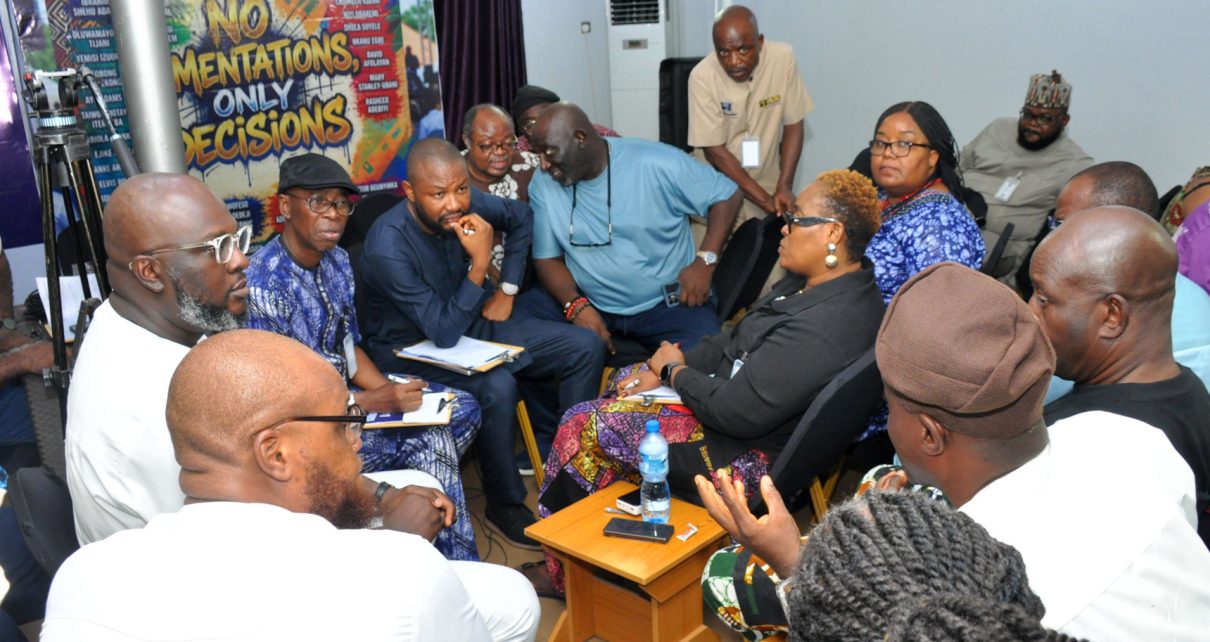
The words hung above the room like a quiet indictment.
Abeokuta, May 2026. Media executives, editors, newsroom leaders, digital operators and industry thinkers had made their way to Ogun State for the 4th Nigerian Media Leaders’ Summit — not for the usual pageantry of a conference, but for something the organisers were careful to call something else entirely: a Reset Council. The distinction mattered. Conferences produce panels. A council, if it works, produces decisions.
Outside, the country moved at its usual velocity — loud, unresolved, hungry for information. Inside, the people responsible for feeding that hunger sat with a more uncomfortable question: what happens when the pipes begin to fail?
Convened by The Journalism Clinic through its founder and veteran journalist, Taiwo Obe, the numbers had arrived before the conversations did. Between 2024 and 2025, traffic across Nigerian media platforms had reportedly fallen by 26.2%. Not because Nigerians had stopped being curious. Not because the stories had stopped mattering. But because something had changed in the architecture of how people find things — and the industry, by its own admission, had not changed with it. Artificial intelligence was quietly rerouting audiences. Platforms were harvesting attention that once belonged to newsrooms. And somewhere in the gap between what media organisations were still producing and what their audiences were now doing, a crisis had taken root.
What made the gathering in Abeokuta different — or at least what it aspired to be — was the refusal to look away. The facilitators — apart from Taiwo Obe, fondly called TO, the indefatigable duo of Dolapo Otegbayi and Dr. Helen Emore—had built the summit around three honest verbs. Reset: understand what is no longer working. Restart: experiment with what might. Restore: identify what the industry still owes itself and its audiences. There would be no room, the framing suggested, for the comfortable language of resilience without the uncomfortable work of reckoning.
And yet, threading through the fatigue and the friction, something else kept surfacing. Something that surprised even those who raised it. Despite everything — the falling revenues, the platform dependency, the newsroom burnout, the slow erosion of editorial depth — Nigerian media, it turned out, was still trusted. Remarkably, stubbornly trusted. More so, by some measures, than media in countries that considered themselves further ahead.
Trust, the summit would keep returning to, is more valuable than traffic.
The question Abeokuta was really asking was simpler and harder than any of the working cluster documents could fully contain: does the industry still have the courage to deserve it?
The Pipes Are Failing
For years, the story Nigerian media told itself was one of endurance. Structural adjustment. Adaptation. The industry had survived military rule, economic contractions, the arrival of the internet, the social media explosion — and each time, it had found a way to keep moving. The assumption, rarely spoken but deeply held, was that the next disruption would be no different.
Abeokuta, in several quiet but significant ways, challenged that assumption.
The challenges delegates brought into the room were not new in name, but they had arrived at a new level of severity — and more troublingly, they had arrived together. Declining traffic. Fragmenting audiences. Weakening advertising revenue. Platform dependency. Newsroom fatigue. Rising operational costs. The kind of pressures that, managed separately, might be survivable. Arriving simultaneously, they described something closer to a structural unravelling.
The traffic problem alone deserved its own session. Audiences had not vanished — they were still online, still scrolling, still consuming. But increasingly, they were doing so without ever arriving at a media organisation’s front door. AI-generated summaries were answering questions before the click. Platform ecosystems were curating feeds that left original sources invisible. The relationship between content creation and content discovery, once relatively direct, had been quietly severed. Nigerian media was still producing the journalism. It was just no longer controlling the journey to it.
Underneath the traffic crisis sat a quieter, older problem that the summit was willing to name: much of what the industry was producing had become indistinguishable. Delegates spoke about the proliferation of undifferentiated content — the same breaking news story reproduced across dozens of platforms within the same hour, stripped of context, depth or editorial personality. Volume had become a substitute for value. And the market, slowly, was reflecting that back.
“Future relevance,” one of the cluster discussions concluded, “may depend more on depth, niche authority, audience intelligence and specialised storytelling.”
That sentence, for anyone who has watched Nigerian media operate under the pressure of pageview culture, carries a certain weight. The newsroom model that emerged from the digital transition was built around speed and scale. Produce more. Publish faster. Chase the traffic. It worked — until it stopped working. And now the very habits the industry developed to survive the last disruption have become part of what is making this one harder to escape.
The commercial picture compounded everything. Advertising revenue — the industry’s primary lifeline for decades — continued its retreat, as brands redirected spend toward platform ecosystems that promised more precise targeting and cheaper reach. What remained was being competed for aggressively, with media organisations undercutting one another’s rates in ways that hollowed out the collective commercial floor. Quality journalism, delegates noted with a frustration that felt well-earned, was being systematically underpriced — and there was no industry mechanism to stop it.
Younger audiences added another layer of complexity. The instinct in many newsrooms had been to frame their departure as apathy — a generation that didn’t read, didn’t care, couldn’t concentrate. Abeokuta pushed back on that reading directly. Young Nigerians, the discussions made clear, were not rejecting information. They were rejecting the formats, the platforms and the institutional voices through which that information was being delivered. The appetite was there. The relevance was not.
Taken together, what the summit’s Reset phase was diagnosing was not a collection of individual organisational failures. It was a picture of an industry that had reached the limit of incremental adaptation — and now faced the harder work of structural reinvention.
The pipes, to borrow the metaphor the room kept circling back to, were not just leaking. In places, they had stopped working altogether.
What the Industry Still Has
There is a particular kind of surprise that comes not from the unexpected, but from the forgotten. Abeokuta produced several moments of that kind — but none more quietly striking than the one that kept returning, across clusters, across sessions, across the different registers of frustration and ambition that filled the room.
Nigerian media, it turned out, was still trusted.
Not grudgingly. Not marginally. By some of the measures delegates brought to the table, Nigerian mainstream media retained one of the highest levels of public trust globally — a finding that sat in sharp, almost uncomfortable contrast to the operational picture the summit had spent considerable energy documenting. Here was an industry describing itself as fragmented, underfunded, algorithmically displaced and commercially weakened — and yet the audiences it was struggling to reach still believed in it.
The temptation, in a room full of people who had spent years watching the ground shift beneath them, might have been to receive that finding as consolation. A reminder that things weren’t as bad as they felt. Abeokuta resisted that reading. Trust, the summit kept insisting, was not a comfort. It was a competitive asset — and one the industry had not yet learned to fully protect or properly monetise.
The sources of that trust were worth examining. Investigative journalism, wherever it had been practised with rigour and courage, continued to command genuine public respect. Radio — often overlooked in conversations dominated by digital anxieties — retained a quality of intimacy with its audiences that no platform algorithm had yet managed to replicate. Strong editorial personalities, the journalists and editors whose names carried their own credibility, still moved audiences in ways that institutional mastheads increasingly struggled to. And local storytelling — the reporting that took seriously the lives of ordinary Nigerians in ordinary places — continued to matter to the people it was about.
These were not small things. In a global media environment where trust had become genuinely scarce, where misinformation had degraded public confidence in information systems across entire continents, the fact that Nigerian audiences retained meaningful faith in their media institutions was — or should have been — remarkable.
The summit reached back into its own history to understand what that kind of trust had once been built on. The name that surfaced most consistently was Alhaji Babatunde Jose, and the era of the Daily Times he had helped define. It was not nostalgia that drove the reference — or not only nostalgia. It was an attempt to identify something structural: what had made that moment in Nigerian media feel different? The answer that emerged pointed toward a set of practices that had less to do with resources than with disposition. Consumer-led product development. Editorial courage. Deliberate experimentation. A commitment to talent. Operational discipline. The willingness to build products around what audiences actually did, rather than what institutions assumed they wanted.
Those qualities, delegates suggested, were not relics. They were a template.
But they existed now in a context that Jose’s generation did not have to navigate — one where trust, however real, could be eroded faster than it was built. Where a single editorial failure could travel further than a decade of credible reporting. Where audiences had more alternatives than ever before, and the cost of switching was effectively zero. The industry’s trust, in other words, was not unconditional. It was a balance that required active maintenance, and several of the summit’s discussions suggested it was a balance the industry had been drawing down without fully replenishing.
The Newsroom and Trust cluster put it plainly: Nigerian media had developed a habit of detachment. Reporting that felt increasingly distant from ordinary human realities. Volume-driven publishing that left little room for the kind of contextual, emotionally intelligent storytelling that had once been the industry’s signature. Elite-focused narratives that spoke about the country but not always to it. The journalism was still happening. The connection, in too many places, had weakened.
What the summit was arguing, in the end, was that trust and the crisis facing Nigerian media were not separate conversations. They were the same conversation. The industry’s ability to rebuild its commercial models, reconnect with younger audiences, navigate the disruptions of AI and platform dependency — all of it ran through the same question.
What are you willing to do to deserve what your audiences still give you?
The Guest That Arrived Early
Nobody had formally invited artificial intelligence to the 4th Nigerian Media Leaders’ Summit. It showed up anyway — in every cluster, across every session, woven into nearly every major conversation the room attempted to have about something else entirely. By the time delegates had worked through the Reset provocations, it had become clear that AI was not one topic among many. It was the weather inside which all the other topics were happening.
The relationship the Nigerian media industry has with AI in 2026 is one of the more instructive examples of how disruption actually arrives — not announced, not gradual, but already present by the time the conversation about it begins. The 26.2% traffic decline that opened the summit’s diagnostic sessions was not, at its root, an audience behaviour story. It was an AI story. The audiences had not gone anywhere. They had simply found a new first stop — AI-generated summaries, search interfaces powered by large language models, platform ecosystems with their own embedded intelligence — and Nigerian media’s original reporting was being consumed at that first stop, without the click, without the visit, without the relationship.
Discoverability, a word that once belonged to the relatively manageable world of search engine optimisation, had become something far more complex and far less controllable. The chain between a journalist filing a story and an audience finding it had quietly acquired a new intermediary — one that neither asked permission nor shared revenue.
What made Abeokuta’s handling of this particular tension valuable was its refusal to collapse it into a single emotional register. AI, the summit acknowledged, was genuinely threatening to models the industry depended on. And AI was also, with equal genuineness, one of the more practical tools available to newsrooms that were trying to do more with less. Both things were true simultaneously, and the industry’s response would need to hold both.
On the threat side, the picture was already familiar to anyone paying attention. Traffic disruption was the most visible symptom, but not the deepest wound. The deeper concern was what happens to the economic logic of original reporting when the system that benefits most from it is not the one that produces it. Nigerian journalists spending weeks on an investigation, editors shaping a story with care and precision, sub-editors crafting the headline — and the return on that investment being captured somewhere upstream, by an intelligence that had learned from the industry’s archive without contributing to its survival. The IP and licensing questions this raised were discussed, acknowledged, and left — as they were in newsrooms everywhere — largely unresolved.
The operational anxieties ran alongside the structural ones. Most Nigerian newsrooms, delegates admitted with a candour the summit’s format seemed to encourage, were not prepared. Not in terms of policy, not in terms of training, not in terms of the basic infrastructure questions that AI adoption requires an organisation to answer before it can begin. The gap between what AI could do for a well-resourced, well-organised newsroom and what it was currently doing for most Nigerian media operations was significant — and closing it would require more than curiosity.
But the opportunity side of the ledger was also real, and the summit was careful not to let anxiety swallow it. AI transcription was already reducing the time cost of interview-based reporting in ways that freed journalists for the parts of the work that intelligence could not replicate. Headline support, research assistance, translation tools capable of working across Nigeria’s linguistic diversity, summarisation for editorial planning — these were not hypothetical applications. They were available, relatively affordable, and in some cases already being quietly used by the newsrooms whose leaders were sitting in the room.
The argument that emerged most forcefully was not that Nigerian media needed to choose between embracing and resisting AI. It was that the industry needed to choose between managing AI deliberately and being managed by it passively. The former required investment — in training, in policy, in the kind of cross-industry conversation that produces shared frameworks rather than isolated experiments. The latter was already happening, by default, in every newsroom that had not yet decided what it thought.
The Abeokuta Commitments that emerged from Cluster D — the Technology and AI working group — reflected this dual urgency. An industry-wide AI readiness framework. Shared ethics principles. Newsroom workflow integration. Capacity development. Digital infrastructure conversations. A serious engagement with the question of AI licensing and intellectual property. And, perhaps most ambitiously, the exploration of a cross-industry coordination structure capable of turning post-summit intentions into sustained action.
Whether those commitments would survive the journey from Abeokuta back into the daily operational pressures of Nigerian newsrooms was a question the summit was too honest to answer.
What it could say — what the room had earned the right to say by that point — was this: the guest had arrived early, it had already rearranged several pieces of furniture, and waiting for a more convenient moment to deal with it was no longer a strategy.
Not Gone. Just Elsewhere.
There is a version of the young Nigerian audience story that Nigerian media has been telling itself for the better part of a decade. It goes, roughly, like this: young people don’t read anymore. They have short attention spans. They want entertainment, not information. They are lost to Instagram and TikTok and WhatsApp and whatever platform arrives next — and the serious business of journalism was never really built for them anyway.
Abeokuta, with some firmness, retired that story.
The reframe that emerged from the Audience and Distribution cluster was not particularly gentle in its implications. Young Nigerians, delegates acknowledged, were consuming more information than perhaps any previous generation — just not in the places, formats or institutional voices through which Nigerian media had traditionally delivered it. The appetite was intact. What had expired was the assumption that audiences would continue to come to journalism on journalism’s terms.
The distinction matters more than it might initially appear. An industry that believes it has lost its young audiences to indifference will respond differently — and less urgently — than one that understands it has lost them to irrelevance. Indifference is the audience’s problem. Irrelevance is the industry’s.
What the summit was describing was irrelevance — and it was describing it with enough specificity to be useful. Young Nigerians were consuming short-form video. They were following creator-led accounts whose authors spoke in registers that felt human, direct and unmediated by institutional caution. They were getting their news through WhatsApp communities, through the commentary of voices they had chosen rather than mastheads that had chosen themselves. They were mobile-first in ways that went beyond screen size — their entire relationship with information was structured around the device, the scroll, the notification, the forwarded message. And they were participating: reacting, sharing, arguing, contributing to the stories rather than simply receiving them.
None of this was, strictly speaking, new information. The patterns had been visible for years in audience analytics that most Nigerian newsrooms collected and relatively few acted on. What Abeokuta did was force the industry to sit with the gap between knowing and doing — to ask not just what young audiences were doing differently, but what it would actually cost to meet them there.
The answers were uncomfortable in the way that honest answers usually are. Meeting younger audiences where they are requires more than launching a TikTok account or hiring a social media manager and pointing them at existing content. It requires a rethinking of storytelling formats from the ground up — visual journalism, explanatory frameworks, narratives that assume mobility and brevity without sacrificing depth. It requires creator collaborations that bring Nigerian media’s institutional credibility into spaces it does not currently occupy, carried by voices that those spaces already trust. It requires campus engagement, community distribution strategies, audience participation models that give young Nigerians a reason to feel that the journalism being produced is in some meaningful sense theirs.
It also requires something harder to operationalise: a genuine change in whose stories get told, and how. Several delegates returned to a theme that ran through the Newsroom and Trust cluster as much as the Audience one — that Nigerian media’s relationship with ordinary Nigerians, particularly young ones outside the major urban centres, had grown distant in ways that were both editorial and existential. The stories being produced were increasingly about elites, institutions and crises. The texture of everyday Nigerian life — its humour, its ingenuity, its specific local complexity — was underrepresented in ways that audiences noticed even when they couldn’t always articulate why they had stopped showing up.
The proposed National Youth Audience and Community Reconnection Initiative that emerged from Cluster B was, in that sense, more than a distribution strategy. It was an editorial argument. The commitment to mobile-first storytelling, creator collaborations, WhatsApp and community distribution, visual and short-form journalism, direct audience ownership systems — these were not simply channel decisions. They were a position on what journalism is for, and for whom.
Whether the industry would pursue that position with the consistency it required was, again, a question Abeokuta could raise more easily than it could answer. The summit had seen enough of its own history to know that youth audience strategies had been announced before, piloted briefly, and quietly allowed to expire when the pressures of the daily news cycle reasserted themselves.
But there was, in the Abeokuta conversations, a quality of urgency that felt different from previous iterations of the same concern. The window, several delegates suggested, was narrowing. A generation that had grown up finding its information elsewhere was now forming habits — around platforms, creators and communities — that would be increasingly difficult to redirect. Every year the industry delayed the genuine work of reconnection was another year of compound distance.
Young Nigerians had not gone anywhere. They were extraordinarily, visibly, loudly present — online, in communities, in the comment sections of platforms that Nigerian media did not own and could not control.
They were just waiting, without particularly waiting, for journalism to find them.
The Floor That Wasn’t There
There is a particular kind of financial crisis that is difficult to see clearly from inside it — not because the numbers are hidden, but because the decline has been gradual enough to be absorbed, quarter by quarter, into the ordinary texture of operations. You adjust the budget. You reduce the headcount. You accept the lower rate because the alternative is no rate at all. And then one day you look up and realise that the adjustments have become the strategy, and the strategy has become the institution.
Several delegates in Abeokuta recognised that description.
The commercial picture Nigerian media carried into the summit was not the picture of an industry in sudden crisis. It was the picture of an industry that had been quietly haemorrhaging for long enough that the haemorrhage had started to feel normal. Advertising revenue — the model on which Nigerian media had been structurally dependent for decades — was continuing its retreat, and the retreat was not temporary. Brands were not pausing their media spend and waiting for better conditions. They were redirecting it, deliberately and with increasing confidence, toward platform ecosystems that offered more granular targeting, cheaper reach, and the kind of performance data that traditional media had never been able to match.
What was left — the advertising budgets that still flowed toward Nigerian media organisations — was being competed for in ways that were damaging the industry from within. The dynamic that delegates described was one of systematic self-undercutting: media organisations accepting rates below their own stated value because the alternative, in a buyer’s market, was losing the business entirely. There was no floor. There was no collective agreement about what Nigerian journalism was worth or what it should cost to access. And without a floor, the negotiation always ended in the same place — with media on the losing side of a conversation it had already conceded before it began.
The undervaluation of content was not only a commercial problem. It was an editorial one. When the economics of production are compressed far enough, the journalism compresses with them. Fewer reporters in the field. Less time per story. Thinner editing. The gradual substitution of wire copy and aggregation for original reporting — not because editors wanted it that way, but because the budget no longer supported the alternative. The commercial crisis and the editorial crisis that Abeokuta’s Newsroom and Trust cluster had separately diagnosed were, at their root, the same crisis wearing different clothes.
Platform dependency added a third layer of vulnerability. Nigerian media organisations had spent years building audiences on social platforms — investing editorial time, creative energy and institutional resource into presences on Facebook, Twitter, Instagram, YouTube and the rest — only to discover, repeatedly, that those platforms could alter their algorithms, change their monetisation rules or simply deprioritise news content without warning and without recourse. Distribution had been outsourced to infrastructure the industry did not own. Monetisation had been partially surrendered to intermediaries whose interests were not aligned with media sustainability. And the audiences that had been built on those platforms were, in any meaningful sense, borrowed rather than owned.
The summit’s Revenue and Sustainability cluster did not arrive at these conclusions as fresh discoveries. What it did — and what the Abeokuta Commitments reflected — was push beyond diagnosis toward the harder question of what a rebuilt commercial model might actually look like.
The answers that emerged were diverse, practical and, in several cases, already being tested in small ways by individual organisations around the room. Niche subscriptions — not the broad, general-interest subscription plays that had struggled to gain traction, but tightly focused products built around specific professional communities, interests or information needs. Branded communities that converted audience trust into membership relationships. Events and knowledge products that leveraged editorial expertise in formats audiences were willing to pay for. Newsletter products that rebuilt the direct relationship between journalist and reader that platform dependency had eroded. Archive and intellectual property value that most Nigerian media organisations possessed but had not systematically monetised.
Underlying all of these was a concept the summit kept returning to with genuine energy: the idea that media organisations needed to stop thinking of themselves as content producers and start thinking of themselves as value ecosystems. The distinction was not semantic. A content producer’s commercial logic begins and ends with the content. A value ecosystem asks a different question — what does our audience need, what do we uniquely understand about them, and what range of products, services, relationships and experiences can we build around that understanding?
It was, in some ways, the oldest idea in media dressed in new language. The great Nigerian media institutions of previous generations had understood intuitively that their value to audiences went beyond the daily paper or the evening bulletin. They were trusted intermediaries in the life of the community — sources of employment listings, event information, consumer guidance, public debate. The platforms had disrupted that role, but they had not destroyed the underlying appetite.
What the summit was arguing, with varying degrees of explicitness, was that reclaiming a version of that role — adapted for the current environment, built on direct audience relationships rather than platform dependency, diversified across revenue streams that advertising alone could never provide — was not a luxury that the more ambitious organisations might eventually attempt.
It was the minimum required for survival.
The Nigerian Media Commercial Sustainability Initiative that emerged from Cluster A pointed in that direction: native advertising standards, content monetisation frameworks, subscription experimentation, audience intelligence monetisation, media-commercial partnerships built on something more durable than rate-card negotiations. The first suggested action was characteristically unflashy — convene exploratory commercial strategy conversations among media owners, commercial leads and agencies.
It was a beginning. The room was clear-eyed enough to know that beginnings, in this industry, at this moment, were exactly what was needed — and exactly what had been deferred for too long.
The Distance Between Abeokuta and Monday Morning
Every industry gathering of sufficient seriousness eventually arrives at the same moment. The diagnosis has been made. The conversations have been had. The energy in the room is real — the kind that builds when intelligent people stop performing certainty and start speaking honestly. And then someone has to write it down. Someone has to turn the accumulated weight of two days of reckoning into language that will survive the journey home, into the inbox, into the editorial meeting, into the quarterly budget review where the urgencies of next week reliably defeat the intentions of last month.
Abeokuta was aware of this moment. It had, in fact, built its entire architecture around trying to defeat it.
The Abeokuta Commitments that emerged from the summit’s four working clusters were careful, from the beginning, to resist the vocabulary of declarations. They were described, deliberately, as working commitments — not final positions, not signed pledges, not the kind of communiqué that gets framed and forgotten. The language around them was pointed: practical ownership over symbolic declarations. The summit had seen enough of its own industry’s history to know that the distance between a well-worded resolution and a changed practice was not measured in intention. It was measured in the specific, unglamorous work of follow-through.
The four commitments themselves covered the terrain the summit had spent two days mapping. Cluster A’s Nigerian Media Commercial Sustainability Initiative addressed the revenue crisis directly — not with a demand that the market behave differently, but with a call for the industry to build the collective frameworks, standards and strategies that might give it more leverage within the market it had. Cluster B’s National Youth Audience and Community Reconnection Initiative named the audience gap and proposed a direction — collaborative, experimental, format-led — for closing it. Cluster C’s Industry Trust, Verification and Editorial Strengthening Initiative acknowledged that trust, however durable it had proven, was not self-maintaining — and that the editorial practices, leadership pipelines and newsroom cultures required to sustain it needed deliberate industry-level investment. Cluster D’s Nigerian Media AI and Innovation Readiness Framework accepted, without equivocation, that the industry’s relationship with artificial intelligence was no longer optional — and that the choice was between shaping that relationship or being shaped by it.
Taken together, the four commitments described an industry attempting something genuinely difficult: collective action across organisations that were, in the ordinary course of business, competitors. The summit was asking Nigerian media to collaborate on the things that threatened all of them — commercial frameworks, audience strategies, editorial standards, technological preparedness — while continuing to compete on the things that differentiated them. It was not a new idea. Industry bodies and trade associations exist precisely to hold that tension. But in a sector as historically fragmented, as commercially pressured and as institutionally thin as Nigerian media, the ask was not a small one.
The accountability architecture the summit proposed was, in this context, one of its more significant contributions. A structured mechanism for tracking the progress of the Abeokuta Commitments at 30, 90 and 180-day intervals — not as a performance, but as a discipline. The 90-day frame had been embedded in the summit’s Restart language from the beginning: what can realistically be tested within 90 days? It was a deliberately human-scaled question, designed to defeat the paralysis of the ambitious and the evasiveness of the non-committal. Ninety days was long enough to produce something real. It was short enough that the excuses for producing nothing would be visible.
Beyond the four cluster commitments, the summit’s closing documentation pointed toward a set of broader strategic directions that carried their own weight. The exploration of an industry coordination or representative structure — something capable of giving the post-Abeokuta commitments an institutional home, a convening authority and a memory that would outlast individual organisations’ enthusiasm. The deliberate engagement of government stakeholders at federal and state levels around media sustainability, regulatory environment and public interest journalism support — a conversation the industry had historically approached with ambivalence, and that the current environment made harder to avoid. The exploration of partnerships with multilateral and development organisations around journalism sustainability and innovation funding — money the industry needed and had not always known how to ask for on its own terms.
None of these were simple. All of them required the kind of sustained, unglamorous institutional effort that summits produce the appetite for but cannot themselves supply.
There was, in the room, a quality of self-awareness about this that felt earned rather than performed. Delegates had been through enough cycles of industry conversation — enough reports produced, enough commitments announced, enough working groups convened and quietly dissolved — to bring a certain forensic honesty to the question of why previous attempts had not held. The answers pointed, repeatedly, toward the same structural weakness: the absence of ownership. Commitments without owners do not fail dramatically. They simply fade, absorbed back into the operational noise of organisations that have more immediate problems to solve.
What Abeokuta was attempting — with the cluster structure, the working commitments, the accountability intervals, the proposed coordination mechanism — was to address that weakness directly. To create enough institutional scaffolding around the intentions expressed in the room that the intentions might survive contact with the week after next.
Whether it would work was a question that could not be answered in Abeokuta. It could only be answered in the thirty days after. And the ninety days after that.
The summit’s closing charge to delegates was, in that sense, its most honest moment. Not a rousing declaration about the future of Nigerian media. Not a list of aspirations dressed as achievements. Just a set of five direct instructions, human-scaled and specific:
Take one idea forward. Pilot one experiment. Strengthen one institution. Rebuild one layer of trust. Continue one collaboration started here.
Five things. Not fifty. Not a strategic framework requiring board approval and a dedicated budget line. Five things that any delegate, returning to any newsroom, in any corner of the Nigerian media landscape, could begin on Monday morning.
The distance between Abeokuta and Monday morning was, in the end, the only distance that mattered.
What Will You Choose To Become?
There is a question that serious industries ask themselves at serious moments. Not the tactical question — what do we do next? Not the operational question — how do we cut costs and protect margins? But the deeper, harder, more consequential one that sits underneath all the others and refuses to be answered by a working group or a commitments document or a 90-day pilot.
What do we want to be?
Abeokuta, by its final sessions, had earned the right to ask it.
The summit had done the work that entitled it to that question. It had sat with uncomfortable numbers without flinching. It had named the structural disruptions without reaching too quickly for the consolations. It had produced four working commitments grounded in specific, actionable directions rather than the ambient optimism that industry gatherings sometimes mistake for strategy. It had, in its most honest moments, looked at the gap between what Nigerian media was and what it needed to become — and resisted the temptation to make that gap seem smaller than it was.
And yet what lingered, beyond the cluster outputs and the proposed frameworks and the accountability intervals, was something less quantifiable and more essential. A question about identity. About what the Nigerian media industry understood itself to be for — not commercially, not operationally, but in the larger sense that gives institutions their reason to exist beyond their own survival.
The summit’s repeated return to trust was, in retrospect, not simply a commercial argument. It was a philosophical one. The claim that trust was more valuable than traffic was not only a statement about revenue models. It was a statement about purpose — about the idea that journalism’s value to society is not reducible to its ability to generate clicks, and that an industry which forgets that distinction will eventually lose both the clicks and the purpose it sacrificed them for.
Nigerian media, in that framing, still had something that many of its global counterparts had spent years eroding. A public that believed in it. Audiences that, despite everything — despite the platform displacement and the editorial thinning and the commercial compromises that operational pressure produces — still turned to Nigerian journalism at the moments that mattered most. Elections. Crises. The stories that required, above everything else, a source that could be trusted.
That inheritance was not guaranteed. The summit was clear about that. Trust of the kind Nigerian media still carried was not a fixed asset — it was a living relationship, sustained by practice and vulnerable to neglect. Every editorial shortcut taken under deadline pressure, every story shaped more by advertiser sensitivity than by audience need, every young journalist who left the industry because the conditions made staying impossible — these were withdrawals from an account that replenished slowly and could be emptied faster than anyone in the room wanted to believe.
The legacy question, then, was not really about the past. The invocation of Babatunde Jose and the Daily Times era was never a call to return to something — it was a call to remember something. To remember that Nigerian media had, at its best, been built by people who understood that the work was larger than the organisation, that the audience was more than a metric, and that the courage required to produce journalism worth trusting was inseparable from the institutional cultures that either nurtured or extinguished it.
What would the industry choose to carry forward from that understanding, into conditions that Jose’s generation could not have imagined and would, perhaps, have found clarifying in their difficulty?
The closing provocation the summit left in the room was not a comfort. It was a charge, phrased as a question and aimed at the part of every delegate that would still be awake at two in the morning, long after the working groups had dispersed and the commitments had been written down and the journey back from Abeokuta had begun.
What will Nigerian media choose to become before the next disruption arrives?
It was the right question. It was the only question, finally, that the summit had been circling since its first session — dressed sometimes as a revenue problem, sometimes as an audience problem, sometimes as a technology problem, sometimes as a trust problem. Underneath all of those, patient and insistent, was this.
The disruptions would keep coming. AI would continue reshaping the architecture of information. Platforms would continue extracting value from content they did not produce. Younger audiences would continue building habits around formats and voices that Nigerian media did not yet fully understand. The commercial pressures would not relent because an industry had gathered in Ogun State and written down its intentions.
What could change — what Abeokuta was, at its most serious, an argument for changing — was the quality of the industry’s response. Not its speed, not its volume, not the number of pilots launched or frameworks proposed or coordination structures explored. The quality. The seriousness with which Nigerian media chose to protect the things that made it worth protecting, and the courage with which it chose to abandon the things that were no longer serving anyone.
No lamentations, the summit had said.
Decisions.
The conversations had ended in Abeokuta. The responsibility — for every editor who had sat in those sessions, for every media owner who had heard the numbers and felt their weight, for every journalist whose career had been built on the understanding that the work mattered — had not.
It had simply changed address.
The 4th Nigerian Media Leaders’ Summit 2026 was held in Abeokuta, Ogun State, in May 2026. The Abeokuta Commitments documentation is being finalised for circulation among delegates and industry stakeholders.


