
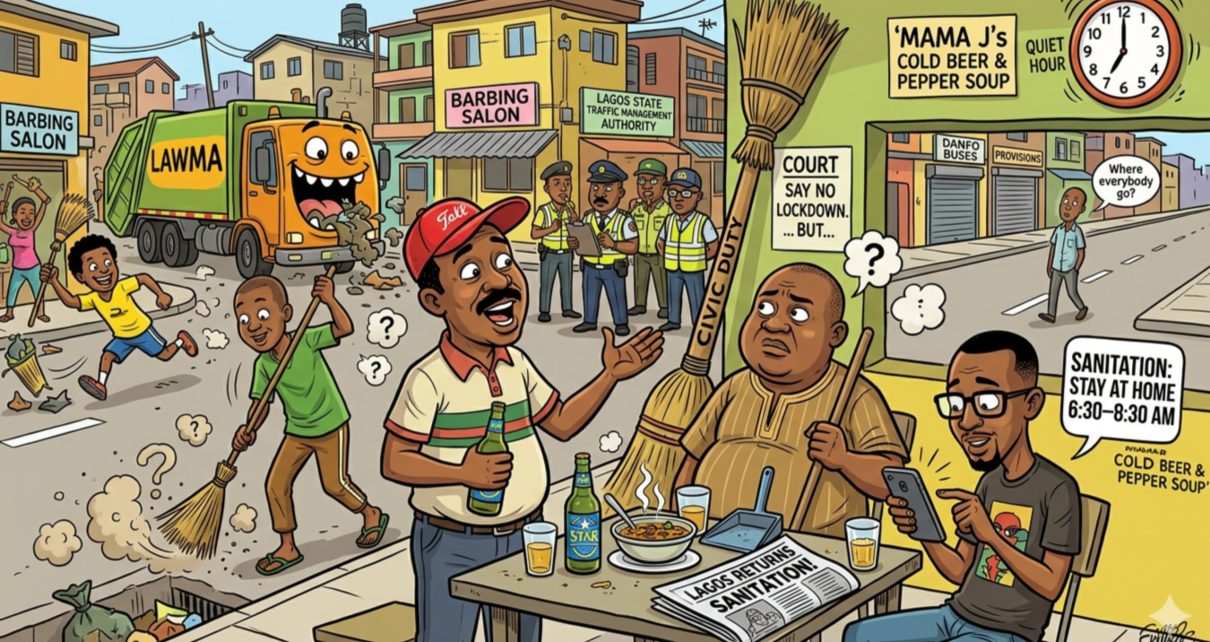

Lagos does not do anything halfway.
When the State Government speaks, it speaks with structure—trucks, task forces, monitoring teams, and, if necessary, court dates.
So as the monthly sanitation exercise returns, it has not returned quietly.
It has returned with a press release.
And by evening, it has reached Aguda.
Chiboy came in holding his phone like evidence.
“Syracuse, read this thing. Dem say make everybody stay at home. STAY. AT. HOME.”
John looked up sharply.
“Stay at home again? I think say court don settle that matter.”
That was the tension.
The Lagos State Government had not only “encouraged” participation—it had charged residents to stay back at home between 6:30 a.m. and 8:30 a.m., while cleaning their surroundings.
And to demonstrate seriousness:
- LAWMA trucks would be deployed
- Government officials would monitor compliance
- Transport unions had agreed to withdraw vehicles
- Enforcement officers would issue notices—and possibly court summons
This was not mere suggestion.
It was coordinated governance.
I cleared my throat.
“The government is trying to restore structure,” I said. “They have mobilised resources—compactors, trucks, enforcement teams. It is more organised than before.”
Chiboy laughed dryly.
“Organised ke? This one na soft lockdown with broom.”
The table burst into laughter.
John leaned forward.
“But make we talk truth. If dem no control movement small, people no go take am serious.”
That was always the argument.
Order requires friction.
But friction must respect the law.
Chiboy was not done.
“Wait—transport unions say dem no go bring motor out. So even if I wan go out, how I wan take go?”
That question landed sharply.
Because while government may not officially “ban movement,” coordinated withdrawal of transport creates practical restriction.
A policy does not need to be explicit to be effective.
I intervened.
“The difference now,” I said, “is that enforcement is tied to environmental laws—abatement notices, compliance checks, legal backing under the 2017 Environmental Management Law.”
John nodded slowly.
“So instead of arresting people for road, dem go carry your house go court?”
“Essentially,” I replied.
Chiboy clapped once.
“Upgrade! From street arrest to legal invoice.”
The beer parlour laughed again.
But beneath the humour was a serious question.
Where does encouragement end—and compulsion begin?
The court had previously frowned at arbitrary movement restriction.
Now, the government had redesigned the system:
- No outright “lockdown” declaration
- But strong expectation of compliance
- Backed by monitoring, enforcement, and legal consequences
It was governance by pressure rather than prohibition.
John leaned back thoughtfully.
“And dem say people even beg for this thing to come back?”
That detail changed the conversation.
According to the government, the exercise was reintroduced after persistent clamour from residents who wanted a designated time for communal cleaning.
Chiboy shook his head.
“Na the same residents go complain tomorrow say dem late for shop.”
The table laughed knowingly.
Lagos wants order—but on flexible terms.
Still, one thing was clear.
This was not the old sanitation era of whistles and roadblocks.
This was a modernised version:
- Structured logistics (LAWMA, trucks, evacuation systems)
- Symbolic leadership (First Lady, top officials monitoring)
- Community involvement (CDAs mobilised)
- Legal enforcement (abatement notices and court action)
It was sanitation as policy—not just practice.
Chiboy raised a practical concern.
“All these trucks good. But after Saturday, wetin happen? Dirt no dey rest for Lagos.”
Exactly.
Sanitation is not a monthly event.
It is a daily system.
Without consistent waste management, drainage maintenance, and behavioural change, the exercise risks becoming ceremonial.
John added quietly.
“Clean environment no be one-day job. Na lifestyle.”
That line carried weight.
Because the real challenge is not waking up early once a month.
It is what happens the next day.
And the day after.
Chiboy leaned forward one last time.
“My own be simple—government do their part, we do our part. But make dem no disguise order as advice.”
Fair point.
Transparency matters.
If it is enforcement, call it enforcement.
If it is voluntary, allow it to be voluntary.
Citizens can adapt—but they resist ambiguity.
I adjusted my cap and delivered the final word.
“Sanitation is necessary,” I said. “But legitimacy matters as much as intention. A clean city built on cooperation will last longer than one built on quiet compulsion.”
Because in Lagos, policy does not fail because it is wrong.
It fails when people feel it is imposed rather than owned.
And until that balance is right, every broom will carry a small argument with it.
Na so we see am.


