
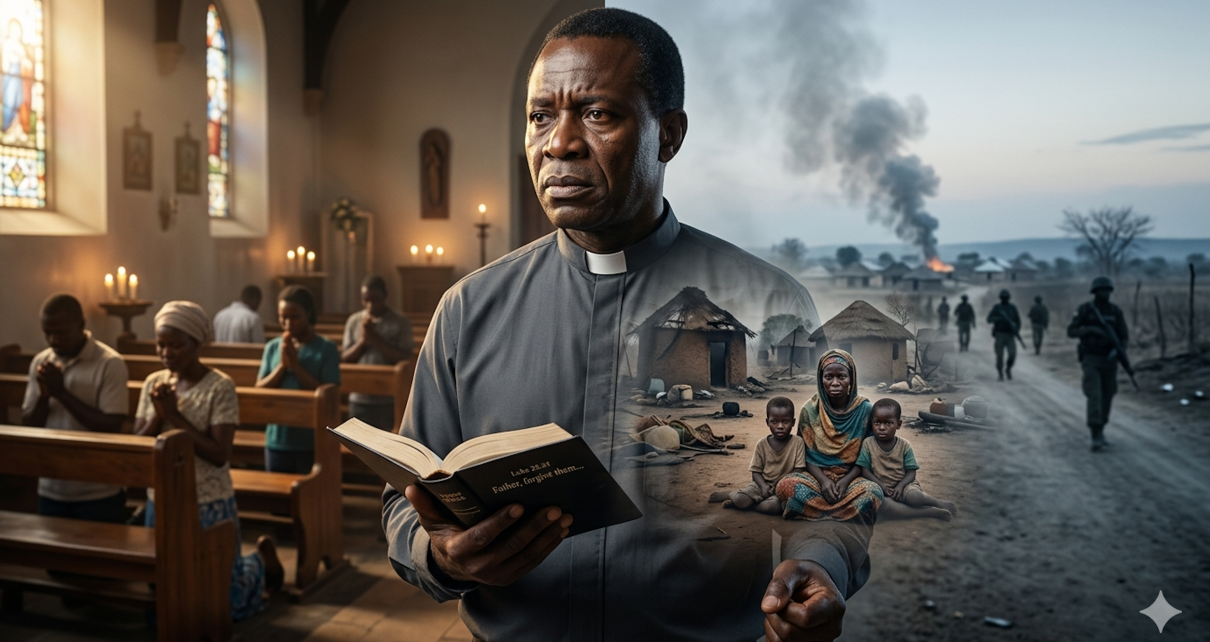
By Nkanu Egbe
Nigeria’s long-running crisis of insurgency and terrorism has stretched the nation’s institutions to their limits. From the scorched villages of the North-East to the tense fault lines of the Middle Belt, violence has become not only a security challenge, but a defining feature of national life. Communities have been attacked, displaced, and left to rebuild under the shadow of recurring fear. Trust—in the state, in institutions, and in the promise of protection—has been steadily eroded.
In such a climate, attention has understandably focused on government—its failures, its responses, and its capacity to secure lives and territory. Yet there is another institution, less frequently interrogated but no less influential, whose role demands closer scrutiny: the Church.
This is not incidental. The Church in Nigeria is not a peripheral actor. It is embedded across communities, shapes moral imagination, commands loyalty, and speaks into both private conscience and public life. In times of crisis, it is often the first place people turn—for comfort, for meaning, and, increasingly, for interpretation of events that defy easy explanation. To ignore its role in a conflict that has both human and moral dimensions is to leave out a critical part of the national equation.
This analysis, therefore, begins from a simple but necessary premise:
if the crisis has a moral and spiritual dimension, then the Church must be examined not only as a victim or observer, but as a potential agent of peace—or of missed responsibility.
The immediate provocation for this reflection came not from a public statement, but from a private conversation. A pastor friend, reflecting on the persistence of insurgency despite years of military and political intervention, offered a striking theological insight. Drawing from Luke 23:24, he suggested that the cycle of violence may not be broken by force alone—and went further to evince that until the Church truly embraces forgiveness at scale, the insurgency may not end.
It is a disarming proposition.
At first hearing, it risks sounding naïve, even unsettling—particularly to communities that have borne the brunt of repeated attacks. In places like Yelwatta and across Plateau State, where lives have been lost and families displaced, the call to forgive insurgents can feel premature, even unjust. It raises immediate questions: Forgive whom? Forgive how? And at what cost to justice and accountability?
Yet the proposition cannot be dismissed outright. It forces a deeper interrogation of what the Church believes about conflict, about evil, and about its own role in confronting both.
The scriptural anchor for this perspective is found in the Gospel of Luke, where Jesus Christ, in the midst of crucifixion, declares: “Father, forgive them, for they do not know what they are doing.” (Luke 23:34). These words, spoken at the intersection of injustice, violence, and systemic failure, have long been interpreted as the ultimate expression of grace.
But what do they mean in a context like Nigeria’s?
Do they call the Church to restraint in speech and action, even when violence persists? Do they imply a spiritual solution to what appears, on the surface, to be a political and security crisis? Or have they been too narrowly understood—reduced to personal piety rather than explored as a framework for public engagement?
These questions sit at the heart of this analysis.
For if the Church is indeed to be considered an agent of peace in Nigeria’s insurgency crisis, then its role must be defined with greater clarity. It must move beyond reactive statements or selective silence and confront the full weight of its calling—spiritual, moral, and social.
This piece does not assume that forgiveness alone can resolve insurgency. Nor does it suggest that justice, security, and governance can be replaced by theological reflection. But it takes seriously the possibility that the Church’s posture—its voice, its actions, and its silences—may be more consequential than is often acknowledged.
To explore that possibility is not to shift responsibility away from the state. It is to recognise that in crises of this magnitude, the work of peace is rarely the responsibility of one institution alone.
The question, then, is not whether the Church has a role.
It is whether it is fully playing it.
The False Choice Between Silence and Outrage
If the introduction frames the Church at a crossroads, the next reality to confront is the narrow path that public discourse has tried to force upon it. In Nigeria’s current climate, the Church is often perceived as having only two options: to speak loudly in condemnation—of terrorists, of government failures, of systemic injustice—or to remain measured, cautious, and in many cases, silent. This framing, though widespread, is deeply misleading. It reduces a complex moral and spiritual calling into a binary that neither Scripture nor history supports.
The urgency of this debate is not abstract. It is written in blood across communities that have become synonymous with recurring violence. In recent months, fresh killings in parts of Plateau State have once again drawn national and international attention, with entire communities attacked, homes destroyed, and survivors displaced into already overstretched camps. These incidents are not isolated; they form part of a longer pattern of rural violence that has persisted despite repeated assurances of improved security.
Particularly emblematic is the attack on Yelwatta in Benue State—one among several communities in Nigeria’s Middle Belt that have experienced cycles of deadly raids attributed to armed groups often described locally as herders. Such attacks have reinforced a growing perception among affected populations that they are being systematically targeted, not only for economic reasons tied to land and resources, but also along identity lines that include religion.
It is this perception—whether universally accepted or not—that has amplified the moral weight of the Church’s response. When communities that identify strongly as Christian experience repeated violence, displacement, and loss, the expectation that the Church will speak clearly and decisively becomes almost inevitable. Silence, in such moments, is not interpreted as neutrality; it is felt as absence.
The scale and persistence of these attacks have also attracted international concern. Statements from officials and advocacy voices in the United States have, at various points, highlighted the vulnerability of Christian communities in Nigeria’s conflict zones, calling for stronger protection of religious freedom and more decisive action against perpetrators of violence. While interpretations of the conflict vary—some emphasising its economic and environmental roots, others its religious dimensions—the fact of international scrutiny underscores the seriousness of the crisis and the perception that it has not been adequately resolved.
Within Nigeria, this has sharpened the divide in how church leaders respond. In affected regions, clergy and Christian associations have spoken with increasing urgency, framing the violence not only as a security failure but as a moral emergency. Their statements often carry both lament and accusation—lament for lives lost, and accusation that more could and should be done to prevent further bloodshed.
Yet elsewhere, a more cautious tone persists. Some church leaders emphasise the complexity of the conflict, warning against framing it purely in religious terms in a way that could inflame tensions. Others prioritise maintaining lines of communication with government authorities, believing that quiet diplomacy may yield more practical results than public confrontation. Still others retreat into generalised calls for peace, avoiding direct engagement with specific incidents or actors.
At first glance, these differing responses appear irreconcilable. One side seems to embody courage; the other, caution—or, in the eyes of critics, complicity. But this reading oversimplifies the reality. What it misses is that both extremes—unchecked outrage and unexamined silence—carry their own risks.
Outrage, when untethered from a clear moral and strategic framework, can become reactive rather than constructive. It may generate attention, but not necessarily change. In a country as religiously and ethnically sensitive as Nigeria, it also risks reinforcing divisions that violent actors can exploit. Conflicts in the Middle Belt, including those involving farming communities and nomadic herders, are shaped not only by identity, but by competition over land, climate pressures, and governance failures. To ignore these layers is to risk misdiagnosing the problem.
Silence, however, poses an even more profound danger. In contexts of sustained violence, silence is rarely neutral. It creates space for harmful narratives to take root unchecked. It can be interpreted—rightly or wrongly—as endorsement of the status quo. For communities experiencing repeated attacks—from Yelwatta to the Plateau villages of Bokkos and Barkin Ladi—the absence of a clear and compassionate voice from the Church can feel like abandonment. And for those responsible for governance, silence removes a crucial layer of moral accountability.
The deeper problem, then, is not simply that the Church is divided in its response. It is that the terms of the conversation have been set too narrowly. By framing the issue as a choice between speaking out and keeping quiet, public discourse obscures the possibility of a third way—one that is both truthful and redemptive, both courageous and constructive.
The Threefold Role of the Church: Prophetic, Pastoral, and Reconciliatory
If Luke 23:34 provides the theological anchor, the question that follows is practical: What does this look like on the ground? How does the Church translate a posture of forgiveness—without surrendering justice—into concrete engagement within a nation grappling with insurgency, terrorism, and deepening mistrust?
To answer this, the Church’s role can be understood through three interlocking functions: the prophetic voice, the pastoral presence, and the reconciliatory bridge. These are not optional emphases to be selected according to preference; they are dimensions of a single calling. When one is neglected, the Church’s witness becomes unbalanced—either loud but ineffective, compassionate but muted, or well-meaning but disconnected from reality.
The Prophetic Voice: Speaking Truth to Power
At its core, the Church is called to be a moral witness within society. This has always included the responsibility to confront injustice, challenge abuse of power, and defend the vulnerable. The prophetic tradition—visible throughout the Hebrew Scriptures in books such as the Book of Amos—does not operate from the margins of relevance, but from the centre of moral clarity. It speaks not for political advantage, but for ethical accountability.
In Nigeria’s context, this means the Church must address two realities simultaneously.
First, it must speak clearly against the perpetrators of violence—whether insurgent groups, bandits, or armed militias responsible for attacks on communities from Plateau to Benue. The sanctity of human life is non-negotiable, and any ideology or grievance that justifies its destruction must be named and rejected.
Second, the Church must hold the state accountable for its primary responsibility: the protection of lives and property. Where there are gaps in security response, failures in intelligence, or patterns of delayed intervention, these must be addressed—not as partisan criticism, but as moral necessity. The Church’s silence in such matters does not preserve peace; it weakens the ethical framework within which governance is evaluated.
However, the prophetic voice must also be disciplined. It must avoid becoming indistinguishable from political opposition or partisan agitation. Its authority lies precisely in its independence—its ability to speak truth without being captured by the shifting loyalties of the political sphere.
The Pastoral Presence: Healing a Wounded Nation
If the prophetic voice defines what the Church says, the pastoral presence defines what the Church does.
Across Nigeria’s conflict-affected regions, the most immediate needs are not theoretical—they are human and urgent. Families have been displaced. Livelihoods have been destroyed. Trauma—often unspoken—lingers in communities that have witnessed repeated cycles of violence.
Here, the Church’s role is not to comment from a distance, but to be present within suffering.
This includes:
- Supporting internally displaced persons with shelter, food, and basic necessities
- Providing spaces for grief, counselling, and emotional healing
- Sustaining hope through community, worship, and practical solidarity
In many cases, local churches are already doing this work quietly, without national visibility. They are feeding the hungry, sheltering the displaced, and standing with communities long after the headlines have moved on. This dimension of the Church’s response rarely attracts attention, yet it is indispensable.
Without it, the Church risks becoming a voice without hands—articulate in critique, but absent in compassion.
At the same time, pastoral presence must extend beyond immediate relief. It must engage long-term recovery—supporting education, rebuilding livelihoods, and restoring a sense of dignity to those who have been uprooted. Healing, in this sense, is not a moment; it is a process.
The Reconciliatory Bridge: Breaking Cycles of Violence
Perhaps the most difficult—and most neglected—dimension of the Church’s role is that of reconciliation.
Nigeria’s conflicts, particularly in the Middle Belt, are rarely reducible to a single cause. They involve overlapping layers of identity, land use, economic pressure, historical grievance, and political manipulation. Religion is often part of this mix, but not always in straightforward ways. Yet because violence is frequently interpreted through religious lenses, it can deepen suspicion between communities and harden divisions that extremists are quick to exploit.
In such a context, the Church must resist the temptation to retreat into inward solidarity alone. While it must stand firmly with affected communities, it must also work to prevent the conflict from becoming an entrenched “us versus them” narrative.
This involves:
- Promoting interfaith dialogue with Muslim leaders and communities
- Rejecting language that assigns collective blame to entire groups
- Supporting local peacebuilding initiatives that address root causes of conflict
- Encouraging narratives that emphasise shared humanity rather than division
Reconciliation, in this sense, is not naïve optimism. It is a strategic necessity. Without it, cycles of retaliation and mistrust will continue to regenerate violence, regardless of military or political interventions.
This is where the deeper meaning of Luke 23:34 becomes most evident. Forgiveness, understood rightly, is not an abstract virtue; it is a force that interrupts cycles of hatred. It creates space—however fragile—for dialogue, understanding, and ultimately, peace.
Holding the Three Together
The challenge for the Church in Nigeria is not simply to perform one of these roles well, but to hold all three in tension.
- A Church that is prophetic but not pastoral may speak loudly, yet fail to heal.
- A Church that is pastoral but not prophetic may comfort the afflicted, yet leave injustice unchallenged.
- A Church that seeks reconciliation without truth may promote peace, but at the cost of justice and trust.
The strength of the Church’s witness lies precisely in its ability to integrate these dimensions—to speak, to serve, and to reconcile, all at once.
This is not easy. It requires courage, discernment, and, in many cases, sacrifice. It demands that church leaders navigate political pressures, security risks, and internal differences while remaining anchored in a consistent moral vision.
But anything less risks diminishing the Church’s relevance at a time when its voice—and its presence—are urgently needed.
For in a nation marked by instability, the Church cannot afford to be one-dimensional. Its calling is broader, deeper, and far more demanding: to stand as a community that confronts evil, cares for the wounded, and works, however patiently, toward the restoration of a fractured society.
The Danger of Selective Theology
If the Church’s role must be prophetic, pastoral, and reconciliatory, then the next question is unavoidable: why does it so often fall short of this balance?
Part of the answer lies not in external pressure alone, but within the Church itself—specifically, in the way Scripture is sometimes deployed. In moments of national crisis, theology can either illuminate reality or obscure it. And increasingly, there is evidence that it is being used selectively—emphasising certain virtues while neglecting others that are equally central to the Christian witness.
Luke 23:34 has, in many quarters, become one such selective anchor. It is invoked to encourage calm, restraint, and forgiveness—qualities that are undeniably essential. But too often, it is cited in isolation, without reference to the broader biblical tradition that holds forgiveness in tension with justice, mercy with accountability, and grace with truth.
The result is a form of theological imbalance.
The same Scriptures that record “Father, forgive them” also preserve the uncompromising moral urgency of the Book of Amos (Amos 5:24, Amos 5:21–23, Amos 2:6–7), where injustice is not tolerated but confronted with stark clarity. The prophetic tradition does not whisper in the face of oppression; it speaks with a voice sharpened by conviction. It names wrongdoing, exposes corruption, and demands change—not as political activism, but as an expression of divine justice.
Similarly, the ministry of Jesus Christ cannot be reduced to gentleness alone. The same figure who forgave from the cross also overturned tables in the temple, challenging systems that had turned faith into exploitation. His compassion was real, but so was his confrontation. To isolate one without the other is to misread the fullness of his witness.
In Nigeria’s current context, this selective emphasis has consequences.
When forgiveness is preached without justice, it risks becoming a tool of pacification—encouraging communities to endure suffering without demanding change. When peace is emphasised without truth, it can create a fragile calm that masks unresolved grievances. And when unity is prioritised at all costs, it may silence necessary critique in the name of national cohesion.
This is not merely a theological issue; it is a practical one.
Communities that experience repeated violence—whether in Plateau, Benue, or elsewhere—are not only asking for prayers. They are asking for clarity. They want to know whether the Church sees what they see, whether it is willing to name what they are enduring, and whether it will stand with them not only in comfort, but in truth.
Selective theology, however well-intentioned, can erode that trust.
It can create a perception that the Church is more concerned with maintaining equilibrium than with confronting injustice. It can deepen the sense of distance between leadership and lived experience. And in a time when moral authority is already fragile, such perceptions carry significant weight.
At the same time, the opposite danger must also be acknowledged. A theology that emphasises justice without forgiveness can harden into something equally problematic—fueling resentment, entrenching division, and closing the door to reconciliation. This is why balance is not optional; it is essential.
The challenge, then, is not to abandon Luke 23:34, but to reintegrate it—to read it alongside the full witness of Scripture, rather than above it. Forgiveness must remain central, but it must be understood as part of a larger moral framework that includes justice, truth, and accountability.
For the Church in Nigeria, this requires a deliberate recalibration.
It must resist the temptation to reach for the most convenient or least controversial texts in moments of crisis. It must be willing to teach and embody a theology that is robust enough to engage suffering honestly, without retreating into abstraction or sentimentality.
Only then can its voice carry the weight required in a nation where the stakes are no longer theoretical, but deeply human.
Toward a Coherent Church Response
If the Church’s apparent division can be explained by context—geography, risk, theology, and politics—the task before it is not to eliminate these differences, but to rise above them with a coherent moral posture. The question is no longer why the Church speaks in different voices, but whether those voices, taken together, point in the same direction.
Coherence does not require uniformity. It requires clarity of conviction.
At the most basic level, this means that the Church in Nigeria must be unmistakable about certain non-negotiables. The sanctity of human life must be affirmed without qualification. The killing of civilians—whether in Yelwatta, Bokkos, Barkin Ladi, or in any other part of the country—must be named plainly as evil. Communities living under threat must know, without ambiguity, that the Church stands with them—not only in prayer, but in truth.
This clarity is especially important in a context where narratives are contested. As violence continues, competing explanations—economic, ethnic, environmental, religious—seek to define its meaning. Some emphasise land disputes and climate pressures; others point to patterns that suggest identity-based targeting. The Church does not need to resolve every analytical debate. But it cannot allow complexity to become an excuse for moral vagueness.
To be coherent is to speak with moral precision, even when analytical interpretations differ.
At the same time, coherence requires that the Church’s public voice be matched by visible action. Statements, however strong, cannot substitute for presence. In communities affected by violence, what matters is not only what the Church says, but what it does—how it responds to displacement, how it supports recovery, how it sustains hope in places where despair is a daily reality.
Here, coherence becomes tangible.
A Church that speaks against injustice but is absent from suffering risks appearing performative. A Church that serves quietly but avoids difficult truths risks appearing timid. The integration of word and action is what gives credibility to both.
Beyond clarity and action, there is a third dimension to coherence: tone.
Nigeria’s conflict environment is already saturated with suspicion. Words carry weight. They can heal, but they can also inflame. The Church must therefore cultivate a voice that is firm without being incendiary, compassionate without being evasive, and courageous without being reckless.
This is not a call for neutrality. It is a call for disciplined engagement.
To speak with anger alone is to risk deepening divides. To speak with excessive caution is to risk irrelevance. The Church’s tone must reflect the tension at the heart of its calling: a commitment to truth shaped by the spirit of forgiveness articulated by Jesus Christ.
This brings us back, once again, to Luke 23:34—not as a closing statement, but as a guiding framework. Forgiveness, rightly understood, does not soften the Church’s stance against evil. It shapes how that stance is expressed. It guards against the dehumanisation of others, even in the act of condemning violence. It keeps the Church’s response from becoming a mirror image of the hostility it seeks to confront.
But coherence also demands something more difficult: consistency over time.
One of the challenges in Nigeria’s public life is the episodic nature of outrage. Attention spikes in the aftermath of major attacks, then fades as new events take centre stage. For affected communities, however, the crisis is continuous. Violence is not an episode; it is a condition.
The Church must resist this pattern.
Its engagement must be sustained—not only in moments of crisis, but in the long, less visible periods that follow. This includes continued advocacy for security reform, ongoing support for affected populations, and persistent efforts at peacebuilding and reconciliation. Coherence, in this sense, is not a single statement or action. It is a pattern of faithful presence.
Finally, coherence requires collaboration.
No single denomination, network, or leader can address the scale of Nigeria’s insecurity alone. The Church’s strength lies in its breadth—its presence across regions, its influence within communities, and its ability to mobilise both spiritual and material resources. Harnessing this strength requires intentional coordination—across denominational lines, across regions, and, where possible, across faith boundaries.
This does not mean erasing differences. It means aligning around shared commitments.
If the Church can agree—implicitly or explicitly—on the core principles of truth, compassion, justice, and reconciliation, then its diverse expressions can begin to reinforce rather than contradict one another. Its voice, though varied in tone, will carry a recognisable consistency.
In a nation searching for moral clarity, such coherence is not a luxury. It is a necessity.
For without it, the Church risks being heard only in fragments—its message diluted by inconsistency, its influence weakened by uncertainty. But with it, the Church can begin to function as something more than a collection of individual voices. It can become, once again, a moral force capable of shaping not only how the crisis is understood, but how it is ultimately addressed.
Forgiveness as Moral Resistance
In a nation strained by violence, the Church is being tested—not only in its faith, but in its relevance.
From Yelwatta in Benue State to the villages of Bokkos and Barkin Ladi in Plateau State, the reality of insecurity is no longer distant or episodic. It is lived, repeated, and deeply human. Communities have buried their dead, abandoned their homes, and watched cycles of violence return with unsettling familiarity. In such a context, the Church cannot afford ambiguity—not in what it believes, and certainly not in how it responds.
Yet the answer is not found in choosing between extremes.
Silence, however well-intentioned, cannot carry the weight of moral responsibility in the face of sustained injustice. It leaves the vulnerable unheard and the powerful unchallenged. But outrage alone, unanchored in a deeper moral vision, risks becoming indistinguishable from the noise of a fractured public sphere—loud, urgent, and ultimately limited in its capacity to transform.
The calling of the Church is more demanding.
It is to speak with clarity when truth is contested.
To stand with the wounded when suffering is widespread.
And to pursue peace without surrendering justice.
This is where the enduring power of “Father, forgive them” must be rightly understood. Spoken by Jesus Christ in the moment of greatest injustice, it was not an escape from reality, but a refusal to be defined by it. It did not silence truth; it elevated it beyond vengeance.
For the Church in Nigeria, this distinction is decisive.
Forgiveness, in this context, is not withdrawal. It is resistance—resistance to hatred, to dehumanisation, and to the slow erosion of moral clarity. It insists that even in the face of terror, the response must not replicate the logic of violence. But it also insists that evil must be named, confronted, and restrained.
This dual commitment—to truth and to grace—is what gives the Church its unique place in moments of national crisis. It is what allows it to speak when others hesitate, to heal where others withdraw, and to build bridges where others deepen divides.
The Church may not always speak with one voice. In a country as complex as Nigeria, that may be neither possible nor necessary. But it must be recognisable—across its diversity—as standing for something consistent, something grounded, something morally clear.
Because in times like these, what matters is not uniformity of expression, but integrity of witness.
And that witness, if it is to endure, must be rooted in a truth that does not shift with circumstance: that every life matters, that justice cannot be optional, and that forgiveness—rightly understood—is not the absence of accountability, but the presence of a higher moral courage.
In that tension lies the Church’s responsibility.
And perhaps, in time, its greatest contribution to the healing of a nation in search of both peace and justice.
- Readers’ comments are welcome.


