
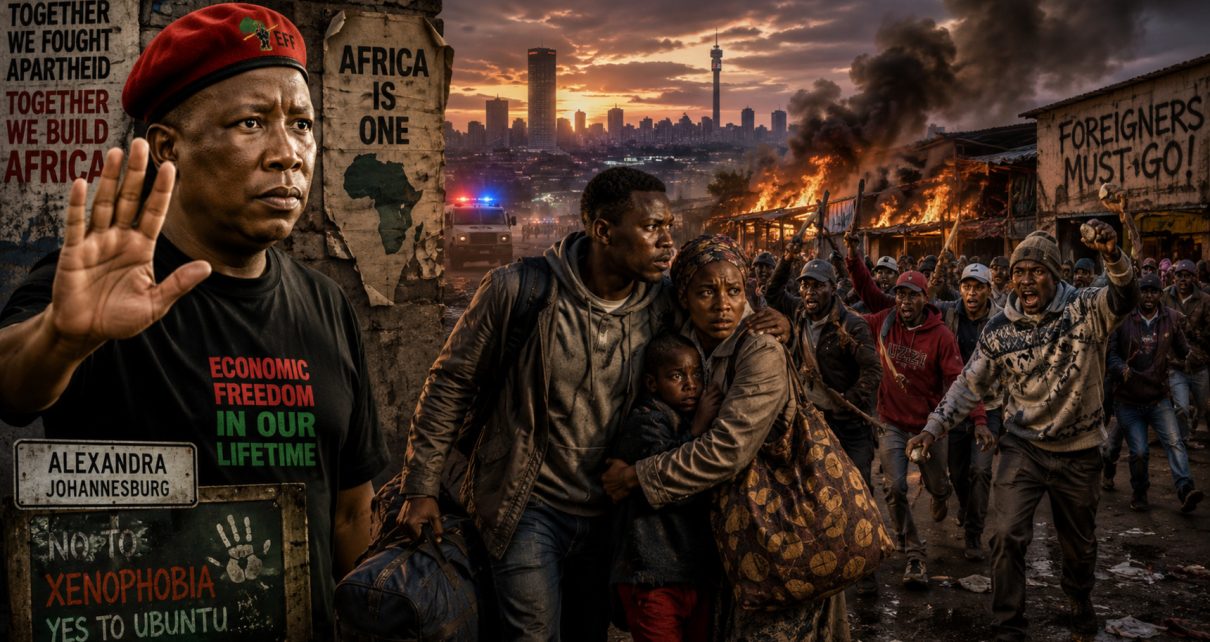

Julius Malema was not yet born when my generation of Nigerian student leaders put our lives and resources on the line for the liberation of South Africa and other countries under the yoke of colonialism and apartheid in the region. Yet, it was he who had the courage to defend foreigners of African descent at the receiving end of a murderous Afrophobic campaign by his fellow South Africans.
Afrophobia is a specific, intense prejudice and violence targeted specifically at Black individuals of African descent, particularly in the context of South Africa. While xenophobia can affect anyone from a different country, Afrophobia often acts as a specific, racialised scapegoating of fellow Africans. In a tragic twist of irony, the black-on-black violence shows how former victims of apartheid have themselves metamorphosed into monsters baying for the blood of “those Africans”, as their victims are derisively called. An illegal white immigrant may live in South Africa ‘till kingdom come’, and nobody would bother to ask for his papers while his Black African counterpart is hounded like a bush rat.
To be clear, I am not advocating that all the borders of South Africa be collapsed to facilitate illegal immigration. By all means, enforce your immigration laws within the bounds of decency. Take note, however, that the type of dehumanisation seen in Trump-era ICE raids does not befit any country in southern Africa which historically has itself suffered savage indignities in the past.
Malema is the only political leader who is unequivocal in his condemnation of Afrophobia. Our great friend and collaborator in the anti-apartheid struggle, Thabo Mbeki, whose sojourn in Nigeria during the liberation struggle I have referenced in the past, has always maintained a cagey reaction more focussed on protecting South Africa’s image than affirming the fundamental human rights of the victims of the South African mobs.
A Brutal Catalogue of Violence
In 2008, 62 foreigners, mostly from Zimbabwe, Mozambique, and Malawi, were killed in xenophobic acts of horrendous brutality in Gauteng. In one particularly savage instance, a Mozambican citizen, Ernesto Alfabeto Nhamuave, was beaten, stabbed, and set ablaze by an irate mob which watched him burn to death. No one was ever charged for his murder. About 100,000 African nationals were forced to seek refuge in internally displaced persons’ camps in Johannesburg.
Mbeki blamed the incidents on the struggle for the control of local business markets, often organised by people looking to damage South Africa’s international relationships. He, however, acknowledged the support his country received during the anti-apartheid struggle.
Writing in The Guardian of Nigeria on what he called “Thabo Mbeki’s Xenophobia Denialism”, journalist Adekeye Adebajo noted that an estimated 350 deaths were recorded in South Africa between 2008 and 2015 and that Mbeki’s statement was both insensitive and irresponsible.
No matter how sympathetic one is to the South African claim of having been psychologically dented by the horrors of apartheid, revelations by the 1988 Human Rights Watch report show that humanity has to help save South Africans from their regression to savagery as evidenced by the following:
Immigrants from Malawi, Zimbabwe and Mozambique living in the Alexandra township were “physically assaulted over a period of several weeks in January 1995 to ‘clean’ the township of foreigners.”
In September 1998, a Mozambican national and two Senegalese citizens were thrown out of a train.
In 2000, seven foreigners were killed on the Cape Flats over a five-week period in what police described as xenophobic murders.
In October 2001, residents of the Zandspruit informal settlement gave Zimbabwean citizens ten days to leave the area and subsequently burnt down and looted their shacks.
In the last week of 2005 and first week of 2006, at least four people, including two Zimbabweans, died in the Olievenhoutbosch settlement after foreigners were blamed for the death of a local man.
In August 2006, Somali refugees appealed for protection after 21 Somali traders were killed in July of that year and 26 more in August. The immigrants believed the murders to be motivated by Afrophobia.
There were at least a dozen attacks between January and May 2008 when two Somali shop owners were murdered in the Eastern Cape towns of Jeffreys Bay and East London, and then in March 2008 when seven people, including Zimbabweans, Pakistanis and a Somali national were killed after their shops and shacks were set ablaze in Atteridgeville.
On 12 May 2008 a series of riots started in the township of Alexandra (in the north-eastern part of Johannesburg) when locals attacked migrants from Mozambique, Malawi and Zimbabwe, killing two people and injuring 40 others. Some of the attackers were reported to have been singing Jacob Zuma’s campaign song, “Umshini Wami” (Zulu: “Bring Me My Machine Gun”). By the end of the riots, 62 people were reported dead.
One Good Turn Deserves Another
Flashback to our students’ union days in the 70s when South African students enjoyed free scholarships in Nigeria: I remember the celebrated case of one inebriated South African student dragged before the disciplinary committee for stabbing a fellow student during an argument. (The South Africans were the undisputed champions of ‘beering’ on campus.) The conclusion our panel reached was that the South Africans were already under too much psychological stress from home and that other students should please avoid triggering an already sparking circuit breaker.
That was in the 70s. Now the children of those South African refugees who received mercy in our hands are running riot against our own children, whom they derisively call ‘kwerekwere’ (a term often associated with the idea that foreign nationals are taking jobs and resources from locals).
We should continue to wish South Africans well. I’ve also recently seen video clips indicating that Ghanaians and Togolese are beginning to rev up their afrophobia engines too. They are all still our brothers and sisters. If they ever find themselves again at the receiving end of apartheid or some other form of enslavement in the future, we shall continue to consider it our duty to join them at the barricades to rout their oppressors. For now, we can only supplicate for them. Father forgive them, for they know not what they are doing.
When Ghanaians accuse many of the female Nigerian immigrants in their midst of prostitution, I wonder if it was that long ago when Nigerian brothels were populated by fellow West Africans. Mobile tailors (“Ejika-ni-Shop”) and mobile cobblers from Ghana and Togo were a fixture of our urban centres. Even now, the bulk of artisans at building sites in Lagos and Abuja are from neighbouring countries.
I don’t need to be lectured that we should get governance right in Nigeria. We are working at it. That is why some of us are in the public space. But Afrophobia is not the right answer to economic pressure, just as decapitation is not the cure for a headache.
Africans, put on your Malema cap. Think!
High Chief S. O. Oguntimehin
The lessons of a life well lived in the service of humankind were highlighted again at the funeral of the late Lisa and traditional prime minister of Ondo Kingdom, High Chief (Sir) S.O. Oguntimehin, who also happened to have been the immediate past chairman of Academy Press Plc. ‘Celebrators’, not mourners, came from home and abroad to do honour to this remarkable past president of the Institute of Chartered Accountants of Nigeria (ICAN). Among the dignitaries were top technocrats, professionals, captains of industry, traditional leaders, senior Christian clerics of various denominations, politicians and thousands of the sons and daughters of Ondo who played host as their Lisa bowed out in glory.


