By Joy Essien
Luxury living in Ikoyi has evolved into something far more sophisticated than simply occupying an expensive address. In today’s Lagos, Ikoyi represents a carefully insulated ecosystem — a private world designed to shield its residents from the pressures, unpredictability, and infrastructural inconsistencies of the wider city. Here, luxury is measured less by extravagance alone and more by autonomy, privacy, convenience, and controlled living.
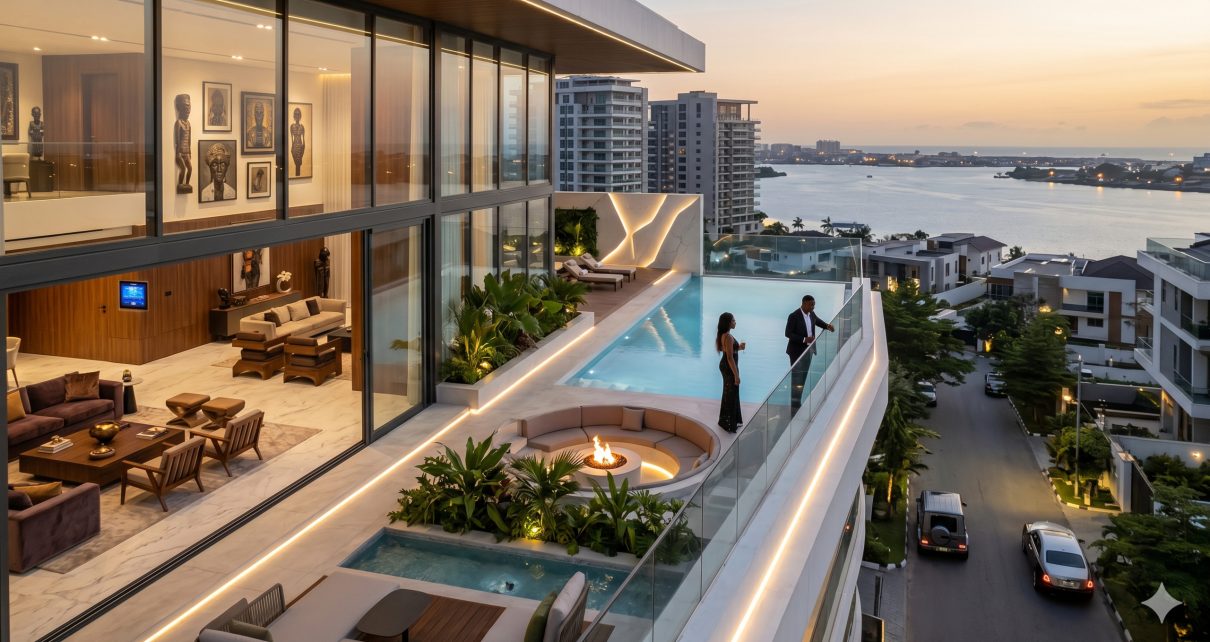
The district has undergone a dramatic transformation over the last decade. The old image of sprawling detached mansions hidden behind high walls is increasingly being replaced by sleek residential towers, glass-fronted maisonettes, and ultra-modern penthouses rising above the Lagos Lagoon. This “vertical luxury” movement has redefined elite housing in Nigeria, introducing a lifestyle shaped by technology, concierge culture, and resort-style amenities.
In many of these developments, residents no longer merely rent apartments; they subscribe to a fully managed ecosystem. Buildings operate like private cities within the city — powered by independent energy systems, protected by multilayered security architecture, and maintained by teams responsible for everything from housekeeping logistics to technical maintenance. The result is a lifestyle deliberately detached from the everyday disruptions associated with urban Lagos.
But beneath the polished marble lobbies, infinity pools, and smart-home systems lies an important economic reality: Ikoyi’s luxury market is fundamentally a wealth-preservation zone. The area attracts corporate executives, political elites, expatriates, old-money families, and globally mobile Nigerians who are willing to pay a premium not only for comfort, but also for exclusivity, social capital, and psychological distance from the city’s intensity.
This is why conversations about Ikoyi real estate are rarely just about rent. They are about status positioning, infrastructure independence, proximity to influence, and access to a highly curated residential experience. A ₦5 million monthly housing budget in Ikoyi therefore does not simply buy space — it buys entry into one of the most tightly controlled luxury environments in West Africa.
Below is a closer look at what that level of spending actually delivers in Ikoyi’s rapidly evolving high-end property market.
The Modern Residential Standard
Luxury in 2026 Ikoyi is defined by high-rise penthouses and maisonettes. Developers have moved toward vertical density to provide residents with panoramic views of the Lagos Lagoon and the Atlantic Ocean.
Smart Home Integration
Properties now feature full automation—controlling lighting, climate, and security via integrated AI systems.
Infrastructure Autonomy
These residences operate on private grids. Industrial-scale water treatment plants and 24/7 independent power supply are baseline requirements, ensuring a lifestyle completely decoupled from public utility fluctuations.
Building Amenities
Modern towers like those on Bourdillon Road and Alexander Avenue function like five-star resorts, featuring:
• Private cinema rooms and cigar lounges.
• Infinity pools and temperature-controlled indoor pools.
• Technogym-equipped fitness centers and private spas.
• Concierge desks that handle everything from housekeeping to private jet bookings.
Elite Gated Enclaves
While towers dominate the skyline, exclusive land-based estates remain the peak of social capital.
Banana Island
This remains the most isolated and prestigious address. It’s a man-made sanctuary where the “luxury” is as much about the silence and the strictly controlled access as it is about the architecture.
Parkview & Osborne Foreshore
These estates offer a mix of classic detached mansions and new “Sky Villas.” They are favored by those who want the security of a gated community but require closer proximity to the commercial bridges of Victoria Island.
The “Luxury” Entry Point (Market Realities)
Living in these spaces comes with a significant financial barrier that reflects Ikoyi’s status as a premier wealth-preservation hub.
Rental
A serviced 3-bedroom luxury apartment typically ranges from ₦30 million to ₦50 million per year, excluding service charges.
Purchase
New-build 3-bedroom units in prime towers start around ₦600 million to ₦900 million, while waterfront detached houses can easily exceed ₦2.5 billion.
Logistics & Security
The luxury lifestyle here is also defined by low-density living. Unlike other parts of Lagos, the zoning laws in Old Ikoyi ensure that even the high-rises have significant green spaces and ample parking.
Security is multi-layered, involving private estate guards, building-specific security details, and advanced surveillance (CCTV/drones) that monitor the perimeter of the major roads.
What Does the Monthly Rent Look Like?
In the Ikoyi luxury market, rents are almost exclusively quoted and paid annually in advance. While the concept of “monthly rent” exists for corporate accounting or short-let staycations, a standard long-term lease requires a lump-sum payment.
Based on current 2026 market data, here is the breakdown of what those costs look like when averaged monthly:
Average Monthly Cost Equivalent
These figures represent the “base rent” before service charges and utilities.
| Property Type | Monthly Equivalent (Approx.) | Typical Annual Lump Sum |
|---|---|---|
| 1-Bedroom / Studio (Serviced) | ₦400,000 – ₦850,000 | ₦5M – ₦10M |
| 2-Bedroom Luxury Flat | ₦1.2M – ₦2.5M | ₦15M – ₦30M |
| 3-Bedroom Premium Apartment | ₦2.9M – ₦5.8M | ₦35M – ₦70M |
| Banana Island (3–4 Bed) | ₦4.5M – ₦10M+ | ₦55M – ₦120M+ |
The “Short-Let” Exception
If you specifically need a month-to-month arrangement without a one-year commitment, you would move into the “Short-Let” or “Serviced Apartment” market. Because the landlord takes on the risk of vacancy and covers all utility costs, the premium is significant:
• Luxury 2-Bedroom Short-Let: ₦150,000 – ₦300,000 per day.
• Monthly Short-Let Total: Expect to pay between ₦4.5 million and ₦9 million per month for a fully managed apartment where you only bring your suitcase.
Hidden Monthly Operational Costs
In Ikoyi, the rent is only the “entry fee.” To maintain a luxury lifestyle, you must factor in these recurring monthly outflows.
Power (The “Diesel” Factor)
Most luxury towers charge for power based on consumption (₦240 – ₦350 per kWh). For a large 3-bedroom apartment with constant AC usage, this can add ₦300,000 – ₦600,000 to your monthly expenses.
Service Charge Provisions
While often paid annually (₦3M – ₦9M), it averages out to roughly ₦250,000 – ₦750,000 per month.
Estate Levies
Gated communities like Parkview or Banana Island often have separate monthly dues for security patrols and waste management, usually ranging from ₦50,000 to ₦150,000.
Summary of Reality
To live comfortably in a standard 3-bedroom luxury apartment in Ikoyi, your total monthly “burn rate” (Rent + Power + Service) generally starts at a minimum of ₦4.5 million ($2,800) and can easily scale to ₦12 million ($7,500) for top-tier waterfront properties.
Final Thoughts
Luxury living in Ikoyi is less about “flash” and more about insulation. It represents a shift from the high-energy, commercial pulse of Victoria Island to a quieter, “old money” residential standard, though that comes with its own set of trade-offs.
Here are my thoughts on the reality of living there:
The “Insulation” Advantage
Ikoyi is essentially a series of well-managed bubbles. When you pay for luxury here, you aren’t just paying for a house; you are paying to bypass Lagos’ infrastructure issues.
• Order over Energy: Unlike Victoria Island, which can feel cluttered, Ikoyi has preserved its tree-lined streets and residential calm. It is the only place in Lagos where you can truly “disconnect” from the city’s chaos.
• The “Club” Effect: Living in Ikoyi is a social signal. Whether it’s membership at the Ikoyi Club 1938 or just having a Bourdillon address, it places you in the immediate proximity of the country’s decision-makers.
The Modern “Vertical” Tension
There is a fascinating tension right now between “Old Ikoyi” (large, sprawling family compounds) and “New Ikoyi” (high-rise glass towers).
The Pros
These new towers (like those from Sujimoto or the 4 Bourdillon project) offer a global standard of living—private cinemas, gyms, and 24/7 technical support—that traditional mansions can’t match.
The Cons
You lose the sense of “land.” Some “luxury” apartments are surprisingly tight on square footage, sacrificing room size for high-end finishes and “smart” features.
The Reality Check
It isn’t a perfect paradise, and the “luxury” tag can sometimes mask daily frustrations.
• The “Diesel Tax”: You are essentially running a private local government. Your power, water, and security are all private. When diesel prices spike, your service charge isn’t just a fee—it’s a significant monthly “tax” on your lifestyle.
• The Flooding Paradox: Despite the prestige, some parts of Ikoyi (especially the newer waterfront areas) still struggle with drainage during peak rainy season. Truly elite living requires vetting the building’s drainage and elevation as much as its interior decor.
• The “Bland” Factor: Because it is so residential and private, Ikoyi can feel “quiet” to a fault. If you enjoy walkability to coffee shops or a spontaneous night out, you might find Ikoyi a bit too sterile compared to the vibrancy of VI or Lekki.
The Verdict
Ikoyi is ideal if your priority is wealth preservation, family stability, and privacy. It’s the best place in Nigeria to live if you want the world to leave you alone. However, if you want to be “where the action is,” you might find the gated walls of Ikoyi a bit isolating.


