
By Joy Essien
In Lagos, attracting high-end clients requires far more than expensive aesthetics, polished Instagram pages, or premium pricing. The city’s affluent consumers operate within a sophisticated ecosystem shaped by influence, perception, speed, exclusivity, and social signaling. They are not merely buying products or services; they are buying trust, convenience, discretion, emotional ease, and access to environments that reflect the lifestyles they aspire to maintain.
For this demographic, luxury is no longer defined by loud displays of wealth alone. Increasingly, the Lagos elite are drawn toward businesses that embody “quiet confidence” — brands that communicate competence without desperation, exclusivity without arrogance, and sophistication without noise. In a city where daily life can often feel chaotic and unpredictable, premium clients gravitate toward businesses that create order, calm, and certainty.
This is why branding for high-end clients in Lagos functions differently from mass-market branding. The goal is not visibility everywhere; it is relevance in the right rooms. The most successful premium brands are rarely the loudest. Instead, they position themselves as carefully curated experiences trusted by a select circle of discerning people. Their appeal lies in refinement, consistency, emotional intelligence, and operational excellence.
Whether the business is a luxury real estate company in Ikoyi, a boutique consultancy in Victoria Island, a members-only lounge in Banana Island, or a high-end creative agency serving corporate executives, the psychology remains largely the same: affluent clients are searching for businesses that reduce friction in their lives while reinforcing their sense of identity and status.
They want seamless service. They want proactive communication. They want discretion. They want environments that feel intentional rather than chaotic. Most importantly, they want to feel understood before they even have to explain themselves.
In Lagos, where social reputation carries enormous weight and referrals move faster than advertising, branding for the upper tier becomes less about selling and more about signaling. Every detail — from your website typography to your response time, your office atmosphere, your packaging, your staff conduct, and even your silence — communicates whether your brand truly belongs in the premium market.
Below is a deeper look at how businesses can position themselves to attract and retain high-end clients in Lagos’ increasingly competitive luxury economy.
Understanding the High-End Client Mindset
High-end clients operate on a different value metric than the average consumer. For them, price is rarely the primary hurdle; instead, the “cost” they are most concerned with is time, reputation, and emotional friction.
To attract and retain this demographic, a business must excel in the following areas:
1. Curation and Exclusivity
High-end clients often look for “the best” rather than “the most.” They want to know that a business has already done the heavy lifting of filtering out mediocre options.
The Draw
A business that offers a curated selection or a bespoke service makes the client feel like their specific needs are understood. Exclusivity isn’t just about high prices; it’s about access to expertise or products that aren’t available to the general public.
2. Operational Seamlessness
For a premium client, convenience is a luxury. They are attracted to businesses that anticipate their needs before they have to ask.
The Draw
If a process is “frictionless”—meaning easy booking, proactive communication, and zero administrative headaches—the client will remain loyal. They are paying for the peace of mind that the job will be done correctly without them having to micromanage.
3. Discretion and Trust
At the higher tiers of business, reputation is everything. Clients need to know that their data, their privacy, and their professional standing are protected.
The Draw
A business that demonstrates high ethical standards and a “silent partner” approach is highly attractive. They look for established authority and a track record of handling sensitive or high-stakes projects with composure.
4. Aesthetic and Intellectual Alignment
High-end clients are often drawn to businesses that mirror their own values or aesthetic sensibilities.
The Draw
This includes everything from the physical environment (or digital interface) to the “philosophy” of the brand. They are attracted to businesses that contribute to a larger narrative—whether that’s sustainability, innovation, or a commitment to craftsmanship.
5. Tangible Results and ROI
While they appreciate the experience, high-end clients are results-oriented. They look for a clear, superior outcome that justifies the investment.
The Draw
Proof of excellence. This could be in the form of case studies, high-level testimonials, or a portfolio that demonstrates a consistent ability to solve complex problems.
Service-Based Firm vs. Physical Luxury Space
To cater to high-end clients across both service-based firms and physical luxury spaces, the focus shifts from “utility” to “experience.” While the medium changes, the underlying psychology remains the same: the client is buying an upgraded version of their own time and status.
1. Service-Based Firms (Consultancies, Agencies, etc.)
In services, the “product” is invisible, so high-end clients look for competence and confidence.
Anticipatory Service
They want a partner who identifies problems before they arise. If a client has to follow up with you for an update, you have already lost the “premium” feel.
Deep Specialisation
High-end clients rarely hire generalists. They are attracted to the “authority” in a specific niche. They want to feel they are working with the best in that particular field, not a “jack of all trades.”
The “Luxury of No”
Paradoxically, being highly selective about who you work with makes you more attractive. It signals that your time is valuable and your standards are high.
High-Touch Communication
This doesn’t mean constant talking; it means high-quality, concise, and professional interactions that respect their schedule.
2. Physical Luxury Spaces (Hotels, Offices, Lounges)
In a physical space, the client is looking for atmosphere and sensory alignment.
Intentional Design
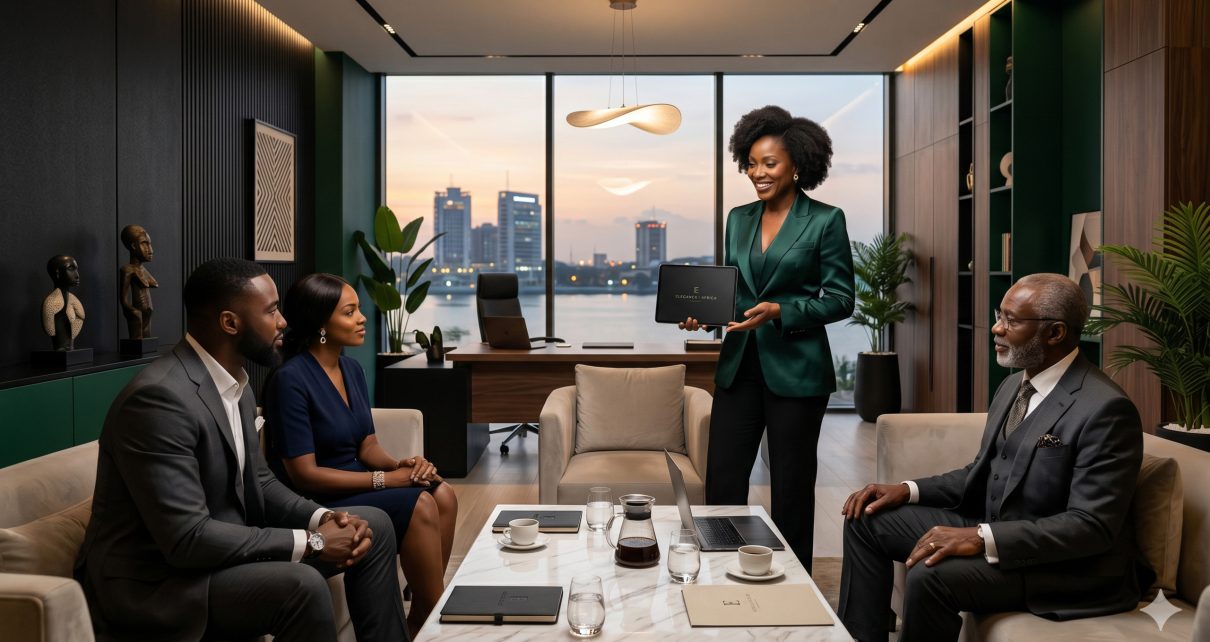
High-end clients are attracted to spaces that feel “curated” rather than “decorated.” This includes everything from the lighting levels to the acoustic treatment (quiet is a luxury).
Exclusion of Chaos
A premium space acts as a sanctuary. It should feel organized, calm, and private. Visual clutter or loud, unmanaged environments are immediate turn-offs.
Sensory Details
Small touchpoints carry immense weight. This includes the quality of the stationery, the scent of the room, the weight of the cutlery, or the comfort of the seating.
Human-Centric Hospitality
Staff should be invisible when not needed but instantly available when they are. The goal is to make the client feel like the space was prepared specifically for their arrival.
Branding for High-End Clients
Branding for the high-end market in Lagos requires a blend of global luxury standards and a deep understanding of local social currency. In a city where “status” is a language of its own, your brand needs to signal that it belongs in the inner circles of Ikoyi, Victoria Island, and Banana Island.
Here is how to position your business for the Lagos elite:
1. Sell “Peace of Mind” as the Ultimate Luxury
In Lagos, the biggest pain points for wealthy clients are unreliability and friction (erratic power, poor communication, delayed delivery).
The Strategy
Position your brand as an “oasis of order.” Your messaging shouldn’t just be about how great your product is, but how seamless the experience is.
The Signal
Use words like Bespoke, Managed, Guaranteed, and Seamless. If you are a service firm, your “on-time” delivery is a bigger luxury than a gold-foiled logo.
2. Prioritise “Invisible” Exclusivity
High-end Lagosians value privacy and “in-the-know” access. If everyone can have it, the elite often don’t want it.
The Strategy
Create a “velvet rope” effect. Instead of aggressive mass-market advertising on the Third Mainland Bridge, focus on high-touch referrals, private events, or a “by appointment only” model.
The Signal
Offer a tier of service or a specific product line that is only available to existing clients or through a specific portal.
3. Visual Identity: “Quiet Luxury” vs. “Loud Lagos”
While Lagos is famously vibrant and bold, the current global and local trend for HNWIs (High-Net-Worth Individuals) is Quiet Luxury.
The Strategy
Move away from cluttered designs. Opt for a minimalist, “international” aesthetic: high-quality paper stocks for physical cards, plenty of white space on your website, and a sophisticated color palette (e.g., deep emerald, matte black, champagne gold).
The Signal
Use a .ng or .com domain with a professional email address (no @gmail.com). In Nigeria, a “corporate” look is the first layer of trust.
4. Leverage Social Proof & Community
The Lagos elite are highly influenced by their peers. They don’t want to be the “first” to try something; they want to be part of the “exclusive group” that uses it.
The Strategy
Partner with micro-influencers or “taste-makers” rather than massive celebrities. Think of architects, interior designers, or niche industry leaders whose endorsement acts as a “seal of quality.”
The Signal
Showcase high-level collaborations. If your physical space or service has been used by a recognized premium brand (like a top-tier bank or a luxury real estate firm), highlight it subtly.
5. The “Human-Centric” Touch
High-end clients in Lagos expect a high degree of personal recognition. They don’t want to be “Customer #405”; they want to be “Chief [Name].”
The Strategy
Invest in Relationship Management. Whether it’s a service-based firm or a physical space, ensure there is a dedicated person who knows the client’s preferences (e.g., how they like their coffee or their preferred communication style).
The Signal
Personalized follow-ups. A handwritten “thank you” note or a phone call from the founder goes much further in Lagos than a generic automated email.
Summary Checklist for Your Lagos Brand
• Physical: Is the location/packaging impeccable? (No rough edges).
• Digital: Does the website load fast and look expensive?
• Verbal: Is the tone of voice confident, respectful, and expert?
• Social: Are the “right” people talking about you?


