By Nkanu Egbe
The National Theatre has seen many reinventions. Once the grandest stage in Lagos — host to heads of state, continental summits, and the full spectacle of Nigerian cultural ambition — the building on Iganmu’s waterfront has spent recent decades in a more complicated relationship with its own legend. But on Wednesday 13 May, something fitting will happen inside its reimagined halls.
In Cinema Hall 2 of the Wole Soyinka Centre for Creative Arts and Culture, a room of writers, librarians, booksellers, educators, and policy thinkers will gather for what promises to be one of the more quietly significant events of this year’s Nigeria International Book Fair. Quietly significant, because there will be no pyrotechnics — only a conversation. But it is the kind of conversation that tends to outlast the louder ones.
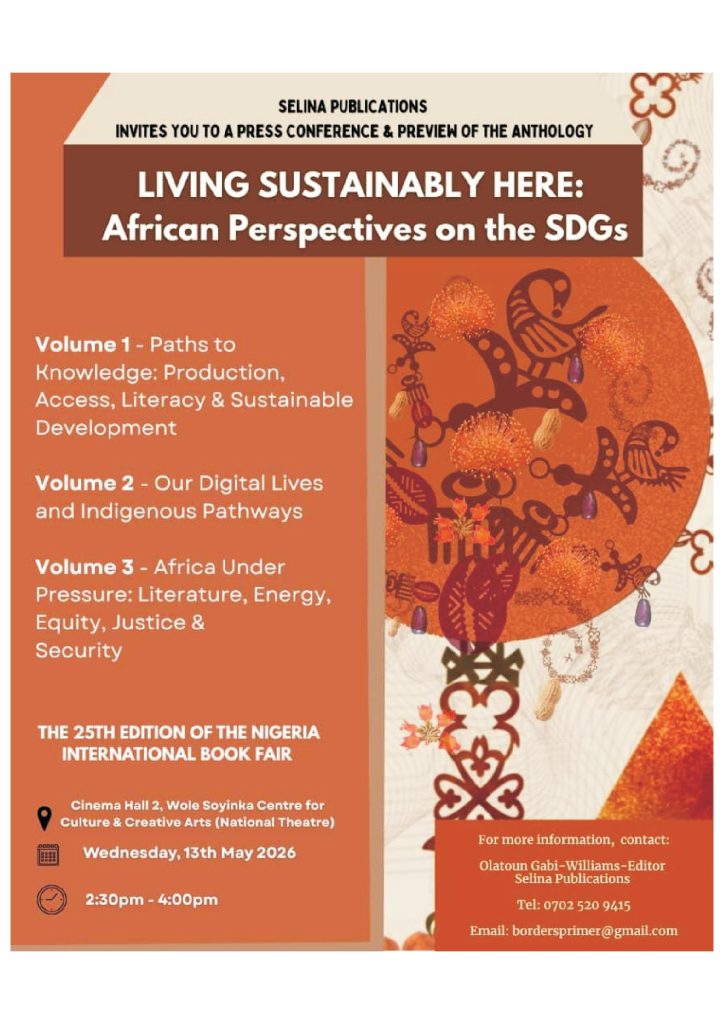
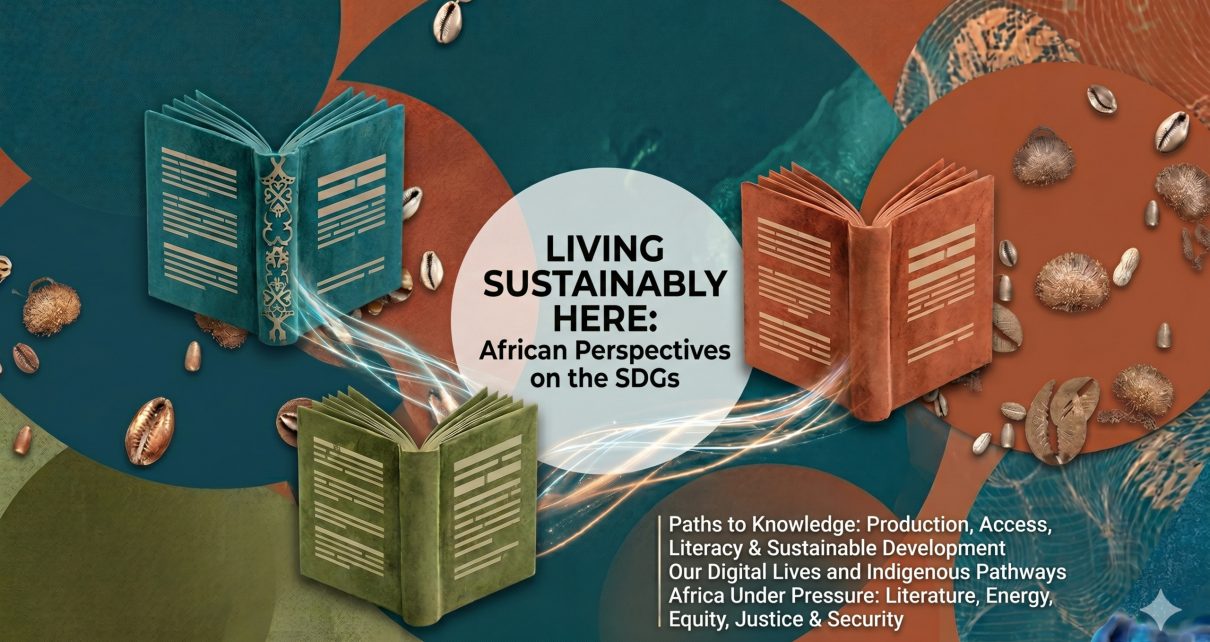
The occasion is the press launch of Living Sustainably Here: African Perspectives on the SDGs — a new multi-volume anthology that asks, with some urgency, whether Africa’s development story is being told by Africans, for Africans, in language that actually reaches people.
Volume 1 — Paths to Knowledge: Production, Access, Literacy and Sustainable Development — arrives with a deceptively simple proposition at its centre: that books, libraries, publishers, schools, and reading culture are not the decorative edge of development policy. They are its foundation. And that foundation, across much of the continent, remains dangerously unfinished.
The session runs from 2:30 to 4:00 PM — ninety minutes to take on questions that have occupied African educators, writers, and advocates for generations. Who has access to knowledge? Who produces it? Who is systematically left out? And what does any of that have to do with whether a young person in Lagos, Accra, or Nairobi can build a life of dignity and agency?
It is, in other words, exactly the kind of conversation the Book Fair was made for.
What is this anthology?
There is a particular kind of book that arrives not as a single voice but as a chorus — and Living Sustainably Here: African Perspectives on the SDGs is precisely that. Conceived and curated by Nigerian journalist and literary activist Olatoun Gabi-Williams, the series sets out to do something that development literature has rarely managed: make the United Nations Sustainable Development Goals legible, personal, and genuinely readable to the people whose lives they are meant to describe.
The anthology does not read like a policy brief. It reads like Africa thinking aloud.
Blending journalism, life-writing, reportage, advocacy, and policy reflection, the series draws on contributors from across the continent to explore how the SDGs are actually lived — where they are working, where they are failing, and where Africans are quietly reimagining them on their own terms. The format is deliberate: essays sit alongside infographics and curated imagery, making the volumes function as educational visual readers for adults and young people from fifteen upwards. This is not a text aimed at conference rooms. It is aimed at the curious, the engaged, and the impatient.
What distinguishes the project further is its tone. The anthology insists on accessible, engaging language — a choice that is itself a political statement in a landscape where so much writing about African development is produced elsewhere, in idioms that travel poorly and land lightly. “This project,” the editors note, “brings sustainability out of policy rooms and into everyday African life.” That sentence is both a description and a manifesto.
The series is planned across multiple volumes, each anchored to a cluster of SDGs and the lived African experiences that illuminate them. Volume 1, launching at this week’s Book Fair, takes knowledge itself as its subject — who produces it, who can reach it, and what happens to a society when too many of its people cannot.
Volume 1 in Focus: Paths to Knowledge
Every development conversation eventually circles back to the same place: education. But Volume 1 of Living Sustainably Here is not interested in education as abstraction. It arrives at something more specific, and more demanding — the question of knowledge itself. Not merely whether children are in school, but whether the infrastructure that produces, carries, and sustains knowledge is being treated with the seriousness it deserves.
The volume’s argument is direct: books, libraries, publishers, schools, and reading culture are not optional. They are not the civilising garnish on top of the real work of development. They are, in the language of the anthology, essential development infrastructure — as fundamental to a functioning society as roads, power, or clean water. It is a claim that will strike many readers as obvious. The more uncomfortable question the volume raises is why, if it is so obvious, so little of Africa’s development architecture actually reflects it.
Paths to Knowledge examines the full ecosystem of how knowledge moves — or fails to. How it is produced, and by whom. How it is distributed, and to where. Who is structurally excluded from it, and at what cost. How literacy shapes not just individual opportunity but the texture of economic life, civic participation, and democratic culture at a national scale.
It is a volume that takes the long view. The SDG framework — particularly SDG 4, which calls for inclusive and equitable quality education — provides the scaffolding, but the essays reach beyond targets and indicators into the lived reality of what it means to grow up in a society where a functional public library is a rarity, where booksellers are struggling to survive, and where reading for pleasure remains, for many, an unreachable habit rather than a natural one.
The volume’s anchoring conviction carries the weight of a challenge: “A nation’s reading culture is a measure of its developmental future.” On Wednesday afternoon in Cinema Hall 2, five contributors will make the case for why that measure matters — and what it will take to change it.
Meet the Panelists — Five Voices, One Ecosystem
What makes the Volume 1 panel unusual is not just the range of perspectives it brings together, but the fact that each participant is operating at a different pressure point within the same system. Together, they map something close to the full terrain of how knowledge reaches — or fails to reach — people across West Africa and beyond.
Nkem Osuigwe has spent her career at the intersection of libraries and the communities that most need them. Her essay, The Role of Libraries in Realizing SDG 4: The West African Perspective, makes a case that will resonate far beyond the library profession: that public libraries, properly resourced and genuinely accessible, are among the most democratic institutions a society can maintain. She examines their potential as engines of early literacy, as lifelines for out-of-school learners, as entry points to digital inclusion and Open Education Resources. The question she brings to the panel is one of uncomfortable honesty — why do so many libraries exist in name only, their doors effectively closed to the people they were built to serve?
Ore Lesi approaches the knowledge ecosystem from a different angle — the bookshop. In The Role of 21st-Century Booksellers in Realizing SDG 4, she examines what the bookseller has become, and what they could yet be. Her argument is that the bookshop, often dismissed as a struggling retail category, is in fact something more durable and more necessary: a community institution, a space of literacy advocacy, a place where reading culture is either quietly nurtured or quietly abandoned. At a moment when bookselling across Nigeria faces genuine structural pressures, her essay asks what it would look like to take the bookseller seriously as a development actor — not just a merchant.
Wale Okediran brings the writer into the frame. A medical doctor, novelist, and former member of the Federal House of Representatives, Okediran has long occupied the space where literature meets civic life. His essay, The Role of African Writers in Realizing SDG 16, is concerned with writers as agents of peace, justice, and accountability — the argument that storytelling is not peripheral to governance and social cohesion but deeply entangled with it. SDG 16, which calls for peaceful, just, and inclusive societies, may seem an unlikely destination for a literary essay. Okediran makes the journey feel inevitable. Can literature genuinely influence governance? Do writers shape the societies they inhabit, or merely reflect them back? These are the questions he carries into the room.
Moulin Sade Marriott widens the lens to international education systems and their relationship with sustainability. Her essay, focused on Lagos, examines the international school as a site of both promise and contradiction — spaces where global citizenship and SDG awareness are increasingly embedded in curricula, but whose reach remains, by definition, limited. The questions she raises have implications well beyond the schools she writes about: are we educating young people for examinations, or for the future? And can models developed in well-resourced international environments be translated meaningfully into public education systems serving the majority? It is a provocation as much as an essay.
Richard Mammah arrives with perhaps the most expansive vision of the five. The founder of the Nigerian Network of Book Clubs and Reading Culture Promoters, Mammah has built what amounts to a civic movement around the act of reading. His essay documents a remarkable network of book clubs, reading advocates, and public initiatives — including the Lagos Book Walk and the Lagos Book Charter, a ten-point framework for embedding reading culture into national life. Where others examine institutions or industries, Mammah is interested in something harder to quantify: the shift in public attitude that turns reading from a private habit into a shared social value. His central conviction — that literacy is a collective national responsibility, not simply an educational outcome — gives the panel its most openly activist voice.
Anchoring the proceedings as session chair is Dare Oluwatuyi — Chairman of the Nigeria International Book Fair Trust, President of the Booksellers Association of Nigeria, and Managing Director of CSS Bookshops. His presence is a reminder that the conversations happening around this anthology do not exist in a vacuum. They have a market, an industry, and an institutional context — and the future of that context is very much part of what Wednesday’s session is about.
The Academic Dimension
Any anthology that positions itself at the intersection of African knowledge systems, sustainable development, and public literacy invites scrutiny from the academy — and Living Sustainably Here has sought that scrutiny deliberately.
The foreword to Volumes 1 through 3 has been contributed by Professor Rasheed Olaniyi, Dean of the Faculty of Arts at the University of Ibadan. That Olaniyi — a historian whose work engages seriously with African social history, urban experience, and cultural life — has lent his framing to three volumes of the series is significant. It signals that the anthology is not positioning itself against academic rigour but in conversation with it, asking the university to recognise what a literary and journalistic project can do that a monograph cannot: reach people where they are, in language they will actually finish reading.
The critical reflection on Volume 1 specifically comes from Dr. Olawale Olayide, a Professor of Sustainability at the University of Ibadan whose work sits at the crossroads of environment, development, and policy. His engagement with the volume brings a disciplinary lens that sharpens the anthology’s arguments without flattening them — situating the essays on libraries, booksellers, writers, and reading culture within the broader frameworks of sustainability science and African development thought.
Together, these contributions do something important for the project. They provide intellectual scaffolding without transforming the anthology into something it is not trying to be. The academy is present here not to validate the voices of practitioners and writers — those voices need no such validation — but to extend the conversation into spaces where policy is shaped and curricula are built. It is, in its own quiet way, a model for how African knowledge institutions might work together across the boundaries that too often keep them apart.
The Bigger Picture — A Continent At A Turning Point
There is a particular tension at the heart of contemporary African life that no single policy framework has yet resolved — and that Living Sustainably Here refuses to look away from.
Africa is urbanising faster than any region in human history. Its digital landscape is being rewritten in real time, with mobile technology leapfrogging infrastructures that wealthier economies spent decades building. Its youngest generation — the largest cohort of young people the continent has ever produced — is more globally connected, more formally educated, and in many places more economically precarious than any that came before it. And threading through all of it, with a quiet insistence that development discourse has been slow to absorb, is the climate emergency: not a future threat for this continent, but a present one, reshaping agriculture, water, displacement, and the basic calculations of daily survival.
It is against this backdrop that Volume 1’s central argument gains its full force. When a society is navigating transformation at this speed and scale, the question of who has access to knowledge — reliable, relevant, accessible knowledge — is not a cultural nicety. It is a survival question. A young person who cannot read fluently, who has never encountered a functional library, who lives in a city where books are scarce and reading culture thin, is navigating that transformation with one hand tied behind their back. The stakes, in other words, are not abstract.
What the anthology understands — and what Wednesday’s panel will make the case for — is that this moment of pressure is also a moment of possibility. Across Africa, a new generation is not waiting for permission. It is building knowledge systems, reshaping cultural industries, and forcing its way into global conversations on its own terms. Living Sustainably Here positions itself within that energy: not as a lament for what is missing, but as a contribution to what is being built.
Knowledge access and literacy, Volume 1 argues, are not the reward that comes after development. They are the road itself.
The Series Ahead
Wednesday’s launch is, in one sense, a beginning. Volume 1 is the first instalment of a project whose full architecture is still unfolding — and the scope of what is planned suggests that Living Sustainably Here intends to be a sustained intervention in African public discourse, not a single event dressed up as a series.
Volume 2, Our Digital Lives and Indigenous Pathways, will turn to the intersection of technology and cultural identity — a terrain that is already generating some of the most urgent and unresolved debates on the continent. How does digital transformation sit alongside the preservation of indigenous knowledge systems? Who benefits from Africa’s digital future, and who is quietly written out of it? These are questions with no easy answers, which is precisely why they belong in an anthology of this kind.
Volume 3, Africa Under Pressure: Literature, Energy, Equity, Justice and Security, takes on the hardest cluster — the overlapping crises of climate vulnerability, energy poverty, social inequality, and the fragile architectures of peace and governance that hold (or fail to hold) across so many African states. That literature is placed at the front of that title is a deliberate signal: the anthology continues to insist that storytelling and creative writing are not bystanders to these conversations but active participants in them.
Volume 4, scheduled for 2027, will focus on The Health and Wellbeing of Our Cities and Communities — arriving at a moment when African urbanisation will have deepened further still, and when the relationship between city life, public health, and human dignity will be even more pressing than it is today.
Read together, the four volumes trace something close to a complete picture of the African development challenge as it is actually experienced — not from above, but from within. Each volume stands alone. But the cumulative argument they make, across knowledge, technology, justice, and health, is that sustainable development in Africa will be built by Africans who can see themselves clearly in the story — and who have the tools, the literacy, and the cultural confidence to write the next chapter themselves.
Profile: The Editor
There is a thread that runs through everything Olatoun Gabi-Williams has built over the past two decades — and it is not difficult to find. It is the conviction that access is not a privilege. That knowledge, culture, care, and representation are not things to be rationed by circumstance of birth, geography, or income. And that the work of closing those gaps is, at its core, a form of advocacy that belongs as much to journalists and literary activists as it does to policymakers and development economists.
Gabi-Williams came to that conviction early, and has tested it in remarkably varied arenas.
In 2003, she founded Sponsor A Child Nigeria, a platform through which she would spend more than a decade directing resources and attention toward children in institutional care — a constituency that Nigerian public life has rarely paused to consider. Under its banner, she led Building Futures, a programme funded by Procter & Gamble that brought educational and recreational resources into care institutions across the country. She also developed The Good Home Scheme, a project recognised by the French Government in Nigeria as its 2014 Human Rights Project — a distinction that speaks to the quality and seriousness of what she had built.
When she founded Borders Literature for All Nations in 2015, the focus shifted — but the underlying logic did not. Borders is a pan-African literary and advocacy platform with a specific and under-served mission: promoting African literature globally while advancing what Gabi-Williams calls fair-trade publishing. The platform pays particular attention to indigenous and endangered languages, and to recognising the community origins of works produced in those languages — a concern that places her work squarely within the broader struggle over who owns African cultural production and on whose terms it circulates in the world.
She writes for The Guardian Nigeria, and administers the Gabi Williams Alzheimer’s Foundation, established in memory of her father, Dr. Gabisiu Ayodele Williams — a respected public health pioneer whose legacy clearly informs her own instinct for work that serves communities rather than careers.
Living Sustainably Here is, in many ways, the project in which all of these threads converge. The journalist’s eye for the telling detail. The advocate’s insistence on reaching people who are routinely overlooked. The literary activist’s belief that the stories a continent tells about itself shape the future it is capable of imagining. And the editor’s discipline to hold a chorus of voices together without flattening any of them.
She has described the anthology as bringing sustainability into everyday African life. What she has not said — but what the project makes plain — is that she has spent the better part of her adult life doing exactly that, one initiative at a time.
Call to Action
There is a line in the anthology’s press materials that deserves to land beyond the Book Fair, beyond Cinema Hall 2, and beyond the community of readers and practitioners who will already know why it matters: “Sustainable development begins with knowledge — who has it, who shares it, and who is left out.”
It is a simple sentence. It is also, if you sit with it long enough, a fairly complete description of the fault lines running through contemporary African life.
On Wednesday 13 May, from 2:30 to 4:00 PM, that sentence will be unpacked, tested, and argued over by some of the most thoughtful voices currently working at the intersection of knowledge, culture, and development on this continent. The venue — Cinema Hall 2 of the Wole Soyinka Centre for Creative Arts and Culture at the former National Theatre, Iganmu, Lagos — is itself a kind of statement. A space reclaimed for culture. A stage returned to the work it was always meant to serve.
For Lagos readers, this is not a distant conversation. The city that is home to Nigeria’s most strained public libraries and some of its most vibrant reading communities. The city where booksellers are reinventing themselves in real time, where book clubs are quietly multiplying, where a generation of young Nigerians is hungry for stories that reflect their lives back to them with honesty and ambition. The questions Volume 1 raises are Lagos questions. They are Nigeria questions. They are, unmistakably, ours.
Living Sustainably Here: African Perspectives on the SDGs, Volume 1 — Paths to Knowledge launches at the Nigeria International Book Fair on Wednesday 13 May 2026. The press conference takes place in Cinema Hall 2, Wole Soyinka Centre for Creative Arts and Culture, from 2:30 to 4:00 PM.


