

Work is the tribute that man must pay for his sin in the Garden of Eden, as recounted in the Bible (Genesis 3:19). If Adam had stayed on the side of propriety and not allowed Eve and Satan to lure him into disobeying God, man and his descendants would not have needed to work from the cradle to the grave. Some critics have argued that they would rather live in a world of struggle than in an Eden of laziness. What excitement, they ask, could there be in a human community where all one has to do is sleep and wake up without toil, without hunger, without needs?
Well, no matter which side of the argument we endorse, we are stuck with what we have—a world in which we can only find our bread by the sweat of our brow. That expression is often used to emphasise the dignity of work, personal sacrifice, earning a living through strenuous, often physical work, and the human condition of working for sustenance.
Over the ages, as society became more sophisticated, the need to devise objective, universally acceptable criteria for measuring compensation for units of work done has tasked governments and other employers of labour within society. As provided for in ILO Minimum Wage Conventions, Nigeria adopted a monthly wage system through social dialogue. The Minimum Wage Fixing Machinery Convention 026 was ratified by Nigeria under a democratic government on 16th June 1961. Another major wage calibration was done 20 years later under the Shagari-led administration of the Second Republic.
Milestones
1981: Introduced by President Shehu Shagari at ₦125 per month.
1991: Increased to ₦250 per month under Gen. Ibrahim Babangida.
1998/1999: Raised to ₦3,000 per month during the Gen. Abdulsalam Abubakar administration.
2000: Raised to ₦5,500 by President Olusegun Obasanjo.
2011: Increased from ₦7,500 to ₦18,000 under President Goodluck Jonathan.
2019: Raised to ₦30,000 per month by President Muhammadu Buhari.
2024: President Bola Ahmed Tinubu raised the minimum wage to ₦70,000.
Labour activists have, however, contended that if there is anything that needs restructuring, it is the maximum wages arbitrarily fixed by elected political office holders and which have no bearing whatsoever with international law or standards. In their view, it is difficult to imagine that those who enjoy very fat wages, allowances, pensions and other perks of office would be the ones thinking of snatching from workers’ mouths the little minimum wage the workers are struggling to survive on.
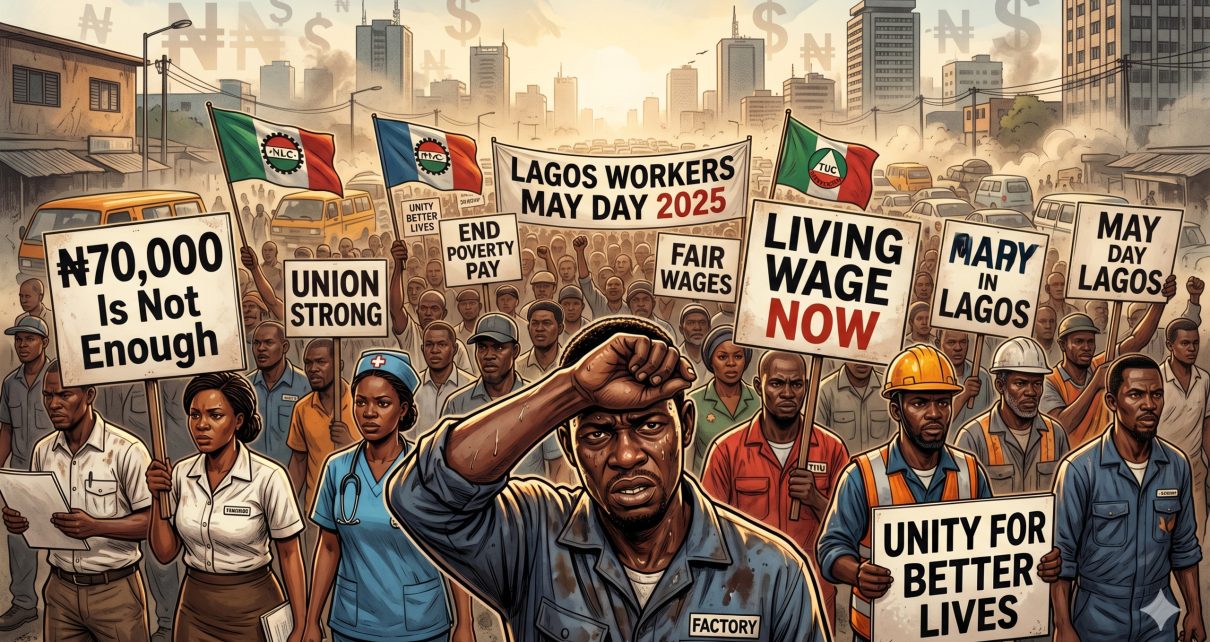
On May 1, 2026, Nigerian workers held their usual May Day protests all over the federation, demanding a review of the ₦70,000 minimum wage. While the ₦70,000 rate remains the current standard established in late 2024, labour unions (NLC/TUC) are calling for drastic increases, arguing that the current rate is unrealistic due to high inflation. Even then, some states are yet to pay the ‘meagre’ ₦70,000. The ₦125 wage in 1981 was equivalent to $76.25, while today’s ₦70,000 equals about $50.87.
Workers in various regions, including terror-ravaged Borno State, are protesting for the full implementation of the ₦70,000 minimum wage, especially for local government staff. Both the Nigeria Labour Congress (NLC) and the Trade Union Congress (TUC) have stated that the current ₦70,000 rate will have to be urgently reviewed to avoid social strife. Although the last wage act was passed in 2024, labour leaders can’t wait for another review to address economic realities.
Economic dislocation
In truth, many Nigerian workers have been flung down the social ladder since the ongoing economic reforms, in which the national currency has been massively devalued and workers have struggled to keep up appearances.
Employers, on the other hand, always complain that they are carrying too many burdens in addition to paying what they regard as decent wages. Apart from the fact that industrial establishments in Nigeria usually have to augment municipal facilities or run their operations on diesel because of the unreliability of public power supply, they also have to cater for the employer’s share of pension contributions, NSITF, ITF, NHF, NHIS and PAYE tax remittances.
For a minimum wage employee, the approximate total employer cost breaks down as follows: gross salary of ₦70,000, employer pension (10%) of approximately ₦7,000, NSITF (1%) of approximately ₦700, and ITF and NHIS costs depending on company size. The total employer cost for a minimum wage worker is approximately ₦78,000 to ₦85,000 per month, roughly 11 to 21% above the headline salary.
Usually, in the midst of the heated arguments attending the current economic crisis, politicians and members of the ruling elite insensitively pour ogogoro on troubled waters when they isolate a lone index (e.g., petrol price) and use it to arrive at an illogical conclusion that Nigerians are economically better than other Africans in other countries. What they need to do is use the more far-reaching issue of minimum wage against the US dollar as a barometer. If that is done, it will be clearly seen that the Nigerian worker needs an urgent salary review.
| Country | Monthly Minimum Wage | Approx USD |
|---|---|---|
| South Africa | ZAR 4,892 (~₦450,000) | $270 |
| Kenya | KES 15,840 (~₦180,000) | $120 |
| Ghana | GHS 570 (~₦65,000) | $44 |
| Nigeria | ₦70,000 | $42 |
| Egypt | EGP 7,000 (~₦200,000) | $140 |
| Tanzania | TZS 100,000–400,000 | $38–$150 |
Nigeria’s minimum wage is among the lowest in Africa in dollar terms, despite having the continent’s largest GDP. South Africa’s minimum is roughly six times higher. Kenya’s is nearly three times higher. Even Ghana, a much smaller economy, has a comparable minimum in dollar terms. The gap is largely driven by the naira’s depreciation rather than differences in legislative intent.
We can pay a fair wage to Nigerian workers if we consider the objective templates established in other climes which have navigated that path honestly. For example, the parameters recommended by the Indian Labour Conference in 1957 for fixing the minimum wage are as follows: (a) 3 consumption units for one wage earner; (b) minimum food requirements of 2700 calories per average adult; (c) clothing requirements of 72 yards per annum per family; (d) rent corresponding to the minimum area provided for under the government’s industrial housing scheme; (e) fuel, lighting and other miscellaneous items of expenditure to constitute 20% of the total minimum wage.
Fast forward to 1992, when the Honourable Supreme Court of India delivered a historic judgement in the case of Reptakos & Co. vs its workers, directing that children’s education; medical requirements; minimum recreation, including festivals/ceremonies; provision for old age; marriage; etc. should further constitute 25% of the minimum wage and be used as a guide in the fixation of minimum wage.
I urge our legislators to take another look at our compensation system and bring it up to modern standards so that our workforce can live within internationally acceptable standards of human dignity. Fair compensation is a matter of decency, justice, and economic stability, not just business costs. Going forward, we must ensure a living wage above subsistence, closing gender/racial pay gaps, and treating workers with respect.
It is double jeopardy when a man cannot put bread on the table from the sweat of his brow!


