
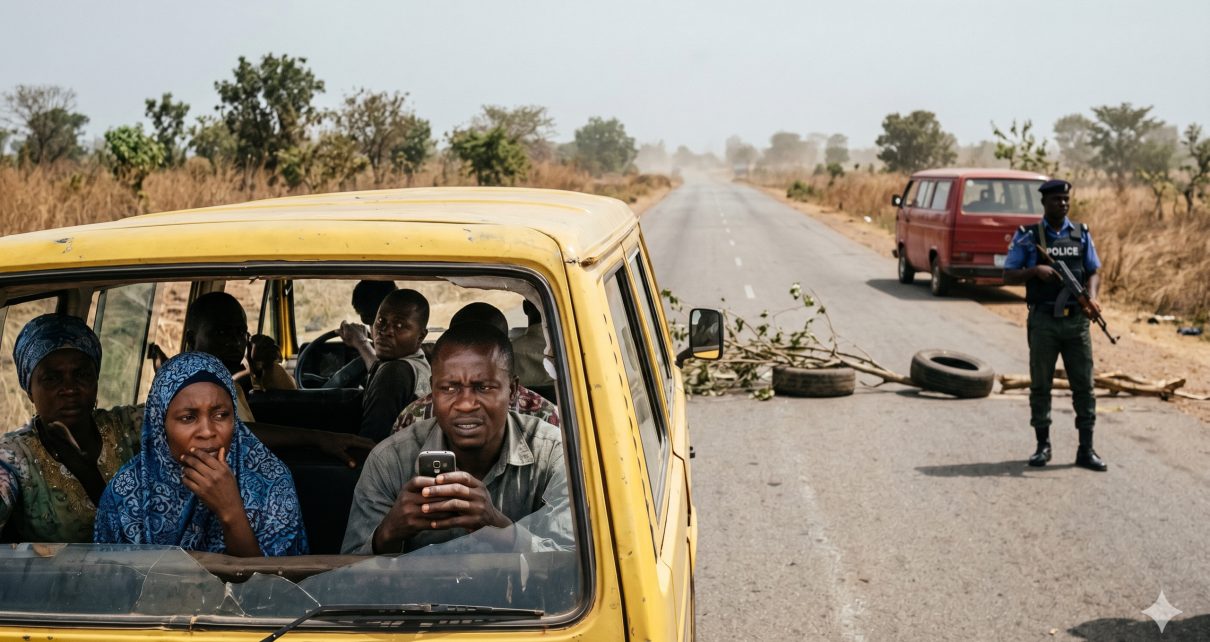

To deaden the pain of insecurity gripping the citizenry, Nigerians have resorted to their old pastime of gallows humour. They’ve even invaded the innocent territory of nursery rhymes. So, instead of “A for Apple; B for Ball; C for Cat”, you have “A for Axe; B for Bomb; C for Cutlass”. You’ve got to cry to laugh!
It is so sad to see how evil elements are destroying Nigeria one village at a time. Internally Displaced Persons (IDP) camps are everywhere. Most of the camps have virtually become makeshift villages too because there is little chance of their occupants returning to their original homes. But we pretend that things are not as bad as they really are. We use euphemisms for the civil war that is raging from state to state. We call them skirmishes, farmer/herder clashes, banditry, inter-tribal raids, etc.
Road Scare
To experience these variants of insecurity at the same time that Boko Haram and ISWAP are claiming territory and harvesting the lives of senior military personnel in the northeastern part of the country is like living in a roofless house at the height of the rainy season. Road travel has become a nightmare. Tourism is virtually dead. Educational excursions have been suspended indefinitely. If you must travel, make sure there’s a good ransom negotiator in your family before you set out.
See what Plateau State has become! Between Plateau and Benue, we had a food basket and a tourist destination. Now the basket is empty because the farmers have been chased off their land by terrorists. No tourist will dare go near Plateau now unless he has a death wish. We scream “Never again” after each tragic bloodletting, but underneath our breath, we know we shall soon gather again to commiserate with the bereaved.
I’m sorry to have to repeat the obvious: if we continue to do things the same old way, we shall continue getting the same results. Over the years, I’ve suggested that military contractors be employed in the interim to clear the gutters while we rebuild the policing system.
If past governments had introduced state policing, perhaps by now, we would have been in a better position to tackle the merchants of terror who have become so emboldened that they are challenging the armed forces. It is curious that, in spite of the acquisition of tracking devices, we are unable to track and apprehend terrorists who negotiate ransom payments through open GSM lines. The outlaws now operate sophisticated drones in competition with the security forces. We are in trouble.
State Police
Mr Tunji Disu, the new Inspector-General of Police (IGP), started on a good note when he publicly supported the plan to introduce state police. His predecessors seemed to have operated under some ill-defined imperial philosophy which blinded them to whatever merits there were in the concept.
Now that we have an IGP who is not scared of re-engineering, we have no time to waste. The 60-month timeline that the new IG has given is rather long. The gradualist approach gives the impression that the government and its security agencies are not treating the issue with the urgency it deserves. Between the National Assembly and the government agencies, everything about state/regional policing can be tidied up in 18 months so that the law can take effect and foundational structures can be established.
Disu’s 75-page framework for restructuring Nigeria’s security system introduces a two-tier policing architecture. This system comprises a Federal Police Service (FPS) and 37 State Police Services, including the Federal Capital Territory (FCT). The FPS will primarily focus on national security issues such as terrorism, interstate crime, and the protection of federal assets. In contrast, the state police will be responsible for addressing localised crimes, including armed robbery, homicide, domestic violence, and gathering intelligence at the community level.
Central to this framework is the concept of community policing, which will serve as the operational backbone of the entire policing system. To alleviate concerns about potential misuse of police forces by state governors for political purposes, the framework includes robust constitutional and institutional safeguards. Notably, it proposes the establishment of independent State Police Service Commissions that are insulated from gubernatorial influence, granting them authority over recruitment, promotions, and disciplinary actions.
Additionally, the framework stipulates criminal penalties for unlawful directives, particularly those aimed at partisan deployment of police officers. It also empowers the Federal High Court to fast-track cases involving politically motivated abuses.
To further enhance accountability, the framework calls for the creation of State Police Ombudsmen, the mandatory use of body-worn cameras, and the implementation of public performance dashboards to monitor incidents of use-of-force and community satisfaction levels.
At the federal level, the framework advocates for the establishment of a National Police Standards Board (NPSB), an independent body consisting of 13 members tasked with setting and enforcing uniform standards across both federal and state police formations. This board would publish annual compliance ratings for each state, imposing penalties such as funding restrictions on those jurisdictions that fail to meet standards. This mechanism is designed to prevent fragmentation of standards and ensure professionalism throughout the federation.
On the matter of personnel management, the document proposes a Voluntary Transfer Programme (VTP), allowing officers from the current Nigeria Police Force to transfer to state commands without losing their benefits.
Like with everything in Nigeria, there are as many ‘experts’ as there are interlocutors. There are pessimists who believe that state governors are irredeemable and that they will reduce the state police under their command to political thugs. I am not one of such pessimists. We can’t just throw up our hands and say that a law that is yet to be promulgated will not work. Let’s all put our ideas together and plug the holes now that the law is under construction. All effective policing is local.
Central to the entire proposal are targeted amendments to the 1999 Constitution, particularly Section 214, to allow the coexistence of federal and state police and to transfer policing from the Exclusive Legislative List to the Concurrent List. A new constitutional provision, Section 214A, is also being proposed to establish the National Police Standards Board as a legally recognised body.
Death Lurks
However, before the arrival of corn, won’t the chicken feed on something? Anyone who has watched the series of video clips purportedly shot in the northern part of Kwara State will agree that the same forces of terror that sacked villages in Benue, Plateau, and Niger are coming through that belt and knocking on the door of the Southwest and South-South. Already, some deaths have been recorded in the Oke-Ogun area of Oyo State and Edo North. Many of the forests are said to harbour bandits. Whichever direction of the compass a Nigerian faces, death lurks.
Expectedly, there is still plenty of work to do before state policing comes into effect. However, in terms of preparation, we are in a better place today than we were yesterday. The security situation in the country has recently been taking a nose dive because we are overusing the military for police duties for which they are ill-suited. Soldiers are trained to kill, not to negotiate ransoms. The earlier we get state policing going and return our soldiers to the barracks so that they can concentrate on their core mandate, the better for the country.
Whatever we choose to do, let’s do it quickly.


