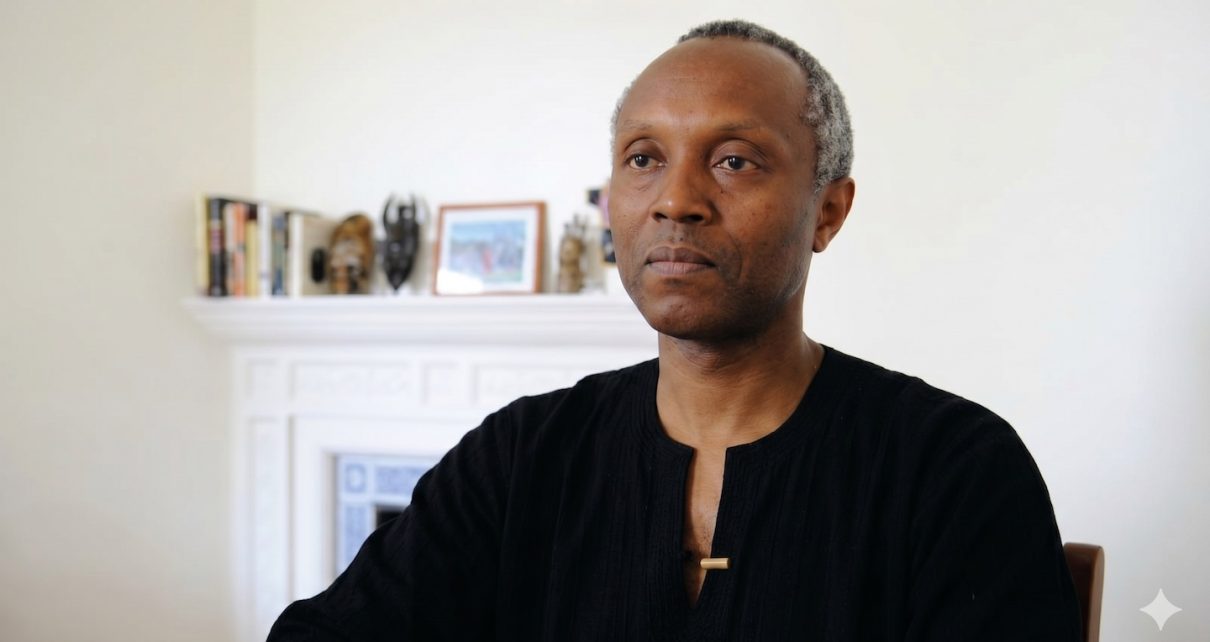
The arrest of Prof. Okey Ndibe at Murtala Mohammed Airport is only the latest act in a disturbing pattern of intimidation — one that grows more brazen as governance fails and dissent becomes the only honest accounting of power.
When Prof. Okey Ndibe, the distinguished Nigerian novelist, academic and public intellectual, stepped off a flight at Murtala Mohammed International Airport in Lagos, he was not carrying contraband. He was not a fugitive from justice. He was a man coming home on family business, as any citizen of the Federal Republic of Nigeria has a right to do. The officials of the State Security Service who detained him on arrival had no charge ready, no warrant, and seemingly no reason beyond waiting — in their own words — for “orders from above.”
That phrase, “orders from above,” is one of the most chilling in the lexicon of authoritarian governance. It is the language of the midnight knock, the disappeared journalist, the writer shackled by bureaucratic caprice. In the Nigeria of 2026, under President Bola Tinubu, it is also, astonishingly, beginning to feel routine.
I.A Pattern, Not an Incident
This is not Ndibe’s first encounter with the machinery of state repression at an airport. Since 2008, his name has been on a DSS watchlist originally compiled by the late President Umaru Yar’Adua’s administration, which declared him an “enemy of the state” for columns critical of government. Since then, the list has outlasted Yar’Adua, Goodluck Jonathan, Muhammadu Buhari — and apparently now survives into the Tinubu era. He was arrested and interrogated for several hours in January 2011, again on at least four further occasions over the following years, and as recently as January 2022 was detained at Lagos airport when DSS officers stopped him from boarding his return flight to the United States. Each time, the service apologised. Each time, nothing changed.
The persistence of Ndibe’s name on a secret government watchlist across six presidencies is, in itself, an indictment of the impunity that has hardened into institutional culture. That the list was created under one administration and weaponised by every subsequent one is not merely a bureaucratic failure — it is evidence of a state that has never truly been reconciled with the idea of a free press.
“Security agencies now conveniently snatch and detain journalists in Nigeria, under President Tinubu’s watch.”
— Political analyst, quoted by The Government & Business Journal, August 2024II.The Numbers Do Not Lie
The arrest of Ndibe is far from isolated. Since President Tinubu assumed office on May 29, 2023, the documented evidence is staggering. The Committee to Protect Journalists (CPJ), in a report released to mark the president’s three years in office, confirmed that at least 91 journalists had been arrested, assaulted, or harassed since his inauguration — a figure the Tinubu administration attempted to dispute and which the CPJ emphatically reaffirmed. The Centre for Journalism Innovation and Development (CJID) Press Attack Tracker recorded 110 verified attacks in 2024 alone, a figure that had already surpassed the total for all of 2023 by the third quarter of that year.
In August 2024, at least 56 journalists were assaulted or arrested in a single month while covering the #EndBadGovernance protests. Media Rights Agenda documented 141 attacks on journalists and citizens for online speech in the first two years of the Tinubu administration. Nigeria’s ranking in the Reporters Without Borders World Press Freedom Index fell 10 places to 122nd in the 2025 edition. And in August 2025, authorities orchestrated the removal of 59 million pieces of content and the shutdown of 13.5 million accounts across TikTok, Facebook, Instagram, X, Google, and Microsoft.
| Metric | Figure |
|---|---|
| Journalists arrested, assaulted or harassed since May 2023 (CPJ) | 91+ |
| Verified press attacks in 2024 (CJID Press Attack Tracker) | 110 |
| Journalists attacked during August 2024 #EndBadGovernance protests | 56 |
| Total attacks on journalists & citizens for online speech, Years 1–2 (Media Rights Agenda) | 141 |
| Nigeria’s 2025 World Press Freedom Index ranking (RSF) | 122nd |
| Drop in RSF ranking from previous year | 10 places |
| Content items removed from social platforms, August 2025 | 59 million |
| Social media accounts shut down, August 2025 | 13.5 million |
| Times Prof. Okey Ndibe detained by security services over 15+ years | 6+ |
III.The Weapon of Choice: The Cybercrimes Act
The amended Cybercrimes Act of 2024, signed into law by President Tinubu, has become what civil society organisations and press freedom groups now call the regime’s primary instrument of media suppression. Section 24, on so-called “cyberstalking,” is the provision deployed most aggressively. Its language is deliberately vague and dangerously open to abuse, and has created, in the words of SERAP and the Nigerian Guild of Editors, “a chilling environment for freedom of expression.”
The documented cases make grim reading. In May 2024, police detained Daniel Ojukwu, a journalist with the Foundation for Investigative Journalism, over a story exposing procurement fraud involving a government official. He was held for ten days without charge. That same month, staff of the International Centre for Investigative Reporting were arrested for alleged cybercrime. TikTok creator Olumide Ogunsanwo was detained hours after posting a video criticising President Tinubu, Lagos Governor Babajide Sanwo-Olu, and the Inspector General of Police. In September 2025, Sahara Reporters publisher Omoyele Sowore — who has been arrested at least eight times since 2017 — was charged under the Cybercrimes Act for anti-Tinubu social media posts and spent a month in prison. In November 2025, Innocent Onukwume was arrested in Port Harcourt on six charges for tweets calling for military overthrow.
Even a National Youth Service Corps member, Ushie Uguamaye, was not spared: in March 2025, her service certificate was withheld and her service extended by two months after she declined to delete a TikTok criticising the president’s economic policies.
“The most prominent cases of arbitrary arrest of journalists since the onboarding of the Tinubu Presidency have affected reporters who put the spotlight on issues of the use of public resources.”
— Centre for Democracy and Development (CDD), West Africa, July 2024IV.The Elephant in the Room: Governance Failure
Let us speak plainly about what is happening. When governments perform well, they do not need to silence critics. When roads are passable, hospitals are staffed, children can afford to eat, and the lights come on with predictable regularity, the press becomes, at worst, an irritant. It is only when governance fails comprehensively that criticism becomes existential for those in power, and the apparatus of state is deployed not against criminals but against those who document the criminal failure of public office.
The numbers here are equally damning. When Tinubu assumed office in May 2023, he immediately removed the petrol subsidy and deregulated the foreign exchange market. The initial shock was brutal: inflation, which stood at 22.41 per cent at his inauguration, climbed to a peak of 34.8 per cent by December 2024. Food prices surged. Transport costs multiplied. The cost-of-living crisis that followed was one of the most acute Nigeria has experienced in decades. Though inflation has since moderated to 15.69 per cent as of April 2026, food inflation remains at 16.06 per cent year-on-year, and prices of staple goods remain far above their pre-2023 levels in most households.
Tinubu’s approval rating, measured three years into his tenure, has fallen to 30.2 per cent, with nearly half of Nigerians — 47.5 per cent — expressing active disapproval of his performance. Critics note that the subsidy removal generated potential savings of over ₦11 trillion between May 2023 and December 2025, yet these have not translated into visible improvements in public infrastructure, healthcare, education or welfare for ordinary Nigerians. Security remains a compounding crisis: kidnapping, banditry, terrorism and communal violence have continued despite repeated assurances from security agencies.
It is in this context — a context of real and visible governance failure, of a population under acute economic stress — that the arrests must be read. When citizens and journalists report that reality, they are not agitating for revolution. They are doing the basic work of democratic accountability. The response of the security apparatus tells us something important: that the state knows it is failing, and has chosen to punish those who say so.
V.The Irony of Tinubu
No analysis of this crisis can avoid the deepest irony of all: that its central actor is Bola Tinubu himself.
Tinubu was not always the man with the watchlists. He was, once, the man who understood exactly what it felt like to be on one. As a pro-democracy activist during the military years, he risked his liberty and his life to resist the very culture of state terror he now presides over. When he became Lagos Governor in 1999, one of his first acts — within days of his inauguration on May 31 of that year — was to rename the Ibrahim Sani Abacha Press Centre at the Alausa Secretariat in Ikeja. He renamed it the Bagauda Kaltho Press Centre, in honour of James Bagauda Kaltho, the News Magazine correspondent who disappeared in February 1996 and was killed by the Abacha junta for journalism that threatened power.
That act was not merely symbolic. It was a statement of principle — a declaration that a free press was not a threat to legitimate government but a pillar of it. In June 2025, Tinubu went further still, conferring a posthumous Officer of the Order of the Niger on Kaltho, which Kaltho’s widow Martha described as a final vindication of her husband’s legacy — “a powerful reminder that the sacrifices of those who speak truth to power are never forgotten.”
Between those two gestures — the 1999 renaming and the 2025 national honour — lies a career that once knew the value of the press. Between them also lies the Tinubu presidency, under which, according to the CPJ, at least 91 journalists have been arrested, assaulted, or harassed in three years.
“To friends and relatives concerned about news that security agents at Lagos airport tried to stop me from travelling out to US base: I’m now at Heathrow and fine. Fear is a choice; I’ve chosen NOT to fear.”
— Prof. Okey Ndibe, tweet following his 2022 DSS detentionVI.What Must Be Done
The detention of Prof. Okey Ndibe must not be allowed to pass with the usual cycle: arrest, outcry, apology, repeat. That cycle has played out now across multiple presidencies, and it serves one function — to maintain the chilling effect on critical speech while preserving plausible deniability.
There must be an immediate and unconditional release of Ndibe, and a formal, public explanation of the grounds on which he was detained. The secret watchlist on which his name has apparently sat since 2008 must be publicly acknowledged, reviewed, and dissolved. No writer, journalist, or public intellectual should be subject to indefinite surveillance and airport detention for the content of their speech.
More broadly, the weaponisation of the Cybercrimes Act against journalists and critics must end. SERAP and the Nigerian Guild of Editors are right to demand that Section 24 be repealed or fundamentally amended. The CPJ, Reporters Without Borders, and the Committee for the Defence of Democracy have all documented a pattern that is now undeniable. The international community has noticed. Nigeria’s descent to 122nd on the World Press Freedom Index is not an abstraction — it is a reputational cost with real consequences for investment, diplomacy, and the country’s standing among democracies.
And finally, the president himself must speak. Not through spokespeople. Not through press releases. Bola Tinubu, who named a press centre after a journalist murdered by a military dictator, owes the Nigerian press and the Nigerian people an explanation of how his administration has arrived at a place where 91 journalists have been harassed or arrested in three years — and where a distinguished professor and novelist cannot land at his own airport without being held for “orders from above.”
The country Tinubu grew up fighting for deserved better than that. It still does.
- Okey Ndibe has since been released.


