
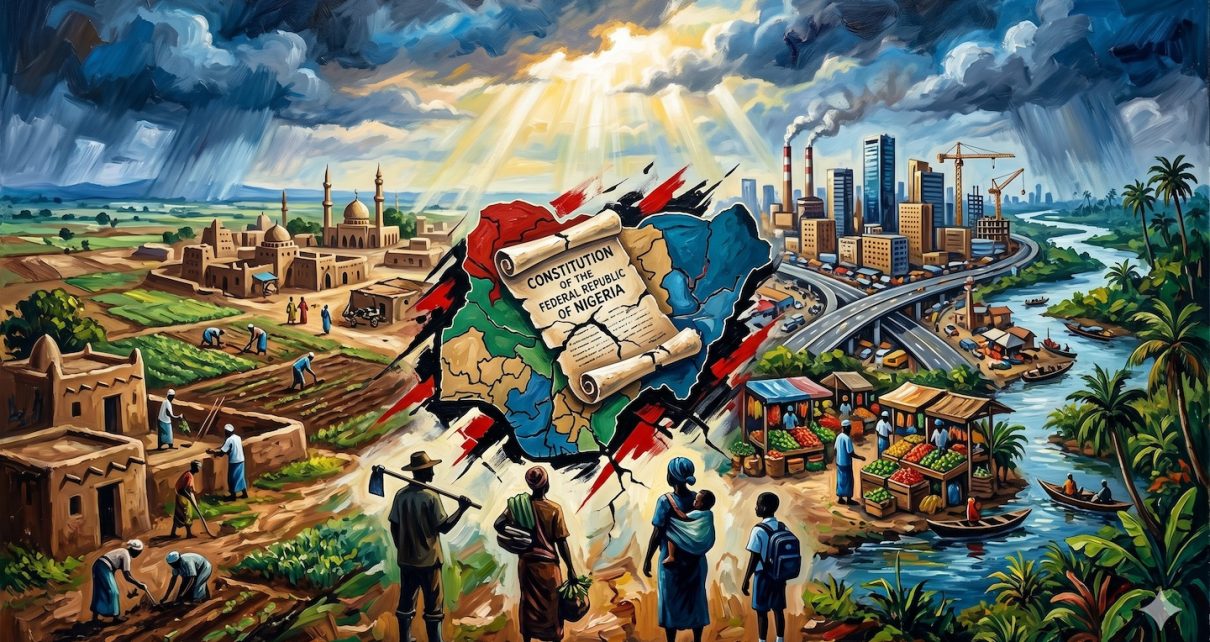

We are on the march again—27 years after our return to democratic governance and three years into the tenure of the Tinubu administration. Centrifugal forces are on the ascendancy. Terrorism is being exported across regional boundaries. Two sections of the nation which were famous for either republicanism or monarchy before colonialism are befuddled by the insistence of another section up north on nomadism as a way of life. Under that contrived civilisational incongruity, our worst nightmares are being played out in the open.
Blood is flowing. Villages are being depopulated. Mothers are being raped. Toddlers are being kidnapped and tortured. Abductors are demanding and receiving ransom payments with minimum decoying. Nigerian citizens are openly saying that if this is the fruit of the unitary constitution imposed by the military 27 years ago, they don’t want any part of it. They want to return to the days of regionalism when they could live in peaceful semi-autonomy without any fear of an invading force disguised as cattle-rearers. They reject the continued assault on their lives and values by terrorists plucked from the Dark Ages and scattered in the wilderness of their region.
Three Regions
Stripped of all diplomatese, the naked truth is that Nigeria has a civilisational problem. That reality was factored into the negotiations preceding independence from Britain in 1960. The result was a constitution based on a three-region format guaranteeing resource control at the regional level and contributions from the constituent parts to fund the central government.
The Premier of Northern Nigeria, Sir Ahmadu Bello, explained the rationale for allowing each region to develop at its own pace by comparing Nigeria to a compound with three separate houses (North, West, and East). All were embarking on a journey, but the West and the East rose up early and were already on their way. The North started its journey later in the day and needed to run at a terrific speed to catch up. The fair thing is to allow him to devise a means totally under his control to achieve his goal of catching up with his colleagues.
Bello sought to modernise Northern Nigeria from within its inherited political framework rather than discarding it for a Western model. He successfully shifted legislative, executive, and judicial powers from the absolute control of individual Emirs to broader regional and provincial structures. This allowed him to maintain the symbolic cultural legitimacy of the traditional institutions while building a centralised regional bureaucracy capable of competing with the South.
The regional government of the North did not depend on any federal feeding bottle to survive. Indeed, it contributed its quota to sustaining governance at the centre, proudly designing its own economic blueprint to harness its resources in such a manner as to stand tall in the comity of regions. The North, throughout the First Republic, was a major economic player, not a parasite.
Although Dr Nnamdi Azikiwe saw himself, first and foremost, as a nationalist and pan-Africanist, he conceded to superior argument when confronted with the fact that a unitary kind of government run from the centre would fuel fears of possible domination of one region by the other. Whichever region controlled the lever of government at the centre was bound to be viewed with suspicion by the others. The federal arrangement which was eventually designed for Nigeria was a compromise which allowed each region to retain its uniqueness and control its destiny while at the same time belonging to a loose federation.
As early as the 50s, Zik advocated the creation of states to cater to the fears of domination expressed by the minority ethnic groups within the regions. At the same time, he canvassed that African nations should come together to form the United States of Africa and advance the cause of the Black man. He was, first and foremost, a pan-Africanist.
However, the most philosophical among the founding fathers of modern Nigeria was the Premier of the Western Region, Chief Obafemi Awolowo. He believed that giving regions control over their internal development allowed local leaders to be held accountable by their people. Regionalism would also create healthy economic competition between sections of the country and allow enlightened leadership to uplift the citizens.
Not Yet A Nation
It used to be fashionable among his political opponents to laugh at Awolowo’s contention that “Nigeria is not a nation”. But people are not laughing at his contention anymore because the violent consequences of cosmetic political unitarism are now staring the nation in the face.
“Nigeria is not a nation,” argued Awo. “It is a mere geographical expression. There are no ‘Nigerians’ in the same sense as there are ‘English’, ‘Welsh’, or ‘French’. The word ‘Nigeria’ is merely a distinctive appellation to distinguish those who live within the boundaries of Nigeria from those who do not.”
Sir Ahmadu Bello agreed and added that it was unhelpful to pretend that there were no differences among the various ethnic nationalities in Nigeria. He advised that Nigerians should rather recognise and appreciate the diverse backgrounds, cultures, and perspectives within a community or nation so that we can foster unity, cooperation and respect among various groups.
Awolowo advocated true federalism—where strong regional governments would control their domestic affairs, resources, and local security while cooperating at a lean but effective central hub. In an address to the Western Leaders of Thought in Ibadan in 1967, he outlined the exact limits of what a regional government should control to remain stable.
He argued that (a) Revenue allocation must be handled strictly on the principle of derivation—meaning regions should keep the wealth generated within their borders after paying a tax or share to the centre for federal services; (b) Each region should have and control its own militia and police force; (c) Any union maintained by force is bound to fail in the long run; (d) Regional governments should be the designated centres of development and engines for rapid socio-economic transformation.
The Republican constitution, which guaranteed all those negotiated rights within a regional governmental structure, was toppled by the military in 1966. Since then, Nigeria has been groping in the dark. Each time the military government wanted to humour its civilian lickspittles, it arranged “constitutional conferences” at which selected members of the socio-economic and traditional elite pretend to be reinventing Nigeria.
How do you mount floodlights in search of something that is not lost?
Retrace Steps
The military murdered sleep when they jettisoned the only validly negotiated constitution Nigeria has to date. Since that time, Nigerians have been sleeping with one eye open. The 30-month civil war, perennial ethnic suspicions, political instability, ethnic militancy, religious extremism, mass poverty and terrorism in its several different manifestations can all be traced to the refusal of our political elite to do the commonsensical thing: If going forward is impossible, why not retrace your steps back?
In a deeply pluralistic nation with over 250 ethnic groups, centralised governance often intensifies friction, whereas regionalism can act as a pressure valve. That ought to be the single most important campaign point by all the Nigerian political parties as we approach 2027.
By shifting the focus of governance, resource control, and development from Abuja back to the regional capitals, the desperation to capture the centre diminishes. When regions manage their internal affairs, national politics loses its volatile, do-or-die edge, and the regions blossom, each in its unique style.
Any political party that cannot take Nigeria back to the glory days of regionalism does not deserve our votes in 2027.


