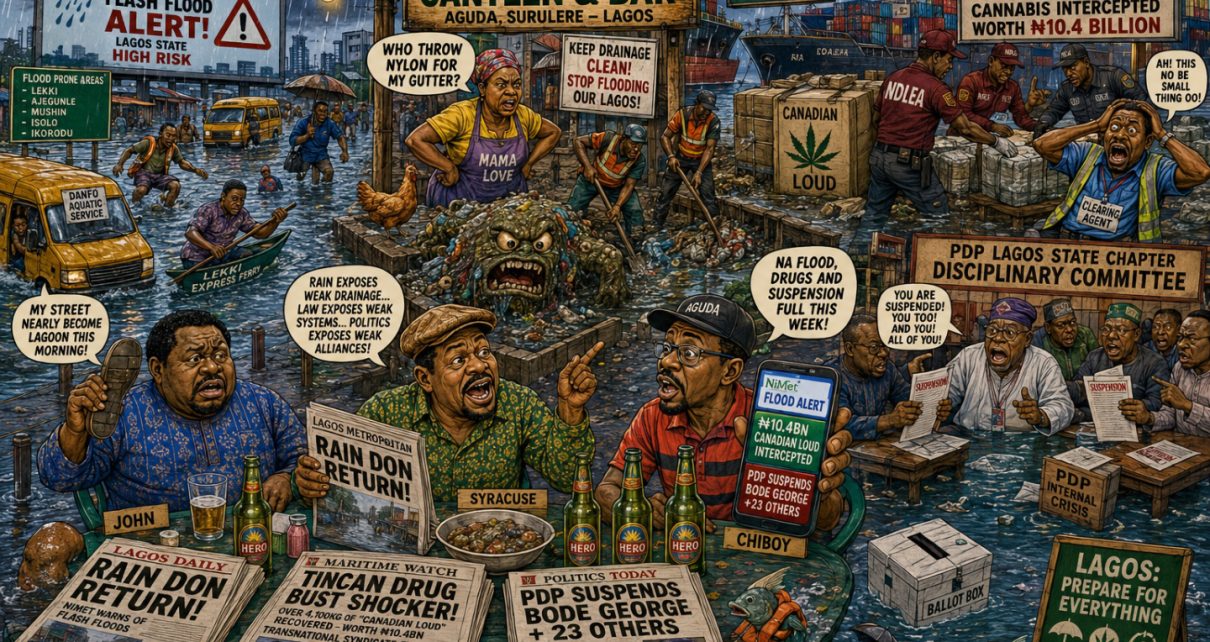
By Friday evening, Mama Love’s Canteen and Bar looked like a refugee camp for weather survivors.
All week, Lagos had been soaked.
Rain had fallen with the kind of seriousness that makes every Lagosian suddenly become amateur hydrologist.
From Lekki to Surulere, from Ajegunle to Ikoyi, residents had spent the week staring suspiciously at drainage channels, calculating whether their streets would remain roads or temporarily become tributaries of the Atlantic.
The Nigerian Meteorological Agency had already issued flood alerts.
And Lagos, to its credit, took the warning seriously.
At least until Friday.
Because by Friday evening, when the skies briefly cleared, Mama Love’s became the official post-rain rehabilitation centre for Aguda’s finest political philosophers.
Chiboy arrived first, trousers still damp.
“This rain no be ordinary rain. Na government-level rain.”
John looked exhausted.
“My street nearly collect boat service this morning.”
The beer parlour laughed knowingly.
There is no faster way to unite Lagosians than collective drainage anxiety.
I adjusted my cap.
“Urban flooding,” I announced, “is what happens when rainfall meets poor planning and blocked ambition.”
Chiboy blinked.
“Blocked ambition?”
“Yes,” I said. “Drainage and politics have similar problems. Too many obstructions.”
That was enough to begin the evening properly.
The weather had indeed dominated conversation.
NiMet’s warnings about flash floods had placed residents on alert, especially in flood-prone Mainland and Island corridors.
And for good reason.
In Lagos, heavy rain performs annual audits of urban planning.
It reveals:
- blocked drains,
- abandoned infrastructure,
- illegal constructions,
- and every resident who secretly dumped refuse into gutters during dry season.
Rain is Lagos’s most honest inspector.
John nodded solemnly.
“Rain dey expose everybody.”
Exactly.
And before the beer parlour could recover from meteorological analysis, Chiboy dropped the next bombshell.
“Una hear Tincan gist?”
Now this was serious.
The NDLEA had intercepted over 4,100 kilograms of high-potency “Canadian Loud” cannabis at Tincan Island Port—worth an estimated ₦10.4 billion.
Even by Lagos standards, that quantity deserved respect.
Criminal respect.
John nearly choked on his drink.
“₦10.4 billion? Wetin dem wan use am do? Start pharmaceutical company?”
The table exploded.
The scale of the bust had stunned everyone.
Tincan Island, already a theatre of intense maritime scrutiny, had suddenly become the centre of a transnational trafficking conversation.
For logistics operators, clearing agents, and maritime analysts, the interception signalled increasingly aggressive port oversight.
For Aguda beer-parlour economists, it raised simpler questions.
Chiboy leaned forward.
“Who fit even calculate that quantity?”
I replied calmly.
“Transnational criminal syndicates understand something many legal businesses ignore.”
The table paused.
“Systems.”
Even criminal networks rely on:
- coordination,
- logistics,
- supply chain discipline,
- financial planning.
That was the uncomfortable truth.
The same efficiency Nigeria struggles to institutionalise often appears effortlessly in illicit operations.
John sighed.
“Bad people always too organised.”
A disturbingly accurate observation.
Then came politics.
And once Lagos politics enters a Friday evening, no topic survives untouched.
The Lagos PDP had entered yet another dramatic internal conflict.
A factional disciplinary committee had announced the suspension of Chief Olabode George and 23 other prominent members over alleged anti-party activities.
That announcement had sent political observers into familiar Lagos confusion.
Chiboy laughed immediately.
“PDP no dey suspend people. Dem dey suspend themselves.”
The beer parlour nearly collapsed.
John added quickly:
“Every month, fresh suspension package.”
Again, painful accuracy.
The PDP’s Lagos chapter has spent so much time reorganising itself that many observers now regard internal conflict as part of its operational model.
I leaned forward.
“The significance,” I explained, “is structural.”
This was not merely disciplinary drama.
It represented a direct challenge to long-established power arrangements on the Mainland.
And in Lagos politics, structure is everything.
When long-standing centres of influence become contested, it signals deeper realignment.
John frowned thoughtfully.
“So na internal flood?”
That line deserved immediate preservation.
“Yes,” I said. “Political flooding.”
Because just like rainfall, internal political pressure reveals weak foundations.
Chiboy grinned mischievously.
“This week everybody collect warning:
Lagos from rain.
Drug people from NDLEA.
PDP people from suspension letter.”
And perhaps he was right.
The week had become one long cautionary tale.
Nature was warning the careless.
Security agencies were warning traffickers.
Party factions were warning rivals.
Everywhere one looked, systems were testing limits.
Then Mama Love interrupted dramatically.
“Speaking of warning… who block my drainage with pepper soup nylon?”
Silence.
Collective guilt descended.
The beer parlour instantly looked less philosophical.
There, beside the canteen, sat a struggling drainage channel carrying enough debris to qualify for federal intervention.
Chiboy pointed immediately.
“Mama Love, no blame customers. Your gutter need environmental committee.”
The table erupted.
Even Mama Love laughed reluctantly.
As always, satire had accidentally exposed local hypocrisy.
Everybody wants cleaner Lagos.
Everybody condemns environmental indiscipline.
Yet somehow, every clogged gutter belongs to “someone else.”
John shook his head.
“Na funny city. We dey debate flood while sitting beside flood source.”
That was Lagos in one sentence.
As the evening ended, light drizzle began again.
The entire beer parlour looked upward suspiciously.
Nobody trusted the sky anymore.
I adjusted my cap and gave the final reflection.
“In Lagos,” I said, “rain exposes weak drainage, law exposes weak systems, and politics exposes weak alliances.”
Then I glanced at Mama Love’s gutter bubbling quietly.
“And if we refuse to fix what is local,” I added, “we will keep drowning in what is national.”
Na so we see am.


