
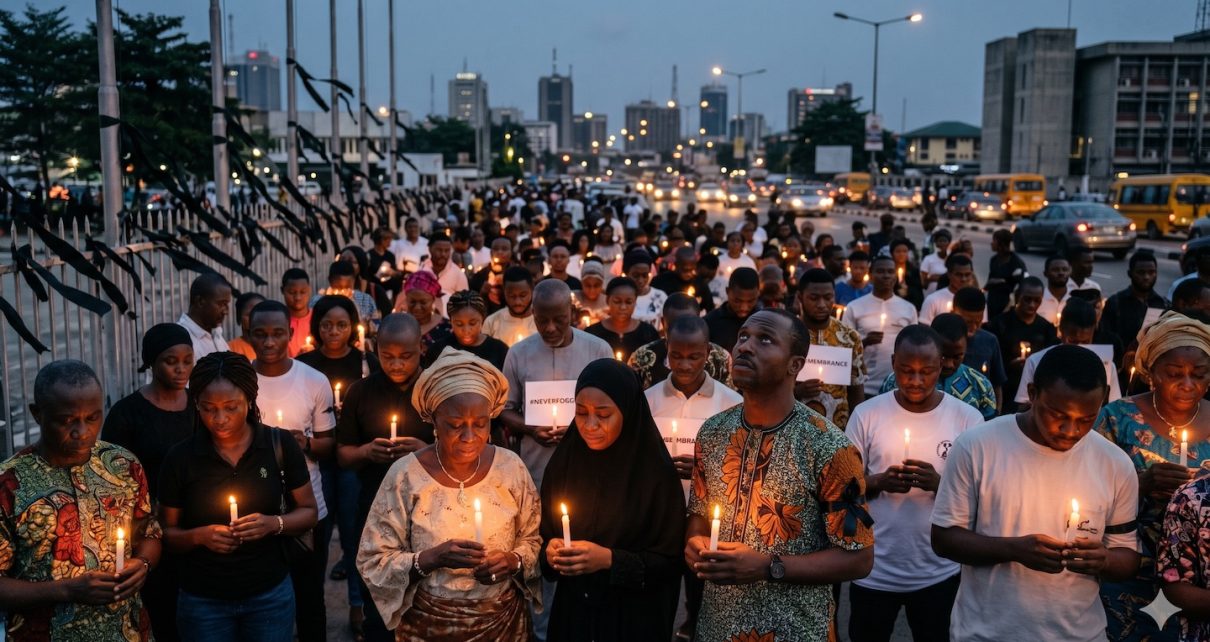
By Nkanu Egbe
Three years ago today, Bola Ahmed Tinubu stood at Eagle Square in Abuja and made Nigerians a promise. “Security shall be the top priority of our administration,” he declared at his inauguration, “because neither prosperity nor justice can prevail amidst insecurity and violence.” On that same date — May 29, 2023 — the calendar of grief was already running. Today, as the nation marks his third year in office, more than ninety civil society organisations have gathered not to celebrate, but to mourn: releasing a damning joint statement that calls the promise broken, the social contract shattered, and the death toll a national disgrace.
The 9th National Day of Mourning, observed annually on May 28, is a citizen-led initiative born from the conviction that behind every security statistic is a human life — a farmer who never returned from his field, a student snatched from a classroom, a soldier ambushed on a forest road. It was conceived as a ritual of remembrance and a demand for accountability. Nine years on, its continued necessity is itself an indictment.
This year’s theme — “Nigerian Lives Matter” — is simultaneously a protest slogan and a provocation: a direct challenge to a political culture in which mass death has become, in the words of the statement’s signatories, something Nigerians are expected to normalise.
The Weight of the Numbers
The figures cited in the joint statement, sourced from massatrocities.org, are not statistics easily set aside. Since President Tinubu assumed office in May 2023, at least 19,980 people have been killed and at least 12,362 abducted. A further 1,486 security personnel have been killed in active duty — men and women sent to stem a tide their commanders have struggled to turn.
These figures are corroborated by independent data. In 2025 alone, banditry accounted for 599 incidents and 2,724 deaths, while kidnapping reached 3,141 victims — one of the highest figures in recent years. Between January and April 2026, at least 1,100 people were kidnapped across northern Nigeria. A report by Lagos-based SBM Intelligence found that 2,938 people were kidnapped in the Northwest region between July 2024 and June 2025, over sixty percent of reported incidents nationwide. Zamfara recorded the highest toll at 1,203 abductions, followed by Kaduna, Katsina, and Sokoto.
The statement also highlights 865 students abducted from schools since 2023 — compounding Nigeria’s status as the country with the largest number of out-of-school children in the world.
“Behind every statistic is a human being whose life mattered, whose dreams were cut short, whose fundamental human rights were denied, and whose family deserves justice.”— Joint Press Statement, 9th National Day of Mourning
A Pattern Written in Grief
What makes this crisis analytically distinct from mere governance failure is the remarkable consistency of the state’s response — or more precisely, its non-response. A pattern has crystallised with almost mechanical regularity: a mass killing occurs; the presidency issues a condemnation; agencies are instructed to “intensify efforts”; perpetrators are declared to be “facing justice”; the story fades; the cycle repeats. After the Palm Sunday massacre at Angwan Rukuba and the Kaduna wedding abductions in March 2026, the familiar script played out once more. Before Tinubu, President Buhari spent eight years issuing similar assurances about the Chibok girls and the Kuje Prison bombers — with equally little to show for them.
By the close of 2025, the marginal gains the administration cited — arrests, forest guard deployments, terrorist classifications — were overshadowed by trends it could not reverse. Security gains in Nigeria have proven fragile, reversible, and too easily eclipsed by a single mass kidnapping.
The civil society statement raises a question that deserves more scrutiny: if the Nigerian state possesses the surveillance and intelligence capabilities it routinely claims, why do kidnapping and ransom networks continue to operate openly? The absence of a credible answer is, itself, an answer of sorts.
When Children’s Day Is Not Cause for Celebration
The timing of this year’s Day of Mourning acquires particular poignancy alongside the previous day’s calendar. May 27 is Children’s Day — ordinarily observed with school parades and family celebrations. In 2026, it arrived alongside reports of the abduction of schoolchildren and teachers in Oyo State — a southwestern state, far from the traditionally high-risk northern zones — leaving a nation that had watched the crisis from a perceived distance now confronted with its proximity.
The Oyo abductions illustrate a pattern the civil society statement warns about: insecurity is no longer geographically quarantined. It is metastasising southward. For Lagosians who have watched this crisis as something happening elsewhere, the distance is closing.
The International Lens
An estimated 30,000 armed Fulani militants are now operating across Nigeria in organised groups, according to a May 2026 report from the United States Commission on International Religious Freedom. The US Congress introduced the Nigeria Religious Freedom and Accountability Act of 2026 in February, proposing targeted sanctions. Amnesty International has warned that the scale and persistence of attacks constitutes a breach of Nigeria’s constitutional and international human rights obligations — noting that security forces often arrive hours after attackers have departed, with no meaningful accountability for repeated failures.
The international pressure yielded some government action: in December 2025, President Tinubu formally classified kidnappers and violent armed groups as terrorists. But as critics note, the designation has yet to translate into the decisive disruption of kidnapping economies the law would theoretically enable.
Politics, Power, and the Price of Distraction
The most politically charged passage in today’s joint statement is also its most direct. “Nigeria’s political class,” the signatories write, “is obsessed with their tussle for power and hyper-focused on permutations for the 2027 elections.” Even as casualty figures mounted through early 2026, political conversations in Abuja pivoted toward re-election strategy and the choreography of alliances. The statement’s blunt rejoinder — “corpses do not vote” — is a reminder that political capital cannot be built on communities that have been erased.
Vice President Shettima, speaking at the 2026 National Police Day in April, told Nigerians that “Nigeria shall prevail.” The language was aspirational. But for families who have buried children and hundreds of thousands of internally displaced persons, aspiration without accountability has grown very thin.
“Nigeria cannot continue to gather annually to mourn the dead while failing daily to protect the living.”— Joint Press Statement, signed by over 90 civil society organisations
What the Coalition Is Demanding
The joint statement is not simply an indictment — it is a structured policy demand. The ninety-plus signatories call on the Federal Government to fulfil its constitutional obligation under Section 14(2)(b) of the 1999 Constitution, which designates the security and welfare of citizens as government’s primary purpose. They demand prosecution of perpetrators and accountability for security force abuses; improved intelligence and early warning mechanisms; disruption of ransom financial networks; strengthened protection for schools, farming communities, women, and children; and humanitarian and psychosocial support for survivors and displaced communities.
Among the signatories are Amnesty International Nigeria, BudgIT, Enough Is Enough, Yiaga Africa, the CLEEN Foundation, SERAP, Media Rights Agenda, Global Rights, and the Kukah Centre, alongside dozens of community organisations from Jigawa to the Niger Delta. This is not a fringe coalition. It represents the organised conscience of Nigerian civil society.
The Question That Will Not Wait
There is a question at the centre of this analysis with no comfortable answer: at what point does the National Day of Mourning stop being evidence of civic vitality and become evidence of institutional failure so entrenched that grief has become the most reliable Nigerian tradition? Nine iterations. Nine years of gathering, remembering, and demanding. The death tolls have not declined. The patterns have not broken. The impunity has not ended.
The statement’s closing sentiment captures something data alone cannot: “We refuse to become desensitised to preventable killings. We insist that Nigerian lives matter and demand justice.” That refusal is the last line of defence against a political culture that depends on the normalisation of mass death.
Whether the government will respond to today’s demands with the same urgency it brings to election logistics remains the central question of Nigeria’s security crisis — and of its democratic credibility. The dead cannot wait. And, as the signatories note, neither can the living.


