
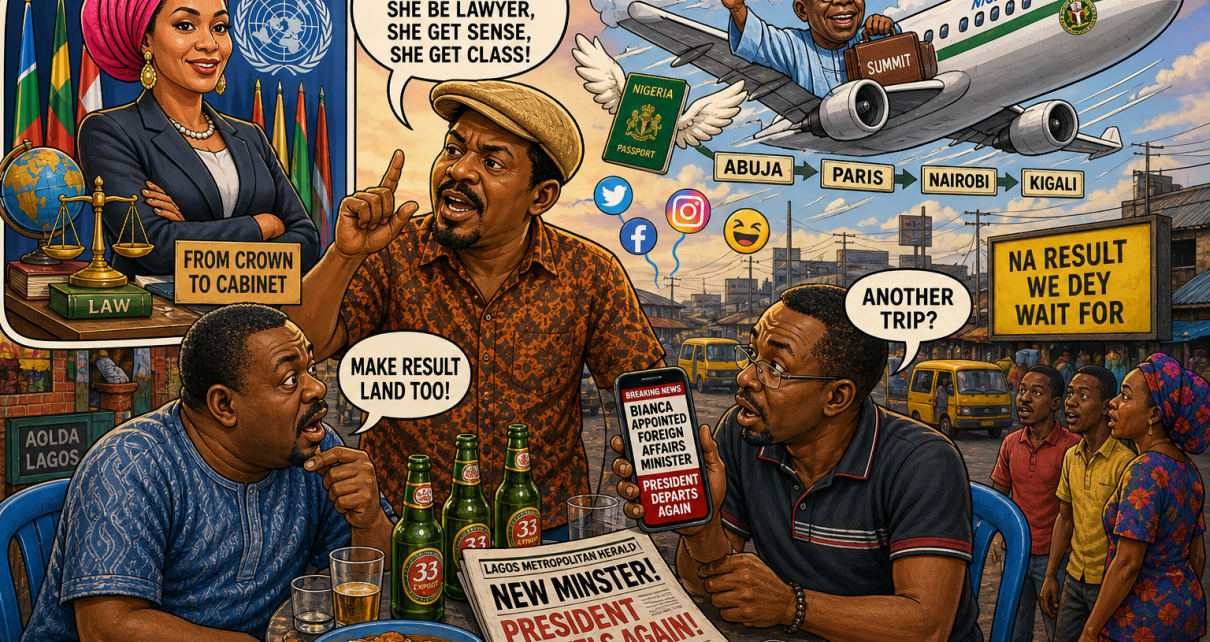

There are weeks when Lagos debates things it barely understands—but debates them with full authority anyway.
This was one of those weeks.
By the time the news reached Aguda, it had already been interpreted, misinterpreted, and fully analysed by people with no access to briefing notes.
Two issues stood out.
First, the appointment of Bianca Odumegwu-Ojukwu as Minister of Foreign Affairs.
Second, the President’s departure—again—on another international trip.
In Lagos, those two topics were enough to sustain a full evening.
Chiboy arrived shaking his head.
“Syracuse, na true? Dem make Bianca Foreign Affairs Minister?”
John looked up immediately.
“That Bianca? Former beauty queen?”
I adjusted my cap before responding.
“Yes,” I said. “The same Bianca. Former beauty queen, yes—but also a trained lawyer, diplomat, and experienced public figure.”
Chiboy raised his hands.
“Ah! Nigeria no dey dull. From pageant to passport.”
The table laughed.
But Lagos has a habit of reducing complex people to their most visible identity.
Bianca Odumegwu-Ojukwu is often remembered for her pageantry and her marriage to Chief Emeka Odumegwu Ojukwu—a central figure in Nigeria’s civil war history.
What is less discussed is her professional evolution.
She is a lawyer. She has served in diplomatic roles. She understands international engagement more than many casual commentators assume.
John leaned forward.
“So you mean say this no be just ‘fine face appointment’?”
I shook my head.
“No. It is symbolic—and strategic.”
Symbolic, because her name carries historical weight, especially in the South-East. It signals inclusion, reconciliation, and recognition of legacy.
Strategic, because foreign affairs requires both intelligence and presence. Diplomacy is not just about policy—it is also about perception.
Chiboy was not entirely convinced.
“But foreign affairs no be small office. Na serious work—negotiation, policy, international wahala.”
“Exactly,” I replied. “Which is why experience matters—and she has more than people realise.”
John nodded slowly.
“Nigeria like to surprise people sha.”
Indeed.
Appointments in Nigeria often come wrapped in assumptions. Sometimes those assumptions are wrong.
Before the conversation could settle, the second issue arrived—like Lagos traffic, impossible to ignore.
The President was travelling again.
France. Kenya. Rwanda.
Purpose: diplomatic engagement and the Africa-France Summit.
Chiboy did not wait.
“Another trip? President don turn frequent flyer.”
The table laughed loudly.
John added:
“This time, na which country go solve our problem?”
There is something uniquely Nigerian about how we view presidential travel. It is either seen as essential diplomacy—or unnecessary movement.
Rarely is it viewed neutrally.
I intervened.
“International relations require presence,” I said. “You cannot conduct diplomacy entirely from Abuja.”
Chiboy rolled his eyes.
“But how many trips we need before light go stay?”
A fair question—though not entirely related.
That is the Lagos method of analysis: connect everything to electricity.
John leaned forward.
“Make we balance am. Trip no bad. But people want to see result. Something tangible.”
That is the key.
Travel is not the problem.
Perceived outcome is.
If citizens do not see the connection between international engagement and domestic improvement, the trips begin to feel like distance—rather than progress.
Chiboy pressed further.
“So after France, Kenya, Rwanda… wetin we dey expect? Better economy? More investment?”
“Yes,” I replied. “That is the objective.”
Diplomatic visits often aim to secure partnerships, investments, and cooperation.
But those outcomes are rarely immediate.
And Lagos, as a city, has little patience for delayed benefits.
The beer parlour settled into that familiar rhythm—half serious, half amused.
On one hand, a new Foreign Affairs Minister whose identity sparked curiosity and debate.
On the other, a President moving across continents in pursuit of international engagement.
Two different stories.
One common question:
How does this affect the ordinary Nigerian?
John summarised it simply.
“Big appointment, big travel… but make small result reach ground.”
Exactly.
Policy operates at one level.
Perception operates at another.
And in Lagos, perception is everything.
As we prepared to leave, Chiboy delivered one last line.
“If Bianca perform well, nobody go remember beauty queen. If she no perform… na that one dem go remember.”
That is the burden of public office.
Identity may open the door.
Performance determines whether you stay inside.
I adjusted my cap and gave the final word.
“Leadership,” I said, “is not about where you come from or where you travel to. It is about what changes because you were there.”
Because in the end, Nigerians are not tracking titles or itineraries.
They are watching outcomes.
Na so we see am.


