By Joy Essien
In Lagos, nothing simply “arrives.” Every product you touch—from a bottle of water to a smartphone—has travelled through a dense web of decisions, delays, detours, and efficiencies before reaching you. Beneath the surface of everyday commerce lies a living system: fast-moving, unpredictable, and constantly adapting.
To understand Lagos is to understand its supply chains. They are the invisible engines of trade, quietly powering markets, startups, and multinational operations alike. For beginners, this is not just a technical concept—it is a lens into how the city works, survives, and thrives.
What A Supply Chain Really Means
At its core, a supply chain is the entire network of entities, people, information, and resources involved in moving a product or service from its origin to the final customer.
Think of it as the “behind-the-scenes” journey of everything you buy. It is not just about transportation; it is a sequence of specialised steps that add value at every stage.
The Core Stages Of A Supply Chain
While every industry differs, most supply chains follow this fundamental flow:
Sourcing Raw Materials: Gathering the basic components (e.g., leather for shoes, cocoa for chocolate, or code for software).
Manufacturing: Processing those raw materials into a finished product.
Logistics & Warehousing: Storing finished goods and managing transport across regions.
Distribution: Delivering products to retailers, wholesalers, or directly to consumers via e-commerce.
The Consumer: The final destination where the product is used.
Why Supply Chain Management (SCM) Matters
Effective management of this chain often separates profitable businesses from failing ones. It focuses on three key goals:
1. Cost Reduction
By streamlining movement, companies reduce waste and “dead time.” For example, Just-in-Time (JIT) manufacturing ensures materials arrive exactly when needed, lowering storage costs.
2. Speed To Market
In competitive markets, speed is an advantage. SCM helps identify bottlenecks—such as port delays or component shortages—before they disrupt production.
3. Quality Control
A supply chain is only as strong as its weakest link. SCM ensures suppliers meet consistent standards, protecting the final brand.
The Lagos Terrain For SMEs
The Lagos supply chain is a study in adaptive resilience. As Nigeria’s primary commercial gateway, it is both sophisticated and constantly challenged by structural bottlenecks.
1. The Gateway: Port Dynamics
Lagos hosts the nation’s most critical ports, and the system has recently undergone a structural shift.
Lekki Deep Sea Port: Now the dominant player, handling over 40% of Nigeria’s cargo throughput. It is highly automated and designed for larger vessels, improving turnaround times.
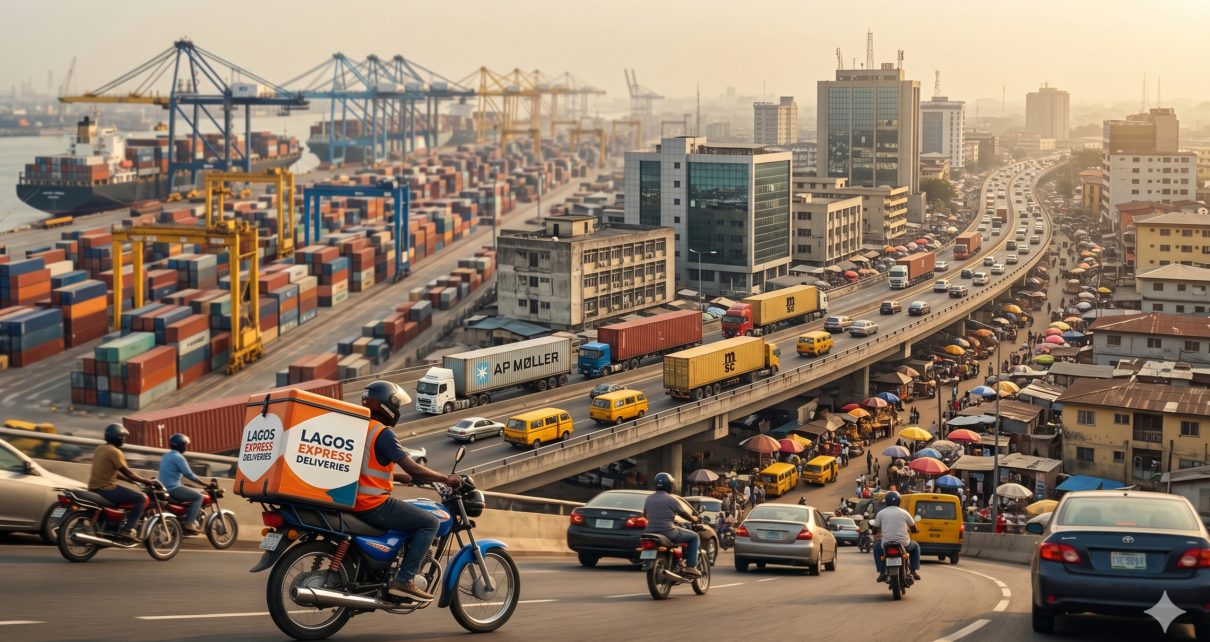
The Congestion Paradox: While port operations have improved, landward evacuation remains a challenge. Limited rail connectivity means heavy reliance on road haulage, leading to localised congestion near port zones.
2. The Last-Mile Challenge
In Lagos, the final leg of delivery is often the most expensive and complex.
The Traffic Tax: Logistics firms account for delays caused by congestion. Many now use decentralised warehousing in hubs like Yaba, Ikeja, and Lekki.
Motorcycle Logistics: Dispatch riders dominate last-mile delivery, navigating traffic to enable same-day service even during peak congestion.
3. Digitisation As A Necessity
With physical movement unpredictable, digital tools are essential.
Real-Time Visibility: GPS tracking and automated address systems reduce delivery failures.
Fintech Integration: Mobile payments and logistics wallets are replacing cash-on-delivery for faster settlements.
4. SME And E-Commerce Growth
Supply chains are no longer limited to large manufacturers.
SME Hubs: Lagos serves as the primary inbound hub for cross-border e-commerce, redistributing goods nationwide.
Informal Networks: Traditional markets like Alaba and Idumota remain highly efficient, though less digitally tracked.
What Every Lagos SME Should Note
For startups, the supply chain is not static—it is a dynamic system requiring constant adjustment.
1. The Hidden Costs Of Moving Goods
Transport costs go beyond fuel and maintenance.
Informal Levies: Unofficial fees may arise at various transit points.
The Traffic Tax: Delivery times vary widely depending on time of day. Businesses must plan for worst-case scenarios.
2. Infrastructure As A Competitive Advantage
Location decisions shape supply chain efficiency.
Proximity To Gateways: Businesses near Lekki Port and the Free Trade Zone benefit from faster access to imports.
Decentralisation Strategy: Micro-fulfilment centres across multiple locations reduce reliance on congested routes.
3. Reliability Over Sophistication
A simple system that works locally is better than a complex one that fails.
Dispatch Rider Reality: Many startups rely on third-party logistics, but maintain small in-house fleets for critical deliveries.
Power And Cold Chain: For perishables, energy costs for preservation can rival transportation costs.
4. Digital Trust And Visibility
Transparency builds customer confidence.
Real-Time Tracking: Tracking links reduce uncertainty and improve customer experience.
Inventory Accuracy: Synchronising digital and physical stock is essential to avoid failed orders.
A City’s Circulatory System
In 2026, Lagos supply chains resemble a circulatory system—high-pressure, complex, but remarkably efficient when managed correctly.
1. The Multimodal Shift (Beyond The Road)
The future is no longer road-only.
Rail Systems: The Blue and Red Lines are enabling movement of light freight across the city.
Water Transport 2.0: Barges and ferries are emerging as viable alternatives, reducing pressure on road networks.
2. The Lekki–Apapa Power Balance
The centre of gravity has shifted.
Lekki Deep Sea Port: A tech-driven entry point favouring modern, data-driven businesses.
Lagos Free Zone: A major hub for FMCG and pharmaceuticals, offering infrastructure and incentives for scaling businesses.
3. The Rise Of Logistics-As-A-Service (LaaS)
Ownership is no longer essential.
Hyper-Local Warehousing: “Dark stores” enable rapid delivery across multiple city zones.
AI-Powered Routing: Predictive systems help businesses avoid congestion and optimise delivery times.
Key Takeaways
Regulatory Ease: Lagos ranks highly for ease of doing business due to digital reforms.
Resilience Over Perfection: Success depends on building systems that can absorb disruption.
Sustainability: There is a growing shift toward CNG and electric delivery fleets.
Final Thoughts
Supply chains today are no longer linear—they are dynamic, data-driven networks.
In Lagos, they reflect the city itself: resilient, creative, and constantly evolving. For businesses, understanding this system is not optional—it is essential.
The Wildcard For 2026: The Rail Factor
The Lagos Blue and Red Lines, alongside expanding cargo rail links, are beginning to reshape logistics.
Startups that integrate rail for the “middle mile”—moving goods between major hubs—may significantly reduce costs and outperform competitors still dependent on congested road corridors.
In Lagos, the future of supply chains will belong to those who can move not just goods—but intelligently.


