
By Joy Essien
Lagos does not run only on glass towers, formal boardrooms, or billion-naira corporate balance sheets.
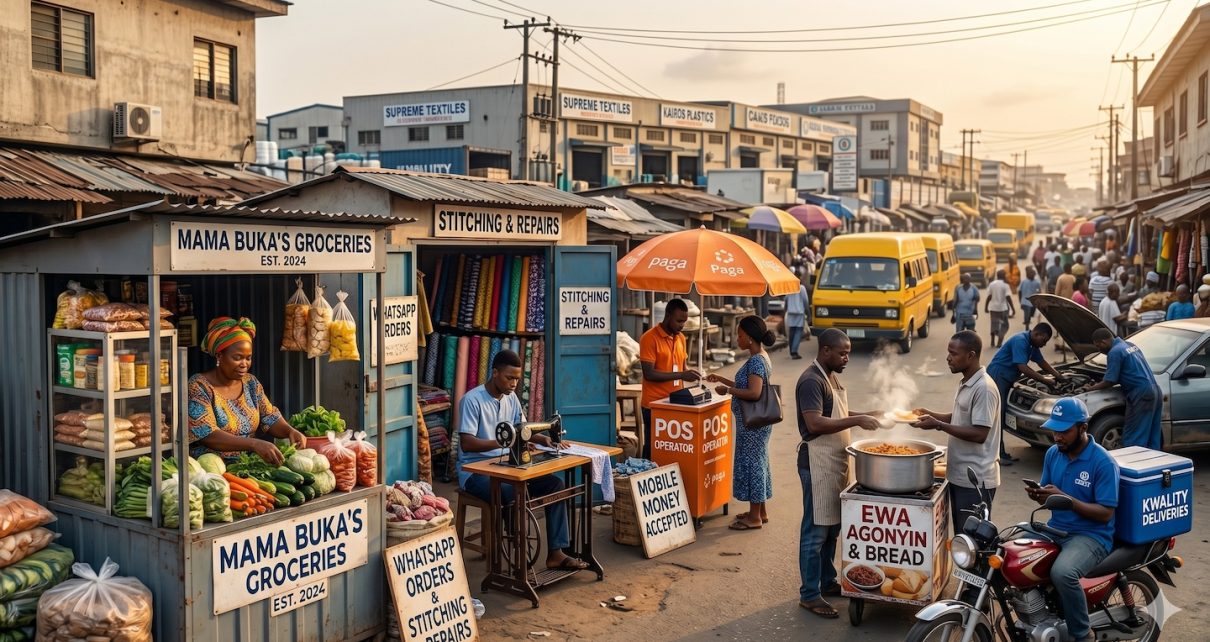
It runs on the woman who opens her kiosk before sunrise. It runs on the tailor taking measurements in a cramped corner shop. It runs on the mechanic under a danfo bus, the food vendor serving late-night commuters, the WhatsApp retailer coordinating bulk food orders, and the countless small operators whose businesses may never appear in official annual reports but whose daily hustle keeps the city alive.
This is the invisible architecture of Lagos.
The informal economy is the true engine room of the state’s commerce, accounting for an estimated 65 to 70 per cent of total jobs in the metropolitan area and contributing massive transaction volumes to the state’s economic output.
According to recent data from Moniepoint’s Informal Economy Report, Lagos State alone holds a commanding 16 per cent share of all informal businesses in Nigeria—a footprint equal to the entire Northeast and Southeast regions combined.
These unregistered, cash-and-mobile-money-driven enterprises are highly adaptive, structurally self-employed, and deeply human-centric.
They are typically structured across several vibrant, high-impact sectors.
1. Retail, Wholesale, and Open Market Trade (44% of the Sector)
Dominating nearly half of the informal landscape, this sector thrives on the sheer velocity of buying and selling daily essentials.
It ranges from hyper-local neighbourhood networks to massive trade ecosystems.
The Mega-Market Clusters
Massive economic ecosystems like:
- Balogun Market (textiles and fashion)
- Ladipo Market (automotive spare parts)
- Computer Village (technology and electronics)
Though largely informal or micro-enterprise in structure, they handle billions of naira in transactions daily.
Neighbourhood Provision Stores and Kiosks
The ubiquitous roadside kiosks and small neighbourhood shops act as the primary supply chain for fast-moving consumer goods across residential communities.
Bulk-Buying Coordination and Food-Sharing Schemes
A rapidly growing micro-trend where informal organisers bypass traditional retail margins by buying food items in bulk directly from distributors and splitting them among subscribers through neighbourhood and WhatsApp networks.
2. Artisanal and Daily Services (33% of the Sector)
Built entirely on specialised personal skills, trust, and community networks, this segment represents the frontline of Lagos’ micro-service economy.
Fashion and Personal Care
Independent:
- Tailors
- Fashion designers
- Hairdressers
- Barbers
Many operate from home-based studios or compact rented spaces.
Domestic and Technical Services
This includes:
- Mechanics
- Electricians
- Carpenters
- Laundry operators
- Domestic support providers
The Micro-Outsourced Digital Layer
An emerging organised tier of informal service providers, including:
- Independent virtual assistants
- WhatsApp catalogue managers
- Micro-tier video editors
- Homework and tutoring networks
3. Food, Drinks, and Hospitality Logistics (Approximately 15%)
Food security in Lagos depends heavily on informal culinary supply chains.
Bukas and Street Food Vendors
Local restaurants and roadside food spots cater to millions of workers and commuters daily.
Structured School and Office Meal Contracts
Informal caterers increasingly move toward recurring meal supply contracts with private schools and corporate offices.
4. Transport and Logistics
Lagos’ legendary mobility challenges have produced an incredibly resilient informal transport ecosystem.
Commercial Operators
Including:
- Danfo drivers
- Korope operators
- Marwa riders
- Dispatch riders
The Informal Governance Layer
Though the operators themselves are informal, transport unions regulate routes, loading systems, and levy structures with remarkable organisational discipline.
Core Trends and Realities of the Lagos Informal Sector
The Low-Employee Structure
Approximately 60 per cent of these businesses operate without hired labour.
Those that employ workers typically scale to only one to three staff.
Rising Operational Pressures
Inventory costs, transportation volatility, and energy expenses constantly compress profit margins.
The Digital Footprint
The sector is no longer purely analogue.
Mobile money, POS terminals, and WhatsApp storefronts have become standard operating tools.
How to Scale
Scaling an informal business in Lagos is very different from scaling a corporate entity.
Traditional growth advice—formalise immediately, seek bank loans, expand physically—often falls flat in Lagos’ high-density, high-inflation operating environment.
According to Moniepoint’s Informal Economy Report:
- 79 per cent of operators face severe cost pressures
- 70 per cent earn less than ₦50,000 daily
Because high revenues rarely translate into high margins, scaling requires community infrastructure, digital adaptability, and lean operational discipline.
1. Shift from Solopreneur to Managed Micro-Teams
The founder is often trapped inside daily operations.
Scaling begins by hiring one or two trusted operational hands.
This separates revenue generation from the owner’s physical presence.
2. Form and Leverage Ajo and Cooperative Clusters
Traditional banks rarely serve this market efficiently.
Informal businesses increasingly rely on:
- Esusu
- Ajo
- Cooperative societies
These structures provide practical, low-interest capital.
3. Digitise Payments and Build Micro-Credit History
POS systems and mobile wallets create transaction records.
These digital footprints increasingly serve as proxy financial histories for fintech-driven working capital loans.
4. Transition from Open Market to Virtual Storefronts
Physical expansion often comes with:
- Omonile costs
- Local government levies
- Rising rents
Smart operators now scale through:
- WhatsApp Business
- TikTok
Their physical shops become fulfilment hubs rather than growth centres.
5. Aggregate B2B Supply Chains
Individual micro-businesses lack bargaining power.
Pooling orders through WhatsApp networks allows operators to buy directly from importers and manufacturers.
This reduces cost pressure significantly.
6. Adopt Gradual Formalisation
Formalisation should be strategic.
Businesses should formalise only when it unlocks specific growth opportunities such as:
- Corporate contracts
- Structured logistics partnerships
- Access to grants or formal procurement channels
By prioritising delegation, digital transaction trails, and supply aggregation, a Lagos hustle can evolve into a resilient enterprise.
The Invisible Systems That Keep Lagos Running
Anyone can quote GDP percentages.
The real story lies in the social architecture of the informal economy.
1. The Human Architecture: Survival Identity vs Self-Discovery
Many operators did not choose entrepreneurship through polished business plans.
They entered it through necessity.
Growth is not just financial.
It is the transformation from survivalist operator to strategic leader.
2. Collective Trust Over Formal Law
The informal economy often runs on relational trust rather than formal legal systems.
Market associations and cooperative systems enforce accountability faster than many formal institutions.
Trust is often the real currency.
3. Fintech as Psychological Safety
Digital payments do more than facilitate transactions.
They reduce anxiety, create visibility, and offer legitimacy.
A WhatsApp catalogue is not just a storefront.
It is emotional order in an otherwise chaotic operating environment.
4. B2B Micro-Alliances as Inflation Shields
Neighbouring businesses increasingly collaborate rather than compete.
By pooling resources, they bypass costly middlemen and build anti-inflation resilience.
This is one of Lagos’ most sophisticated forms of grassroots economic intelligence.
Final Thoughts
The informal economy is not a temporary workaround for Lagos’ structural gaps.
It is the system that keeps the city breathing.
It is where resilience becomes structure, trust becomes infrastructure, and adaptation becomes strategy.
The line between formal and informal enterprise is rapidly dissolving.
Through fintech integration, virtual storefronts, decentralised buying clusters, and collective economic intelligence, Lagos’ informal entrepreneurs are no longer waiting for a formal invitation into the future.
They are building that future themselves.
Quietly.
Relentlessly.
Strategically.
What appears from the outside as hustle is, in reality, one of the most sophisticated organic economic systems on the African continent.
And perhaps that is Lagos’ greatest lesson:
Sometimes the strongest economies are not the ones designed in conference rooms.
They are the ones built every morning on crowded streets, powered by trust, ingenuity, and the refusal to stop moving.
- Joy Essien is Contributing Editor, Lagos Metropolitan


