The investment scout from the Great Lakes states of America, wherever he is today, may or may not have followed developments in Nigeria over the intervening quarter century. He may have moved on to other continents, other assignments, other conversations with other hopeful interlocutors in other hotel lobbies. But if he has been watching — and if the men and women who shape Nigeria’s investment climate are serious about what they say at summits — then the next time a Nigerian extends an invitation, the correct answer is no longer a verdict. It is a plane ticket.
We are not there yet. But for the first time in a long time, the direction is right.
By Nkanu Egbe
It was the year 2000. The venue was a Braai cookout in Pretoria, South Africa — a city then humming with the quiet confidence of a nation still intoxicated by its own democratic rebirth. Nelson Mandela had only recently handed the presidency to Thabo Mbeki. Foreign capital was flowing into the continent’s most industrialised economy with a enthusiasm that felt, to many African observers, both inspiring and faintly envious.
I was there on a training visit. He for business — an American, compact and unhurried in the way that men who have seen many countries tend to be. We fell into conversation the way strangers sometimes do when they are far from home, and I learned that his work was singular in its purpose: he was an investment scout, travelling the continent on behalf of interests in the Great Lakes states of the United States, identifying where American capital might plant itself and grow.
I saw an opportunity. Nigeria, I told him, was worth his attention. Come, I said. The opportunities are there.
He paused. Then he looked at me with the patient, almost clinical expression of a man who had heard many such pitches.
“You see, Nkanu,” he said, “I can count ten people from your country who are investing in other parts of the world but not in Nigeria. What does that tell us? It says even Nigerians are not confident in investing in their own country. Start investing, and we’d come.”
I ended that conversation there. Because there was nothing left to say.
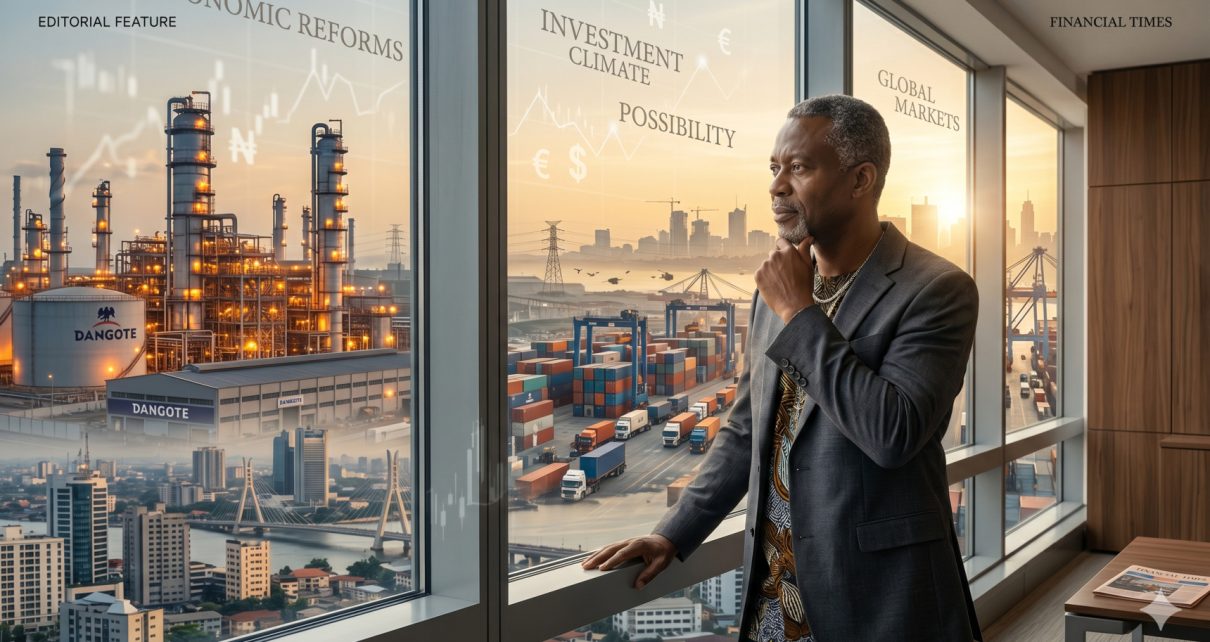
Twenty-six years have passed since that afternoon in Pretoria. In those intervening decades, Nigeria has produced presidents, a central bank reform, a fuel subsidy removal, a naira float, and more summit declarations than any economy its size should reasonably require. It has also produced the Dangote Refinery — the largest single-train petroleum refinery on earth, built by a Nigerian, in Nigeria, against the loud and sustained skepticism of the international energy establishment.
So where does that leave us? Is Nigeria finally ready for foreign direct investment — truly ready, not rhetorically ready?
The question has returned with unusual force in the first half of 2026. In April, the inaugural “Africa We Build” Summit convened in Nairobi, drawing over a thousand participants including heads of state, institutional investors, and development finance heavyweights. Africa Finance Corporation President Samaila Zubairu stood before that gathering and declared with striking confidence that “Africa is not capital-poor; it is capital-trapped.” Days later, at the Africa CEO Forum in Kigali, President Bola Tinubu beat his chest — his words — and announced that Nigeria was on course to attract close to $20 billion in foreign direct investment in 2026 alone, the fruit, he said, of painful but necessary macroeconomic reforms.
And then there was Aliko Dangote, also in Nairobi, doing what he does best: saying plainly what others whisper. His message was not a celebration. It was a warning dressed as inspiration. “In Africa, most of our problems is that we are waiting for foreign investors to come and develop our own land,” he told the summit. “It’s not possible. We Africans must lead; others will join us.”
Three voices. Three different angles on the same stubborn question.
This article does not aim to answer that question with the convenient optimism of a government press release or the reflexive pessimism of a foreign risk report. It aims, instead, to do what the investment scout in Pretoria did to me — hold up a mirror, clearly and without flinching, and ask Nigeria to look honestly at what it sees.
Because the stakes are not abstract. Nigeria is home to over 220 million people, the largest population on the African continent and one of the youngest in the world. Its GDP, Africa’s largest in nominal terms, sits atop reserves of oil, gas, solid minerals, and agricultural land that should, by any reasonable calculation, make it one of the most sought-after investment destinations on earth. And yet, as recently as 2023, companies of the stature of Shell, Unilever, GlaxoSmithKline, Procter & Gamble, and Sanofi were not arriving in Nigeria — they were leaving it. Quietly, methodically, and without much fanfare.
That is the contradiction at the heart of Nigeria’s FDI story. The promise is enormous. The performance is uneven. And the gap between the two is not a mystery — it has a name, or rather, several names: power, corruption, security, transparency, and the rule of law.
Understanding that gap — and whether the Tinubu administration’s reforms are genuinely closing it — is the purpose of what follows.
The Headlines Look Promising
On the surface, the numbers tell a story that Nigeria’s economic managers have every right to feel encouraged by. After years of stagnant capital flows, investor flight, and a currency in freefall, something appears to have shifted.
The shift began to show its shape in 2025. Foreign investments into Nigeria surged through the first nine months of that year, with combined Foreign Portfolio Investment and Foreign Direct Investment reaching nearly $14 billion — a figure that surpassed total inflows recorded for the entire year of 2024 and signalled a strong rebound in capital flows. The Nigerian Exchange, long a laggard on global performance tables, ranked 5th among the world’s top-performing stock exchanges and 4th in Africa for that period. Foreign participation in the bourse, a reliable gauge of international sentiment, rose from 16.6% in 2024 to 21.2% in 2025 — a positive net foreign portfolio balance that Nigeria had not achieved in three years.
The foreign reserves picture also improved markedly. Nigeria’s external reserves climbed to $45.5 billion, accompanied by a strengthening naira compared to end-of-2024 values. For a country that had spent the better part of two years watching its currency hemorrhage value on both the official and parallel markets simultaneously, these were not trivial developments. They were the direct consequence, the government argues, of decisions that were politically costly but economically necessary.
President Tinubu, addressing the Africa CEO Forum in Kigali in 2026, was characteristically emphatic on this point. The removal of the fuel subsidy — a policy that had endured for decades, consumed billions in public revenue, and warped the entire downstream energy sector — and the unification of the foreign exchange windows, which had maintained a fiction of multiple exchange rates that enriched insiders while punishing legitimate businesses, were, he insisted, the turning point. These reforms, he said, had eliminated major bottlenecks, restored global confidence, and proved to the world that Nigeria was, in his precise phrase, “efficient, transparent, and open for business.” On the strength of those reforms, he declared that Nigeria was on course to attract close to $20 billion in foreign direct investment in 2026 alone.
It is a remarkable projection. And it did not arrive in isolation.
At the “Africa We Build” Summit in Nairobi — the most significant infrastructure and finance forum the continent has convened in recent years — the mood among African leaders and financiers was one of deliberate, if cautious, momentum. The summit, co-hosted by the Africa Finance Corporation and the Government of Kenya, drew over a thousand participants and was anchored in a philosophy that challenged the old dependency narrative. Africa Finance Corporation President Samaila Zubairu framed it with the kind of clarity that tends to cut through summit rhetoric: Africa, he said, is not capital-poor. It is capital-trapped. The task before the continent is not to beg for foreign money but to unlock the vast domestic capital — an estimated $4 trillion sitting in pension funds, sovereign wealth vehicles, and institutional reserves — that has been flowing around the continent’s real needs rather than into them.
Nigeria, as Africa’s largest economy, sits at the centre of that argument whether it wishes to or not.
Also at the Nairobi summit was Aliko Dangote, and his presence alone carried a message that no government press release could replicate. Here was a man who had built the largest single-train petroleum refinery on earth — 650,000 barrels per day of capacity — inside Nigeria, against the open skepticism of international energy majors who had deemed the project too risky, too ambitious, too Nigerian. Several international engineering firms had initially refused to participate. Foreign sovereign figures had doubted publicly that an African private-sector businessman could pull off a project of that scale. Dangote’s response had been to build his own internal engineering, procurement, and construction capability and get the job done anyway.
That refinery is now a fact. It is steel and pipes and flame on the Lagos waterfront, and it represents the single most powerful rebuttal to the “Nigeria is too risky” narrative that this country has ever produced. More than any government projection or summit declaration, it is a data point that serious investors must now reckon with.
And Dangote was not finished making news. In Nairobi, he announced that with the right political backing from Kenyan President William Ruto and Ugandan President Yoweri Museveni, he is prepared to replicate the refinery model in East Africa — specifically targeting Tanga, Tanzania, with pipelines extending to Mombasa. The message was unmistakable: African capital, led by Africans, is now moving at a scale that was once the exclusive preserve of Western multinationals and Chinese state enterprises.
Back in Abuja, the legislative architecture around investment has also been getting attention. A new Investment and Securities Act was passed in 2025, repealing the former legislation from 2007. Its stated aim is to strengthen the legal and regulatory framework for investments and capital market activities, while expanding the Securities and Exchange Commission’s regulatory powers to meet international standards. The banking sector, too, is being fortified. In March 2024, the Central Bank of Nigeria issued a directive requiring banks to recapitalize by March 2026. Commercial banks with international licenses are required to increase their capital base tenfold — from 50 billion naira to 500 billion naira — with the entire sector required to raise over $3.7 billion in capital by the deadline. The logic is straightforward: stronger, better-capitalised banks are more credible intermediaries for foreign capital, better positioned to co-finance large-scale projects and provide the financial infrastructure that serious investors require.
On the trade architecture front, President Tinubu added another dimension to Nigeria’s pitch. Speaking at the Africa CEO Forum, he urged global investors to stop viewing Africa as a fragmented collection of small, isolated markets and to engage with it instead as a unified economic bloc through the African Continental Free Trade Area. He called specifically for the establishment of a unified African commodity exchange — a platform through which African nations could trade resources among themselves, reducing dependence on external pricing systems that have historically captured value that should remain on the continent.
The United Kingdom, meanwhile, has signalled continued and deepening engagement. Recent data from the National Bureau of Statistics showed that the UK remained Nigeria’s largest source of Foreign Direct Investment, with approximately $12.21 billion reportedly attracted between 2023 and 2025 following diplomatic engagements. Major UK-based energy investors have also signalled readiness to engage on bankable projects in the renewable energy and climate transition space, with a Nigeria Climate Investment Summit scheduled as part of London Climate Action Week — designed to showcase Nigeria’s climate policy reforms and investment-ready transition opportunities before a global financial audience.
Taken together, these developments constitute a genuine and meaningful improvement in Nigeria’s investment profile. The reforms are real. The numbers, while requiring careful disaggregation, are moving in the right direction. The diplomatic momentum is visible. And the symbolic weight of the Dangote Refinery — sitting there, operating, undeniable — has done more to shift the perception of Nigerian investment risk than a decade of government roadshows ever managed.
The headlines, in other words, are not fabricated. Nigeria has real cause for measured confidence.
But headlines, as any seasoned investor will tell you, are where the story begins. They are rarely where it ends.
What The Numbers Don’t Say
There is a discipline that every serious financial analyst learns early, and that every serious reader of economic news would do well to acquire. It is the discipline of disaggregation — the habit of pulling a headline figure apart at its seams to examine what, precisely, is living inside it. Applied to Nigeria’s celebrated $14 billion in foreign investment inflows for the first nine months of 2025, that discipline produces a finding that is considerably more sobering than the headline suggests.
Of that $14 billion, the recovery was largely driven by Foreign Portfolio Investment, which rose to $12.99 billion. Foreign Direct Investment also recorded a strong turnaround, expanding by 700 percent quarter-on-quarter in Q3 2025 — but reached only $936 million year-to-date.
Read that again slowly.
Of the $14 billion that Nigeria’s government and financial press have rightly celebrated, fewer than one billion dollars represented genuine Foreign Direct Investment — the kind of capital that builds factories, installs machinery, creates employment, transfers technology, and embeds itself in the productive tissue of an economy. The overwhelming remainder — nearly $13 billion — was Foreign Portfolio Investment: capital flowing into Nigerian stocks, bonds, and treasury instruments. Capital that arrived through a screen, that can leave through the same screen before close of business, and that has no obligation whatsoever to concern itself with whether the lights stay on in Apapa or whether a road in Onitsha gets fixed.
This distinction is not a technicality. It is the difference between a foundation and a coat of paint.
Foreign Portfolio Investment is not without value. It deepens capital markets, improves price discovery, provides liquidity, and signals a degree of international confidence in an economy’s macroeconomic management. The fact that Nigeria achieved a positive net foreign portfolio balance — a feat it had not managed in three years — is a meaningful indicator that the forex reforms and monetary tightening have restored a measure of credibility in the eyes of international fund managers. That credibility was not cheaply won, and it should not be casually dismissed.
But portfolio capital and direct investment capital operate on entirely different time horizons, entirely different risk appetites, and entirely different relationships with the underlying economy. Risk factors that portfolio investors can absorb are significant hurdles for long-term investors such as those involved in FDI. Security concerns, including the rise in kidnapping and regional instability, impact economic activities like manufacturing and logistics. Furthermore, the political atmosphere and policy uncertainties around elections create fear among long-term investors about committing capital for extensive periods.
A fund manager in London buying Nigerian Eurobonds is making a bet on interest rate differentials and currency trajectory. He can exit that bet in an afternoon. A German automotive components manufacturer considering a plant in Ogun State is making a ten to fifteen year commitment — to a specific piece of land, to a specific workforce, to a specific power supply, to a specific regulatory environment, and to a specific expectation that contracts will be honoured and disputes resolved without requiring a personal relationship with someone’s uncle in the ministry. The conditions that satisfy the bond trader and the conditions that satisfy the plant manager are not the same conditions. Nigeria has made meaningful progress on satisfying the former. It has made far more uneven progress on satisfying the latter.
The multinational exodus of recent years tells that story with uncomfortable precision. FDI stock in Nigeria declined in 2023, driven by divestments from major multinational companies due to a challenging business environment. Shell sold its onshore oilfields for $2.4 billion, and GlaxoSmithKline Consumer Nigeria exited after 51 years. Other companies that divested include Procter & Gamble, Unilever Nigeria, Sanofi, and Bolt Foods.
These were not fly-by-night operators making speculative bets. Shell had been in Nigeria since 1937. GlaxoSmithKline had built brands, supply chains, and institutional knowledge across more than half a century of Nigerian operations. Unilever had woven itself into the fabric of Nigerian consumer life — Omo, Close-Up, Lipton — across generations. When companies with that depth of roots choose to pull out, the decision is not made lightly, and it is not made primarily because of global portfolio rebalancing. It is made because the operating environment has become too costly, too unpredictable, or too hostile to sustain a viable business case. Their departure is not a data point. It is a verdict.
The sectoral concentration of what FDI does arrive further complicates the picture. FDI in Nigeria is largely concentrated in the extractive industries, particularly oil and gas, which generate limited economy-wide benefits and contribute little to diversification or technology transfer. The absence of a strong industrial base further constrains the country’s ability to benefit from the potential spillover effects of FDI. An oil well does not train a workforce in advanced manufacturing. A gas pipeline does not seed a technology cluster. The kind of FDI that transforms an economy — that builds the industrial base, creates the middle-skill jobs, and generates the domestic supply chains that compound into sustainable growth — is precisely the kind that Nigeria has struggled most to attract and most consistently failed to retain.
President Tinubu’s own $20 billion projection for 2026, examined carefully, is itself a recognition of how far Nigeria still has to travel. The target is ambitious relative to recent performance — but it must be understood in context. Nigeria is the third host economy for FDI in Africa, behind Egypt and Ethiopia. For a country that is Africa’s largest economy by GDP, with its largest population and among its most abundant resource endowments, finishing third on the continent in attracting foreign capital is not a position that any serious economic manager should find comfortable. Egypt and Ethiopia, with their own considerable challenges, are doing something that Nigeria, with its far larger market, has not yet consistently managed to do: convincing long-term investors that the return justifies the risk.
Long-term investors remain wary about future foreign exchange access for imports and profit repatriation, even after the FX reforms. This is a crucial point that tends to get buried beneath the celebration of the reforms themselves. The unification of exchange rate windows was necessary and correct. But the memory of what came before — years of a grotesquely overvalued official rate, a thriving parallel market, arbitrary restrictions on repatriation, and a central bank that changed its rules with disorienting frequency — does not simply dissolve because a new directive has been issued. Institutional credibility is built slowly, across multiple policy cycles, and destroyed quickly. Nigeria destroyed a great deal of it between 2015 and 2023. Rebuilding it will take longer than one administration’s press releases can accomplish.
There is also the question of what Nigeria’s own citizens and businesses are doing with their capital — the question the Pretoria scout posed in the year 2000 that has never fully been answered. Capital flight from Nigeria has been a persistent feature of its economic landscape for decades. When Nigerian money — old money, new money, business money, political money — consistently seeks safety in London property, Dubai apartments, and American treasury bonds rather than in Nigerian manufacturing or Nigerian agriculture, it sends a signal to every foreign investor conducting due diligence. That signal says: the people who know this place best do not trust it enough to keep their wealth here. No government roadshow, however polished, fully overcomes that signal.
This is not a counsel of despair. It is a counsel of honesty. The numbers that Nigeria is celebrating are real, and the momentum they represent is genuine. But momentum and readiness are different things. A sprinter leaving the blocks is not the same as a sprinter crossing the finish line.
The question is what stands between here and there. And the answer, as it has been for decades, lies not in the summits Nigeria attends, but in the streets, ports, courts, and power stations that foreign investors will encounter the morning after they sign the agreement.
The Structural Obstacles — Naming Them Plainly
There is a particular kind of dishonesty that afflicts economic discourse about Nigeria, and it is not the dishonesty of outright fabrication. It is subtler and, in many ways, more damaging. It is the dishonesty of euphemism — the practiced bureaucratic art of describing a broken port as a “logistics bottleneck,” a culture of institutional bribery as a “governance challenge,” and a power sector that delivers eight hours of electricity a day as an “infrastructure gap requiring further investment.” The language is technically accurate. It is also, in its deliberate mildness, a form of evasion that has allowed the same problems to survive decade after decade, administration after administration, summit after summit, because naming them gently is a way of not truly naming them at all.
We will not do that here.
If Nigeria is to honestly interrogate its readiness for foreign direct investment — not for the benefit of a Kigali audience or a London investor roadshow, but for its own citizens and its own future — it must be willing to call its obstacles by their correct names, examine them without flinching, and measure them against the standard that serious, long-term, job-creating foreign capital actually applies before it commits. That standard is not sentimental. It is not moved by the size of Nigeria’s population, the eloquence of its president’s speeches, or the undeniable brilliance of the Dangote Refinery. It asks a set of blunt, practical questions. And it waits for blunt, practical answers.
Here are the questions. Here are the honest answers.
Corruption: The Tax That Never Appears on Any Invoice
Of all the obstacles that confront foreign investors in Nigeria, corruption is simultaneously the most documented, the most discussed, and the least resolved. Its persistence across every administration that has promised to fight it — and every administration has promised to fight it — has given it an almost geological quality, as though it were a feature of the landscape rather than a failure of governance.
The data is unsparing. Corruption remains a serious obstacle to Nigeria’s economic growth and is often cited by domestic and foreign investors as a significant barrier to doing business. Nigeria ranked 140 out of 180 countries in Transparency International’s 2024 Corruption Perceptions Index. To put that ranking in its proper context: it places Nigeria in the bottom quarter of the world’s economies on perceived corruption — below Ghana, below Senegal, below Côte d’Ivoire, and far below the emerging market peers with which its government likes to compare it when projecting investment potential.
The corruption that foreign investors encounter is not merely the grand, headline-generating kind — the inflated contracts, the diverted oil revenues, the politically connected procurement. That corruption exists and is corrosive enough. But it is the quotidian, transactional corruption that breaks the will of businesses trying to operate legitimately on a daily basis. Businesses report that corruption by customs and port officials often leads to extended delays in port clearance processes. A container of imported machinery that should clear in seventy-two hours sits for three weeks while its owner navigates a choreography of unofficial payments, each one undocumented, each one essential, each one raising the true cost of doing business in Nigeria well above what any feasibility study projected.
The legal dimension compounds the problem further. Higher levels of corruption and political instability negatively affect FDI inflows, deterring potential investors and undermining economic growth. Corruption undermines the essential functions of governance, leading to inefficiencies that deter foreign investors and creating an unpredictable business environment. When an investor cannot trust that the rules that applied when they entered a market will still apply when a dispute arises — when they understand that the resolution of that dispute may depend less on the merits of their case than on relationships and resources they do not possess — the rational response is not to invest more. It is to invest elsewhere.
Nigeria was added to the Financial Action Task Force’s grey list in February 2023 for lapses in the country’s anti-money laundering and counterterrorism financing controls. Progress has been made toward addressing those lapses, and the international community has acknowledged the effort. But grey list membership, even briefly, sends a signal through the global compliance infrastructure of banks and institutional investors that is extraordinarily difficult to reverse. Compliance officers in Frankfurt and Singapore do not forget these things quickly. Their memory is institutional, and it is long.
There is, to be fair, marginal improvement. Nigeria’s Corruption Perceptions Index ranking moved from 145 to 140 between 2023 and 2024 — a five-place improvement that the government can legitimately cite. But a five-place improvement in the bottom quartile of a 180-country index is not a transformation. It is a signal that the direction may, finally, be changing. The distance still to travel is measured not in ranks but in culture, in institutional design, and in the consistent, unpredictable enforcement of consequences that powerful people currently have every reason to believe will never reach them.
Power: The Wound That Will Not Close
If corruption is the obstacle that Nigeria’s discourse names most often, power is the obstacle that costs it most dearly — and the one whose true depth is most consistently underestimated by those who do not have to live inside it.
The statistics, when encountered without context, read like a misprint. Nigeria’s annual per capita power consumption is only 144 kilowatt-hours, compared with 351 kilowatt-hours in Ghana and more than 4,000 kilowatt-hours in South Africa. The private sector endures power outages that average eight hours per day. Eight hours per day. In a country of 220 million people, hosting Africa’s largest economy, the average business loses a third of every working day to darkness. Not metaphorical darkness. Literal darkness — the hum of generators, the smell of diesel, the invoice from the fuel supplier arriving alongside the invoice from the electricity distributor, paying twice for a service that delivers once, and poorly.
The consequence for industrial investment is not merely inconvenient. It is, in many cases, decisive. Lack of access to reliable electricity has led several leading global companies to relocate their operations to neighbouring countries where electricity is more reliable. This is the sentence that should be read in every Federal Executive Council meeting, printed on every investment promotion brochure, and confronted honestly by every governor who attends a foreign investor summit and returns home to a state that cannot guarantee twelve hours of electricity to a factory. Companies do not relocate from Nigeria because they dislike Nigerians. They relocate because their cost models collapse when they price in the diesel, the generator maintenance, the production downtime, and the unpredictability of an energy supply that no amount of internal management can fully compensate for.
The power sector’s dysfunction is not for lack of legislation, policy, or international attention. It has received all three in abundance. What it has suffered from, across decades, is the intersection of corruption, underinvestment, pricing distortions, transmission infrastructure failure, and a gas supply chain that feeds the rest of the world before it reliably feeds Nigeria’s own turbines. Each of these problems is, in isolation, addressable. Together, in the configuration they have achieved in Nigeria, they have proved resistant to every administration’s best intentions — and several administrations’ worst ones.
Until this changes — not incrementally, but structurally and at scale — Nigeria’s pitch to manufacturing investors, logistics operators, pharmaceutical producers, and technology companies will carry an asterisk that no investment promotion commission can remove from the small print.
Security: The Risk That Doesn’t Appear on the Brochure
Investment, at its most fundamental level, is an act of confidence about the future. It requires a belief that what is built today will still be standing, operating, and accessible tomorrow. In significant portions of Nigeria’s geography, that belief is genuinely difficult to sustain.
Security concerns, including banditry, kidnappings, terrorism, communal clashes, and separatist agitations in the south-east, further threaten economic stability and limit foreign investment inflows. These are not isolated incidents confined to remote areas that an investor in Lagos or Abuja need not concern themselves with. Banditry in the northwest has crippled agricultural supply chains whose produce feeds processing plants in the south. Kidnapping along major highways has raised the cost and risk of logistics across entire regions. The lingering tensions in the south-east have created zones of operational uncertainty that multinational companies factor into their risk matrices with the same cold precision they apply to any other cost of business.
Security concerns impact economic activities like manufacturing and logistics, and the political atmosphere and policy uncertainties around elections create fear among long-term investors about committing capital for extensive periods. The electoral cycle, in particular, creates a recurring freeze in long-term investment decision-making. Every four years, the uncertainty of what the next administration will do to existing agreements, tax arrangements, sector regulations, and bilateral commitments introduces a pause that compounds across cycles into a structural reluctance to commit. An investor who has watched a carefully negotiated arrangement unravel with a change of government — and there are many such investors, some of them still in litigation — does not need to be told twice.
Transparency and the Rule of Law: The Architecture of Trust
Foreign investment does not flow primarily toward countries that are rich. It flows toward countries that are predictable. The two qualities are not the same, and in the global competition for long-term capital, predictability frequently outranks resource endowment.
Predictability requires transparent governance — budgets that are published and audited, state enterprises that open their books, regulatory decisions that follow rules rather than relationships, and courts that resolve commercial disputes on their merits within a timeframe that a business can plan around. On each of these measures, Nigeria presents a mixed and often troubling picture.
The Debt Management Office has not published a budget implementation report since the first quarter of 2024, and no federal government budget audit has been published since 2021. The state-owned oil company NNPCL reportedly published its audited financial statement for fiscal year 2023 in August 2024, although no copies of it are publicly available online. These are not minor administrative oversights. They are the institutional equivalents of a business owner who refuses to show a potential partner the company’s accounts. The partner, if they are sensible, draws their own conclusion and moves on.
An inefficient judicial system and unreliable dispute settlement mechanisms complete the picture. A foreign investor entering Nigeria must understand that if a contractual dispute arises — with a local partner, with a regulatory agency, with a state government, or with a federal ministry — the path to resolution through the courts is likely to be long, expensive, unpredictable, and susceptible to influences that have nothing to do with the law as written. International arbitration clauses offer partial protection, but they are a workaround for a broken system, not a substitute for one that works.
Land: The Foundation Beneath the Foundation
Every factory, every warehouse, every processing plant, every logistics hub begins with a piece of land. In Nigeria, that beginning is frequently where the trouble starts.
Clarity of title and registration of land ownership remain significant challenges throughout Nigeria. Property transfers are complex and must usually go through state governors’ offices or the Minister of the Federal Capital Territory. Nigeria’s land reforms have attempted to address this barrier to development but with limited success. The Land Use Act of 1978 — a piece of legislation conceived in a different Nigeria for a different era — remains the governing framework for land ownership, vesting all land in state governors and creating a system in which securing a valid title for commercial development can take years, require political access that most investors do not have, and still produce a certificate whose legal defensibility remains uncertain.
For a domestic investor with local knowledge, local relationships, and local patience, this is a serious obstacle. For a foreign investor operating from a headquarters in Seoul, São Paulo, or Stuttgart, accustomed to land registries that function, title searches that conclude in days, and ownership rights that are unambiguous and enforceable, it is frequently a dealbreaker before any other conversation has been had.
The obstacles catalogued here are not secrets. They appear in every serious analysis of Nigeria’s investment climate produced by the World Bank, the U.S. Department of State, Transparency International, the International Finance Corporation, and the African Development Bank. They have been named, in varying degrees of diplomatic mildness, by virtually every major international institution that has engaged with Nigeria’s development agenda. They are not new. They were present, in largely the same configuration, when the investment scout sat across from me in Pretoria in the year 2000 and delivered his verdict.
What is new — and what must be honestly acknowledged — is that some of them are beginning, for the first time in a generation, to be addressed with something resembling genuine political will rather than rhetorical intent. The question of whether that will is sufficient, sustained, and structurally embedded enough to move the needle before the next election cycle resets the clock, is one that only time, and the investors who are watching carefully, will answer.
The Dangote Doctrine — A Mirror and A Mandate
There is a moment in the life of every national conversation when a single individual, by the sheer scale of what they have built or done, renders a certain category of excuse permanently unavailable. Nigeria reached that moment when the Dangote Refinery fired its first crude unit on the Lagos waterfront. Whatever one thinks of Aliko Dangote — and opinions about the man, his methods, and his market position are rarely neutral in Nigerian business circles — the refinery is an argument that cannot be un-made. It exists. It works. It was built here, by an African, with African leadership, in a country that the international investment establishment had collectively decided was too difficult, too risky, and too dysfunctional to host a project of that ambition.
That is the mirror. And it is worth standing in front of it for a moment before rushing to the mandate it implies.
The Refinery as Rebuttal
When Dangote announced his intention to build a 650,000 barrel-per-day petroleum refinery in Nigeria, the response from the international energy establishment was not enthusiasm. It was, by his own account at the “Africa We Build” Summit in Nairobi, something closer to institutional disbelief shading into active discouragement. Several international engineering firms initially refused to participate in the project, having assessed Nigeria through the lens of their standard risk frameworks and concluded that a private-sector African businessman executing a project of that capital intensity, in that operating environment, was not a proposition they could professionally endorse.
Sovereign figures — heads of state and senior government officials from countries that consider themselves Nigeria’s development partners — expressed doubt openly. The subtext of that doubt, rarely spoken aloud but clearly understood by everyone in the room, was a version of the same sentence the Pretoria scout delivered in the year 2000: this is not a place where things like this get built.
Dangote’s response was not a press release. It was not a summit declaration or a government roadshow. His response was to build the refinery. When foreign EPC firms declined, he built the internal engineering, procurement, and construction capability that the project required. When international capital came with conditions that reflected the “Africa risk premium” — the punishing cost of money that the continent pays because foreign lenders price in instability that they often understand only superficially — he found alternative paths. When the skeptics scheduled their doubt for the public record, he scheduled his construction timeline instead, and he kept to it.
The result is the most significant piece of industrial infrastructure built on African soil by an African private citizen in the post-independence era. It is not a symbol. It is not an aspiration. It is a functioning refinery, processing crude oil into refined petroleum products, reducing Nigeria’s grotesque and long-standing dependency on imported fuel from a country that sits atop some of the world’s largest hydrocarbon reserves. Its existence alone has permanently altered what is considered possible in Nigerian and African industrial development.
But here is what makes the Dangote Refinery a mirror rather than simply a monument: the conditions under which it was built have not fundamentally changed. The power is still unreliable. The ports are still difficult. The regulatory environment is still complex. The corruption has not been eradicated. Dangote did not build the refinery because Nigeria became easy. He built it because he had the capital, the determination, the political relationships, and the organisational capacity to absorb and overcome the costs that Nigeria’s operating environment imposes — costs that would have broken a smaller, less resourced, or less connected enterprise long before the first steel was laid.
That distinction matters enormously. The refinery proves that world-class industrial investment is possible in Nigeria. It does not prove that the conditions for such investment are adequate. It proves, if anything, that the bar for succeeding in Nigeria is set so high — in terms of the resources, resilience, and political capital required — that only the very largest and most formidable players can clear it. That is not an investment climate. That is an obstacle course with an occasional winner.
What Dangote Said in Nairobi
At the “Africa We Build” Summit, Dangote did not arrive to take a bow. He arrived to make an argument, and he made it with the bluntness that has become his trademark on public platforms.
His central thesis was direct: Africa’s developmental crisis is, at its root, a crisis of mindset. The continent has conditioned itself to wait — for foreign capital, foreign expertise, foreign validation — before it believes that large things can be done. That waiting is not prudence. It is, in his framing, a form of self-imposed paralysis that foreign interests have, consciously or not, found it convenient to maintain.
The “risk” narrative that surrounds African investment destinations — and Nigeria in particular — is not, he argued, a neutral assessment produced by objective analysis. It is, at least in part, a construct that serves the interests of those who benefit from Africa remaining a supplier of raw materials rather than a processor of finished goods. When international engineering firms decline to participate in an African mega-project, and when foreign lenders price African sovereign and private risk at multiples of what they charge comparable borrowers in other emerging markets, they are not merely reflecting reality. They are, in some measure, creating it — because the elevated cost of capital becomes a self-fulfilling prophecy that makes projects unviable that would otherwise pencil out.
Dangote’s response to this narrative was not to argue with it from the podium. It was to make it irrelevant by building something that the narrative said could not be built. And in Nairobi, he announced his intention to do it again.
With the political backing of Kenyan President William Ruto and Ugandan President Yoweri Museveni, Dangote declared his readiness to replicate the refinery model in East Africa, with Tanga in Tanzania as the targeted site and pipeline infrastructure extending to Mombasa. The announcement was received in Nairobi as a statement of African industrial ambition at the highest level. But viewed from Lagos, it carries an additional, more uncomfortable meaning.
Dangote is prepared to build his next great industrial project in East Africa. Not in Nigeria.
That fact deserves reflection that is neither defensive nor dismissive. Dangote is a Nigerian. His business empire is headquartered in Lagos. His refinery sits on Nigerian soil. His philanthropic commitments are overwhelmingly directed at Nigerian institutions. He is not abandoning Nigeria. He is expanding across a continent, as any serious industrialist at his scale should. But the choice of East Africa for the next mega-project is also, inevitably, a signal about where the political conditions for execution currently present themselves most favourably. Presidents Ruto and Museveni offered something at the Nairobi summit that translated, in practical terms, into a viable project framework. The equivalent offer, for an equivalent project at an equivalent scale in northern Nigeria, or the Middle Belt, or the Niger Delta, is not presently on the table in a form that the market finds credible.
That is the mirror held up not to Nigeria’s potential, but to its current condition.
The Mandate: Domestic Capital as the Vanguard
If the mirror is uncomfortable, the mandate that Dangote’s argument implies is clarifying. And it aligns, with striking precision, with the philosophical framework that the “Africa We Build” Summit was constructed around.
The Africa Finance Corporation’s Samaila Zubairu was not speaking abstractly when he said that Africa is not capital-poor but capital-trapped. The continent’s institutional investors — pension funds, sovereign wealth funds, insurance companies, development finance institutions — collectively manage an estimated $4 trillion in assets. That capital exists. It is real. But it is largely not flowing into the infrastructure, manufacturing, and industrial development that African economies require, for a constellation of reasons that include regulatory barriers, currency risk, the absence of bankable project pipelines, and the persistent cultural deference to foreign institutional validation before domestic capital commits.
Dangote’s argument, and the summit’s broader thesis, is that this must change — and that it must change from the inside out. Foreign capital will not lead Africa’s industrialisation. It never has, and the evidence of six decades of post-independence development suggests that waiting for it to do so is precisely the failed strategy he named on the Nairobi stage. What foreign capital will do, reliably and at scale, is follow African capital once African capital has demonstrated the investment case, absorbed the early-stage risk, and built the track record that international fund managers require before they can satisfy their own compliance and fiduciary obligations.
This is not a counsel against foreign investment. It is a theory of sequencing. Domestic capital goes first. It builds the proof of concept, establishes the institutional frameworks, and creates the investable assets. Foreign capital then amplifies what domestic capital has begun. The Dangote Refinery is the most powerful illustration of this theory that Nigeria possesses. A Nigerian built it. Now the world is watching it. And now, the conversation about foreign investment in Nigerian downstream energy is fundamentally different from what it was a decade ago, because the proof of concept exists in steel and flame on the Lagos shoreline.
The question for Nigeria, then, is not only whether it can attract foreign capital. It is whether it can mobilise its own. Whether the pension funds managing the retirement savings of Nigerian workers are investing those savings in Nigerian infrastructure or in foreign securities. Whether the sovereign wealth fund is being deployed with the strategic ambition that its mandate implies. Whether the diaspora — estimated to remit over $20 billion annually, making it one of Nigeria’s largest sources of external finance — is being given the investment vehicles, the legal protections, and the institutional confidence to channel even a fraction of that flow into productive domestic assets rather than family consumption and real estate.
Weak governance often undermines the effective use of both FDI and aid, with the latter frequently focused on short-term relief rather than long-term development. Poor infrastructure further restricts the country’s ability to benefit from the potential spillover effects of FDI. These twin failures — of governance and infrastructure — are not only barriers to foreign investment. They are barriers to domestic investment. And they will not be resolved by a foreign investor’s arrival. They will only be resolved by a Nigerian state that decides, with genuine and sustained commitment, that the conditions for investment must be built at home before they can be credibly advertised abroad.
The Parting Advice Nobody Should Ignore
Dangote closed his remarks in Nairobi with a call to economic sovereignty that was, in its plainness, the most important thing said at a summit full of important statements. He urged African leaders and industrialists not to be intimidated — not by the scale of what is required, not by the skepticism of those who have historically profited from Africa’s hesitation, and not by the seductive comfort of waiting for someone else to come and do what Africans are capable of doing themselves.
It was advice addressed to the continent. But it was advice that Nigeria, of all African nations, has the most immediate reason to take personally.
Nigeria has the market. It has the resources. It has the human capital — a diaspora that spans every elite institution in the world, a domestic professional class of genuine depth, and a youth population whose energy and creativity express themselves daily in technology, entertainment, agriculture, and entrepreneurship in ways that no investment index has yet found adequate metrics to capture.
What Nigeria has not yet consistently had is the institutional environment that allows that potential to compound — that takes the individual brilliance of its people and multiplies it through reliable infrastructure, enforceable contracts, stable policy, and a state that shows up as a partner to enterprise rather than an obstacle to it.
The Dangote Doctrine, properly understood, is not about one man or one refinery. It is about what becomes possible when a Nigerian decides that the conditions, however imperfect, are not an excuse for inaction — and builds anyway. The mandate it issues is not to Dangote’s peers alone. It is to the Nigerian state: create the conditions in which the next Dangote does not have to be a billionaire to build something great in their own country.
That is the work. And no summit, however well-attended, does that work for you.
The Policy Reforms — Real, But Unfinished
There is a version of this article that would be straightforward to write. It would catalogue Nigeria’s policy failures, note that they are structural and generational, observe that summits change nothing, and conclude with the kind of weary resignation that passes, in certain intellectual circles, for sophistication. That article would be wrong — not because it would be factually inaccurate, but because it would be incomplete in a way that matters. The Tinubu administration has undertaken reforms that are real, that were politically costly, and that have produced measurable results in specific areas of Nigeria’s economic architecture. Intellectual honesty requires that those reforms be acknowledged, examined, and credited where credit is genuinely due — before the harder question is asked, which is whether they are sufficient, durable, and structurally embedded enough to accomplish what Nigeria actually needs them to accomplish.
The answer to that harder question, as we will try to argue here, is: not yet. But the distance between “not yet” and “never” is precisely where policy reform lives, and it is a distance worth mapping carefully.
The Reforms That Have Moved the Needle
The two most consequential decisions of the Tinubu administration’s economic programme — the removal of the fuel subsidy and the unification of the foreign exchange windows — were not, in their conception, novel ideas. They had been recommended by the International Monetary Fund, the World Bank, and virtually every serious economist who had studied the Nigerian economy for the better part of three decades. Previous administrations had known they were necessary. Several had attempted them, partially and without conviction, before retreating under political pressure. What distinguished the Tinubu administration’s approach was not the originality of the prescription but the willingness, however imperfect the execution, to actually fill it.
The fuel subsidy, at its peak, was consuming public revenue at a rate that beggared rational description — funds that should have built roads, powered schools, and equipped hospitals were instead being transferred, through a pricing mechanism of breathtaking inefficiency, to petroleum importers, fuel smugglers, and the owners of jerry cans. Its removal was painful, immediately and viscerally, for millions of Nigerians whose transport costs, food prices, and household budgets absorbed the shock in real time. That pain was real, and it should not be dismissed by anyone writing about Nigeria’s investment climate from the comfort of an air-conditioned office. But the distortion it corrected was also real, and its removal was a precondition for any serious conversation about fiscal sustainability and investor confidence.
The forex unification addressed a related but distinct pathology. The introduction of the electronic Foreign Exchange Matching System narrowed the gulf between official and parallel exchange rates, restoring credibility in market pricing and encouraging repatriation. For years, Nigeria had maintained the economic fiction of multiple exchange rates — an official rate that bore little relationship to the market rate, and a parallel rate that bore all the relationship to reality that the official rate refused to acknowledge. The consequences were predictable and were predicted: capital flight, round-tripping, import distortions, and the systematic disadvantaging of legitimate businesses that needed foreign exchange for genuine commercial purposes but could only access it at official rates that bore no resemblance to the actual cost of dollars in the Nigerian economy.
The unification did not solve every foreign exchange problem. It introduced its own volatility, its own adjustment costs, and its own distributional consequences that fell, as such consequences usually do, most heavily on those least equipped to absorb them. But it restored, for the first time in years, the basic credibility of Nigeria’s exchange rate as a price signal — and price signals, functioning correctly, are the foundation on which every investment decision ultimately rests. Nigeria’s foreign reserves climbed to $45.5 billion and the naira strengthened compared to end-of-2024 values — outcomes that would have been difficult to project with confidence before the reforms were implemented.
The banking sector recapitalisation, while less publicly dramatic than the subsidy removal or the forex unification, may prove equally consequential over time. Commercial banks with international licences are required to increase their capital base tenfold — from 50 billion naira to 500 billion naira — with the entire sector required to raise over $3.7 billion in capital by the March 2026 deadline. The logic behind this requirement is sound. Nigerian banks, measured against international peers and against the scale of the economy they are meant to serve, have been significantly undercapitalised. A banking sector that cannot write large tickets, syndicate major infrastructure loans, or provide the financial infrastructure that serious industrial investment requires is not a banking sector that can support the transformation agenda that Nigeria’s economic managers describe in their summit presentations. Stronger banks are not sufficient for attracting serious FDI, but they are necessary, and their construction is underway.
The legislative dimension of the reform programme has also advanced. The new Investment and Securities Act of 2025 repeals the former legislation from 2007, with its stated aim to strengthen the legal and regulatory framework for investments and capital market activities, while expanding the Securities and Exchange Commission’s regulatory powers to meet international standards. On paper, this is a meaningful modernisation of the framework within which capital market transactions and investment activities are regulated. The critical qualification — one that applies to virtually every piece of legislation Nigeria has passed in the reform era — is that a law’s quality is determined not by its text but by its implementation, its enforcement, and the institutional capacity that gives it practical effect. Nigeria’s statute books are not, in the main, the problem. The gap between what the law says and what actually happens in the port, the court, the regulatory office, and the land registry — that is the problem.
The Tinubu Pitch: Between Vision and Verification
President Tinubu’s address at the Africa CEO Forum in Kigali offered something that Nigerian heads of state have not always provided in such settings: a pitch that engaged directly with the structural reform agenda rather than retreating entirely into the resource endowment argument. The population, the oil, the mineral wealth, the market size — these are real and they are important, but they are also arguments that every Nigerian administration since independence has made, and their repetition without accompanying institutional credibility has, over time, produced a kind of investor fatigue that no natural resource inventory can overcome.
Tinubu’s Kigali pitch went further. He addressed the “Africa risk” narrative directly — acknowledging that perceptions of investment risk in Nigeria must change, while simultaneously insisting that Nigerian institutions must do their part to justify that change. He named transparency, fiscal discipline, and accountability as the specific tools through which Nigeria is working to de-risk investment and stabilise the business climate. He sent a clear message to international companies that the era of purely extractive engagement — arriving to dig up resources and ship them out without adding value locally — is over, citing the specific example of electric vehicle battery manufacturing as the kind of value-added partnership Nigeria now demands.
These are the right arguments. They are more sophisticated, more reform-oriented, and more credible than the standard Nigerian investment pitch of previous eras. The question — and it is always the question — is whether the institutional reality that a foreign investor encounters on arrival matches the institutional aspiration that the president describes on stage.
On the engagement with the OECD, Tinubu’s positioning was particularly notable. The Organisation for Economic Co-operation and Development represents the institutional architecture of the world’s advanced economies, and its standards on taxation, transparency, governance, and regulatory quality are the benchmarks against which serious foreign investors measure emerging market destinations. Nigeria’s engagement with that architecture — seeking not just the capital that OECD member states can mobilise but the institutional alignment that makes capital deployment credible — is a more sophisticated foreign investment strategy than the country has historically pursued. Whether it translates into the policy consistency and institutional depth that OECD engagement requires will be the test.
Tinubu’s call for the full activation of the African Continental Free Trade Area added a dimension to the investment pitch that deserves more attention than it typically receives in Nigerian economic discourse. The AfCFTA, properly implemented, transforms the investment calculus for Nigeria fundamentally — not because it makes Nigeria easier to invest in domestically, but because it makes Nigeria a viable manufacturing platform for a continental market of 1.4 billion consumers rather than a domestic market of 220 million. A company considering a manufacturing facility in Nigeria that can serve only the Nigerian market faces one set of calculations. A company considering the same facility as the hub for a continental distribution network faces an entirely different and considerably more attractive set. The difference between those two calculations is the AfCFTA — but only if it moves from framework to function, from signed agreement to operational reality at the border, the port, and the customs desk.
What Remains Unfinished
Against these genuine advances, the gaps in the reform programme are significant enough that they cannot be acknowledged in a subordinate clause and moved past. They require direct statement.
Long-term investors remain wary about future foreign exchange access for imports and profit repatriation, even after the FX reforms. This wariness is not irrational. It is the rational response of an investor who has studied Nigeria’s policy history and understands that the current administration’s reform commitments, however sincerely held, exist within a political economy that has repeatedly demonstrated its capacity to reverse course when reform becomes politically costly. The investor who locked capital into Nigeria under the reform regime of 2005 lived to see the policy reversals of 2010. The investor who committed under the optimism of 2011 lived through the forex crisis of 2016. Each reversal added a layer of institutional memory that the current reform cycle must overcome — not through rhetoric but through the only currency that institutional memory accepts, which is consistent behaviour sustained across time and across political transitions.
The transparency deficit identified earlier has not been resolved by the reform programme. The Debt Management Office has not published a budget implementation report since the first quarter of 2024, and no federal government budget audit has been published since 2021. A government that declares itself transparent while leaving its own financial reporting this far in arrears is not yet transparent. It is aspiring to transparency — which is better than not aspiring to it, but is not the same thing as achieving it, and investors who are allocating long-term capital know the difference.
The judicial system — the ultimate guarantor of every contract, every property right, and every regulatory commitment that underpins a foreign investment — remains unreformed in the ways that matter most to commercial activity. Laws have been updated. The Investment and Securities Act has been modernised. But an inefficient judicial system and unreliable dispute settlement mechanisms continue to represent a structural risk that legislative modernisation alone cannot address. Courts require trained judges, functioning infrastructure, manageable caseloads, and institutional independence from political influence. These are not things that a new securities act delivers. They are the product of sustained, unglamorous investment in the justice system over years and administrations — investment that has not yet been made at the scale the problem requires.
The high cost of capital continues to stifle domestic and international climate investment. The limited supply of bankable projects — with sufficient scale and ticket size — deters investors from financing mitigation and adaptation. This observation, made specifically in the context of climate finance, applies with equal force to the broader FDI landscape. Nigeria’s investment promotion infrastructure — the Nigerian Investment Promotion Commission, the one-stop shop mechanisms, the sector-specific incentive frameworks — has improved on paper but continues to struggle with the gap between the investment it is designed to attract and the project pipelines it is able to present to investors as genuinely bankable, thoroughly structured, and operationally ready. An investor who arrives at a one-stop shop and finds that the shop’s component agencies are not actually coordinating, that the promised fast-track approvals require the same unofficial facilitation as the standard process, and that the incentives advertised in the brochure are subject to interpretations that vary by desk and by day, will not return. And they will tell their colleagues.
The Durability Question
Above all else, the reform that Nigeria most needs — and the one that no single administration can deliver unilaterally — is the reform of policy durability itself. The single greatest deterrent to long-term foreign direct investment in Nigeria is not any specific policy failure. It is the investor’s inability to trust that the policy environment that exists today will still exist in five years. That inability is not a perception problem to be managed through better communications. It is a structural problem rooted in the concentration of economic policy authority in the executive, the weakness of independent regulatory institutions, and the absence of bipartisan consensus on the basic parameters of economic governance.
Countries that attract sustained, large-scale foreign direct investment — Ireland, Vietnam, Malaysia, Rwanda, in its more recent incarnation — do so not because their governments make better speeches or attend better summits than Nigeria’s. They do so because investors who enter those markets can form reasonable expectations about the regulatory, fiscal, and legal environment they will be operating in across the lifespan of their investment, and those expectations are grounded not in trust in any individual leader but in the demonstrated consistency of institutions that outlast individual leaders.
Nigeria’s institutions are not yet there. They are stronger than they were a decade ago in some respects, and the current reform programme has added genuine elements of improvement. But the distance between where they are and where they need to be — to compete seriously with Egypt for the continent’s FDI crown, to make the $20 billion projection not just a headline figure but a floor rather than a ceiling, to answer the Pretoria scout’s challenge not with a government brochure but with the weight of demonstrated institutional credibility — that distance is still substantial.
It is not unbridgeable. But it will not be bridged at summit pace.
What “Ready” Actually Means
By this point in this extensive discourse, a certain kind of reader — the kind who sits on the investment committee of a Lagos conglomerate, or manages a portfolio out of Victoria Island, or advises a state government on its economic development strategy — may be feeling the weight of accumulated critique and wondering whether the argument is tending toward a conclusion that Nigeria is simply not investable. That reader deserves a direct response, and here it is: that is not the argument. It has never been the argument.
The argument is more precise, and more demanding, than a simple verdict of investable or not investable. It is that Nigeria is partially ready — genuinely, meaningfully, and in ways that matter — and that partial readiness, properly understood, is both an achievement worth acknowledging and an insufficiency worth confronting. The gap between partial readiness and full readiness is not a gap that can be papered over with projections or filled with summit declarations. It is a gap with a specific shape, a specific content, and a specific set of actions that would close it. And until that gap is named with precision — not in the language of investment brochures, but in the language of what investors actually require when they sit down to make irreversible, decade-long capital commitments — Nigeria will continue to occupy the uncomfortable position it has held for most of its post-independence history: a country of extraordinary promise that the world perpetually expects to deliver more than it does, and that perpetually delivers less than it should.
So let us name it precisely. Let us define, as concretely as the evidence permits, what being genuinely ready for foreign direct investment actually means — and measure Nigeria’s current condition honestly against that definition.
Readiness Is Not a Press Conference
The first and most important thing to establish is what investment readiness is not. It is not a declaration. It is not a projection. It is not a reform announced, a law passed, a summit attended, or a target set. These things matter — they are the necessary preconditions of readiness — but they are not readiness itself, in the same way that drawing the architectural plans for a building is not the same as having a building.
Readiness, for the purposes of a long-term foreign direct investor — the manufacturer, the logistics operator, the technology company, the pharmaceutical producer, the agro-industrial processor — is a set of conditions that exist on the ground, reliably and consistently, before the investor signs the agreement, after they sign it, and across the full lifespan of their investment. It is the answer to a set of questions that every serious investor asks, not of the government spokesperson at the roadshow, but of their own advisers, their own lawyers, their own site visit teams, and their own finance committees, who apply to the answers a level of scrutiny that no promotional material survives intact.
Those questions are not complicated. They are, in fact, remarkably consistent across industries, geographies, and investor profiles. They resolve, in the end, into five fundamental conditions. Nigeria’s readiness must be measured against each of them, not in aggregate — because aggregation allows strong performance in one area to mask failure in another — but one by one, with the same precision that an investor’s due diligence team would apply.
The Five Conditions of Investment Readiness
The first condition is operational viability — the ability to run a business, physically and logistically, at a cost and reliability that generates a viable return. This means power that is sufficient and consistent. It means ports that clear goods in predictable timeframes at predictable costs. It means roads, rail, and logistics infrastructure that move inputs and outputs efficiently enough that the business model holds together. It means the ability to hire, house, and retain a skilled workforce without the cost of compensating for infrastructure failure consuming the margin that makes the investment worthwhile.
On this condition, Nigeria’s current position is the most difficult to defend. The private sector endures power outages averaging eight hours per day. Annual per capita power consumption is only 144 kilowatt-hours, compared with 351 kilowatt-hours in Ghana and more than 4,000 kilowatt-hours in South Africa. These are not numbers that describe an inconvenience. They describe a structural operating cost — the diesel, the generators, the maintenance, the downtime, the production losses — that is baked into the P&L of every business operating in Nigeria, and that renders entire categories of industrial activity uncompetitive before a single unit of product has been made. The investor who requires reliable, grid-supplied power at industrial scale — which is to say, virtually every serious manufacturer — is looking at a Nigeria that cannot yet meet that requirement without extraordinary self-provision at extraordinary cost. Until that changes, operational viability for the most valuable categories of FDI remains compromised at its foundation.
The second condition is legal and contractual security — the confidence that agreements will be honoured, disputes resolved fairly and efficiently, property rights protected, and the rules of the game maintained consistently across the lifespan of the investment. This is the condition that separates countries that attract capital from countries that attract capital once, lose it to a bad experience, and spend the next decade trying to recover the relationship.
An inefficient judicial system and unreliable dispute settlement mechanisms remain among the most consistently cited barriers to FDI in Nigeria. The investor who cannot trust the court to enforce a contract has no foundation on which to build a long-term business relationship with Nigerian partners, suppliers, regulators, or governments. International arbitration clauses — now standard in most serious investment agreements involving Nigerian counterparties — are a workaround, not a solution. They acknowledge the inadequacy of the domestic legal infrastructure while doing nothing to improve it. A country that has normalised the practice of routing its commercial disputes offshore because its own courts are not trusted by the parties standing before them has a judicial reform problem that no amount of legislative modernisation resolves.
The third condition is regulatory predictability — the assurance that the policy framework, the tax regime, the sectoral regulations, and the administrative procedures that govern an investor’s operations will be sufficiently stable, sufficiently transparent, and sufficiently consistently applied that the investor can build a ten-year business plan with reasonable confidence that the ground will not shift beneath it. This does not mean that regulations cannot change. It means that when they change, they change through processes that are transparent, consultative, and governed by rules that apply equally to all participants.
Nigeria’s record on regulatory predictability is its most complex and most contested. Long-term investors remain wary about future foreign exchange access for imports and profit repatriation, even after the FX reforms. That wariness is the residue of a regulatory history in which exchange rate policy, import licensing, sector-specific rules, and tax arrangements have changed with a frequency and unpredictability that has made long-term financial modelling in Nigeria an exercise in scenario planning rather than projection. The current administration has improved the predictability of the foreign exchange framework. It has not yet demonstrated — because no single administration can demonstrate — that this improvement is institutionally durable rather than personally committed. Durability requires independent regulatory institutions, bipartisan consensus on economic fundamentals, and a track record measured across political transitions. Nigeria is working toward these things. It has not yet achieved them.
The fourth condition is institutional integrity — the functioning of the state apparatus that an investor interacts with, at every level, as a competent, consistent, and corruption-resistant counterpart. This encompasses the agencies that issue licences, the officials who clear imports, the inspectors who certify compliance, the courts that enforce agreements, and the politicians who set the framework within which all of these actors operate. An investor dealing with an institutional environment characterised by corruption by customs and port officials that often leads to extended delays in port clearance processes is not merely dealing with an inconvenience. They are dealing with a structural cost and a structural risk — the cost of unofficial facilitation and the risk that refusal to pay it results in operational paralysis — that their home country regulators, their compliance officers, their anti-bribery counsel, and their board of directors may find impossible to accept.
Nigeria ranks 140th out of 180 economies on the 2024 Corruption Perceptions Index, 113th among 133 economies on the Global Innovation Index 2024, and 127th out of 184 countries on the latest Index of Economic Freedom. These are not rankings that describe a country at the frontier of institutional integrity. They describe a country that is, on the available evidence, in the bottom third of global peers on the measures that matter most to the long-term investor making a fiduciary decision about where to commit other people’s money. The improvement from rank 145 to rank 140 on the corruption index is real and should be built upon. It is not yet sufficient to move Nigeria out of the category of markets where institutional risk is a primary consideration rather than a secondary one.
The fifth condition is security and social stability — the baseline of physical safety and social predictability within which a business can operate, its staff can function, its supply chains can move, and its management can travel. This is the condition that is most difficult to discuss in a business context without either overstating or understating its significance, because security conditions in Nigeria vary so dramatically by geography, by sector, and by circumstance that no single characterisation is accurate for the whole country.
Lagos is not Zamfara. The south-west is not the north-east. Abuja is not the Niger Delta. An investor establishing a technology company in Lekki faces a security calculus that is entirely different from the one facing an investor building a cement plant in Kaduna or an agricultural processing facility in Benue. Nigeria’s security situation is not a single condition. It is a patchwork of conditions, some of which are compatible with serious investment and some of which are not — and the investor’s task of mapping that patchwork, identifying the viable zones, and pricing the residual risk is a task that Nigeria’s investment promotion infrastructure is not yet doing enough to support with the granularity, honesty, and practical guidance that would actually help.
What is clear, across the patchwork, is that security concerns including banditry, kidnappings, terrorism, communal clashes, and separatist agitations in the south-east continue to threaten economic stability and limit foreign investment inflows. A Nigeria in which significant portions of its agricultural heartland are inaccessible to productive investment because of insecurity is a Nigeria that is leaving an enormous portion of its economic potential unexploited — and signalling to the world, through that unexploited potential, that the state’s capacity to provide the most basic precondition of economic activity remains uneven in ways that matter.
Where Nigeria Currently Stands
Measured against these five conditions, Nigeria’s investment readiness in 2026 presents a picture that is neither the unqualified success that government projections imply nor the hopeless dysfunction that cynical assessments suggest. It is a picture of genuine but uneven progress, with a profile that makes Nigeria considerably more ready for some categories of investment than others.
For financial services, technology, telecommunications, and the creative economy — sectors that are less dependent on physical infrastructure, less exposed to logistics bottlenecks, and more able to operate within Nigeria’s existing institutional framework — the investment case is real and, in some respects, compelling. Nigeria’s ministry said it would focus on transformation pathways with measurable impact, rolling out specialised investor playbooks for solid minerals, digital trade, the creative economy, and climate-smart green industrialisation. These are precisely the sectors where Nigeria’s existing strengths — its digital talent pool, its entertainment industry, its fintech ecosystem, and its vast consumer market — align most naturally with what foreign capital is currently seeking in African markets. In these sectors, the five conditions of readiness are met, at least partially, in ways that justify a serious investment conversation.
For heavy manufacturing, agro-industrial processing, pharmaceutical production, and logistics infrastructure — the sectors that would do the most to diversify Nigeria’s economy, create the most jobs, and build the most durable industrial base — the picture is more challenging. These are precisely the sectors most dependent on reliable power, functional logistics, legal security for long-term commitments, and the kind of regulatory predictability that Nigeria has not yet demonstrated consistently enough to anchor a fifteen-year investment horizon. The private sector endures power outages averaging eight hours per day, and the lack of reliable electricity has led several leading global companies to relocate their operations to neighbouring countries. Until the power problem is solved — not managed, not partially addressed, but genuinely solved at industrial scale — the most valuable categories of manufacturing FDI will continue to find Ghana, Morocco, Kenya, and Ethiopia more attractive platforms than Nigeria, despite Nigeria’s larger market and more abundant resources.
The World Bank’s projection — that Nigeria’s growth will peak around 4.4% in 2026, which would be its fastest pace in a decade — is genuinely encouraging as a macroeconomic signal. But growth at 4.4% in an economy with Nigeria’s population growth rate and its poverty headcount is growth that is treading water more than it is transforming lives. The growth rate required to make a serious dent in poverty, unemployment, and underdevelopment — the kind of growth that Vietnam sustained across two decades of transformation, or that South Korea maintained across its industrialisation period — is in the range of seven to ten percent, sustained, across a generation. Getting there requires not the investment climate that Nigeria has today, but the investment climate that Nigeria is working toward. The distance between the two is the unfinished business of every bit we have discussed here.
The Honest Answer
So is Nigeria ready for foreign investment?
The honest answer is: yes, selectively. No, comprehensively. And not yet, transformatively.
It is ready enough to attract portfolio flows, to pull fintech capital, to grow its stock exchange, and to engage meaningfully with the international financial community on the terms that the current reform programme has established. These are not trivial achievements. They represent real progress from a genuinely difficult starting point, and they deserve genuine credit.
It is not yet ready — in the comprehensive, institutional, infrastructural sense that the question deserves — to compete for the large-scale, long-term, job-creating, technology-transferring, economy-diversifying foreign direct investment that would actually transform its development trajectory. The five conditions of readiness, measured honestly, are partially met in some areas, significantly unmet in others, and nowhere met with the consistency and durability that the most valuable categories of foreign investment require.
And it is not yet ready, transformatively, to make the transition from a country that manages its investment climate to a country that has genuinely built one — from a country that responds to investor concerns to a country whose institutions make those concerns moot before they are raised.
That transformation is possible. The evidence we have shown here — the Dangote Refinery, the forex reforms, the banking recapitalisation, the new legislative frameworks, the genuine momentum in digital and creative sectors — suggests that Nigeria has more of the ingredients for that transformation than at any previous point in its post-independence history. What it requires now is not more ingredients. It is the institutional will, the political consistency, and the unglamorous daily execution to combine what it already has into something that the world’s capital can trust with its long-term commitments.
The scout in Pretoria set the bar. The Dangote Refinery cleared it, once, magnificently. The task before Nigeria now is to build a country where clearing that bar does not require being Aliko Dangote.
The Scout Was Right — And Wrong
Twenty-six years is a long time to carry a conversation. Long enough for the sting of it to fade, for the defensiveness it provoked to soften into something more useful, and for the clarity it contained — however unwelcome its delivery — to be examined on its own terms, without the pride that initially made examination difficult.
The investment scout from the Great Lakes states of America was right. He was right in the way that an outsider with a clear eye and no emotional investment in the answer is sometimes right — not because he understood Nigeria better than a Nigerian, but because he was unburdened by the hope that can, in certain circumstances, obscure the view. His observation was simple: domestic confidence in a market is a leading indicator for foreign confidence in that market. Capital, like most things in the world, follows demonstrated commitment rather than articulated potential. A country whose own citizens and businesses systematically prefer to invest their wealth elsewhere is a country that is, through that preference, sending a signal to the world that no government roadshow can fully contradict.
That signal was real in 2000. It has remained, in important respects, real in the years since. The capital flight from Nigeria — the London properties, the Dubai portfolios, the American securities accounts, the offshore corporate structures holding assets that were created in Nigeria but are owned everywhere except Nigeria — is not merely a financial phenomenon. It is a vote, cast repeatedly and at scale, by the people who know the Nigerian operating environment most intimately, about their confidence in its institutional reliability. And that vote, for most of the period since independence, has been a vote of no confidence — not in Nigeria’s potential, which virtually everyone who knows the country acknowledges is enormous, but in the institutional framework that determines whether that potential can be safely and profitably committed to.
The scout was right about that. And the data, examined honestly, confirms it. The multinationals that left. The manufacturing capacity that relocated. The agricultural land that sits underutilised because the logistics to market it do not exist. The factories running on diesel at three times the cost of grid power. The contracts that route their dispute resolution to London arbitration because the Lagos court is not trusted to deliver justice in a timeframe that a business can survive. These are all forms of the same signal: that the conditions for long-term productive investment in Nigeria have not, for most of its post-independence history, been reliably present.
But the scout was also wrong. And understanding precisely where he was wrong is as important as acknowledging where he was right, because his error contains the most important insight this article has to offer.
Where the Scout’s Logic Breaks Down
His argument, stated simply, was this: Nigerians do not invest in Nigeria; therefore Nigeria is not ready for investment; therefore foreign investors will not come until Nigerians lead. The logic has the appearance of a closed circle, and in certain readings, it is — a self-reinforcing cycle of domestic doubt producing foreign skepticism producing domestic confirmation of that skepticism, round and round, indefinitely.
But the circle is not actually closed. It has been broken before, and it is being broken now, in specific sectors, by specific actors, under specific conditions. And the mechanism by which it breaks is not what the scout’s formulation suggests.
The scout implied that domestic investment confidence must precede foreign interest — that Nigerians must demonstrate commitment before the world will follow. There is truth in this, and Dangote’s refinery is its most powerful illustration. But the fuller truth is more dynamic. Domestic and foreign confidence do not move purely in sequence — one waiting for the other to go first. They move in parallel, shaped by the same underlying conditions, responding to the same institutional signals, and capable of being catalysed simultaneously by reforms that address the root causes of both forms of hesitation at once.
When Nigeria unified its exchange rate, it did not merely improve conditions for foreign portfolio investors. It improved conditions for every Nigerian business that needed foreign exchange for legitimate commercial purposes and had been disadvantaged by a system that rewarded proximity to official allocation over productive economic activity. When the banking sector recapitalises, it does not merely create a more credible intermediary for foreign capital. It creates a more capable financial system for Nigerian entrepreneurs seeking growth capital for businesses that have outgrown the informal sector. When a state opens its electricity market to independent power producers, it does not merely reduce the operating costs of multinational manufacturers. It reduces the diesel bill of the Lagos factory owner who has been cross-subsidising grid failure for twenty years.
The conditions that make Nigeria ready for foreign investment and the conditions that make Nigeria ready for domestic investment are not two different sets of conditions. They are the same set of conditions. And this is where the scout’s formulation — however accurate its diagnosis of the problem — was too simple in its prescription. He told Nigeria to start investing first, and then the foreign investors would follow. The more complete truth is that Nigeria must build the conditions within which all investment — domestic and foreign, large and small, industrial and agricultural, formal and informal — can take root and compound. When those conditions exist, both forms of confidence will follow. Neither needs to wait for the other. Both are waiting for the same thing.
The Signals That Have Changed
There are signals in Nigeria’s current condition that did not exist in 2000, and they matter. They do not resolve the structural obstacles catalogued in this article. But they shift the conversation in ways that the scout’s binary formulation did not anticipate, and they deserve to be named.
The Dangote Refinery is the most visible signal. But it is not the only one. Nigeria’s fintech ecosystem — Flutterwave, Paystack, Moniepoint, and the broader infrastructure of digital financial services that has grown around them — represents a form of domestic investment confidence that is real, that is globally recognised, and that has attracted significant foreign venture and growth capital precisely because Nigerian founders and Nigerian capital went first. The pattern that the scout described as a precondition for foreign interest has, in this sector at least, been demonstrated. Nigerians built something at world-class quality in Nigeria, and the world’s capital followed.
The Nollywood creative economy tells a similar, if less capitalised, story. An industry that began with home video cameras and market distribution has become the second largest film industry in the world by volume, built almost entirely on domestic creative energy and domestic market confidence, and is now attracting the international streaming capital — Netflix, Amazon, Apple — that follows demonstrated audience scale. The scout would recognise the pattern. Nigerians invested first. The world followed.
These are not isolated anecdotes. They are proof-of-concept demonstrations, operating at genuine scale, that the model Dangote articulated in Nairobi — African capital leading, foreign capital following — is not theoretical. It is already happening in Nigeria, in the sectors where the institutional conditions are most conducive to it. The task for the Nigerian state is to extend those conditions — the regulatory clarity, the contract enforceability, the access to capital, the infrastructure reliability — from the sectors where they currently exist to the sectors where they do not yet. That extension is the unfinished work of the reform agenda. But the existence of the proof of concept makes it, for the first time in a long while, work that is being done from a position of demonstrated possibility rather than aspirational hope.
The Verdict, Revised
The scout in Pretoria delivered his verdict in 2000 based on the evidence available to him at the time. That evidence supported his conclusion. Nigeria was not, in 2000, a country in which the conditions for serious foreign direct investment were reliably present, and its own citizens’ revealed preference for investing elsewhere was an accurate and damning reflection of that fact.
In 2026, the verdict requires revision — not reversal, but revision. Nigeria is not yet the investment destination that its potential justifies and its government projects. But it is meaningfully closer to that destination than it was a quarter century ago, in ways that are institutional as well as rhetorical, demonstrated as well as declared. The reforms are real. The proof of concept exists, in steel, in code, in celluloid, and in the digital wallets of millions of Nigerians who are now banked for the first time. The direction is correct, even where the pace is insufficient and the execution is uneven.
The scout’s challenge — start investing, and we’d come — has been partially met. The refinery exists. The fintech ecosystem exists. The creative economy exists. The domestic capital is moving, imperfectly and unevenly, but moving, in directions that are beginning to create the investable assets and demonstrated track records that foreign capital requires before it commits at scale.
What has not yet been fully met is the institutional half of the bargain — the power, the courts, the ports, the transparency, the security — that turns a promising investment destination into a reliable one. That half remains, in 2026, the unfinished business of a country that has been promising its own potential for so long that the promise itself has become a form of background noise, discounted by the world’s capital markets the way a chronic alarm is discounted by those who have heard it too many times without consequence.
The scout was right that confidence must be demonstrated before it can be borrowed. He was wrong to suggest that demonstrating it is simple, linear, or entirely within the control of any single actor — government, entrepreneur, or investor — acting alone. It is a collective project, and it is underway. Imperfectly, unevenly, and far too slowly. But underway.
The Invitation and the Condition
Nigeria should invite foreign investment. It should do so aggressively, confidently, and with the full weight of its extraordinary endowments behind the invitation — the 220 million consumers, the unmatched resource base, the deep and extraordinarily talented human capital, the proven capacity for world-class innovation in finance, technology, and creative industries, and the sheer, irreducible scale of a market that no serious global company can afford, in the long run, to ignore.
The invitation is legitimate. It is grounded in real assets, real reforms, and a real trajectory of improvement that, sustained and deepened, will make Nigeria one of the defining investment stories of the twenty-first century. The Africa Finance Corporation is correct that Africa’s capital is trapped rather than absent. President Tinubu is correct that the reforms of the past three years have moved the needle in ways that his predecessors either would not or could not. Aliko Dangote is correct that African industrialists must lead, and that when they do, others will follow. Each of these things is true. None of them is sufficient alone.
What this article has argued, across the evidence of eight sections, is that the invitation must be accompanied by a commitment — made not to foreign investors, but to Nigeria itself — that the conditions on arrival will match the promises made on the summit stage. That commitment is not made in Kigali or Nairobi. It is made in Abuja, in the thirty-six state capitals, in the regulatory agencies, in the courts, in the ports, and most of all in the daily, unglamorous, politically unrewarding work of institutional construction that determines whether a country is genuinely open for business or merely says that it is.
What the Commitment Requires
It requires, first and most urgently, that the power problem be treated as the national emergency that it is. Not managed. Not studied. Not addressed through a proliferation of policy frameworks that accumulate in government archives while the generators run. Solved — at industrial scale, across the national grid, with the same political priority that a government gives to a security crisis, because the absence of reliable power is, in its consequences for economic development and human welfare, precisely that. A country whose private sector endures eight hours of power outage per day and whose annual per capita electricity consumption stands at 144 kilowatt-hours is not a country that is competing seriously for industrial investment. It is a country that is competing with one hand tied behind its back, and losing to neighbours with smaller markets and fewer resources because those neighbours have made the foundational investment in energy that Nigeria has deferred for too long.
It requires, second, that the judicial system be reformed with the seriousness and resources that commercial justice demands. International arbitration clauses are not a solution. They are an admission of failure — a contractual acknowledgement that the Nigerian state cannot be trusted to enforce its own laws fairly and efficiently. Every agreement that routes its disputes to London is a vote of no confidence in Lagos. Reversing that vote requires not a new arbitration act, but functioning courts — with adequate facilities, adequately compensated judges, manageable caseloads, and the institutional independence from political influence that makes their decisions credible to parties who have everything to lose.
It requires, third, that transparency be practised rather than proclaimed. A government that has not published a budget audit since 2021 and whose debt management office has not produced an implementation report since the first quarter of 2024 is not yet a transparent government. It is a government that has declared transparency as a value while leaving the basic instruments of fiscal accountability in arrears. Publishing the numbers — all of them, on time, in accessible form — is not a technical exercise. It is the foundational act of institutional credibility from which everything else follows. An investor who cannot read Nigeria’s public accounts cannot price Nigerian risk accurately. An investor who cannot price risk accurately does not invest. The connection is direct, and the remedy is straightforward.
It requires, fourth, that the security situation be addressed with the recognition that insecurity is not merely a social problem or a political problem but an economic one — one that is, in its compound effects on investment, agricultural productivity, supply chain integrity, and human capital mobility, costing Nigeria more than any other single obstacle in this article. Banditry, kidnappings, terrorism, communal clashes, and separatist agitations are not background conditions that economic policy can work around indefinitely. They are foreground conditions that determine whether the economic policy has any ground on which to stand. Addressing them requires resources, political will, institutional coordination, and the kind of long-term, community-rooted security strategy that goes well beyond military deployment — but it requires those things because nothing else that this article has recommended will achieve its full effect in their absence.
It requires, fifth and finally, that domestic capital — Nigerian pension funds, the sovereign wealth fund, diaspora remittances, the retained earnings of Nigerian businesses — be systematically mobilised for productive domestic investment through the kind of policy architecture, investment vehicles, legal protections, and institutional incentives that turn private savings into public infrastructure and industrial capacity. Dangote built his refinery with his own capital and his own will. That model cannot be replicated at the scale Nigeria requires by waiting for the next Dangote. It must be institutionalised — through mechanisms that allow the pension savings of a teacher in Ibadan, the remittances of a nurse in Manchester, and the retained profits of a trader in Onitsha to find their way into the power plants, the cold chains, the industrial parks, and the processing facilities that Nigeria’s economy needs and that foreign capital will follow once domestic capital has shown the way.
The Larger Stakes
We began this discourse in Pretoria, with a conversation that ended in silence because there was nothing comfortable left to say. It is appropriate that it ends not in silence but in something more demanding — in the recognition that the question the scout posed in 2000 was never really a question about foreign investors at all. It was a question about Nigeria’s relationship with itself.
Foreign direct investment is not an end. It is a means — a means of accelerating the accumulation of capital, technology, employment, and institutional capacity that economic development requires. Countries that have used it well have done so not by subordinating their development agenda to the preferences of foreign capital, but by building the domestic institutional foundations that made foreign capital a productive complement to domestic effort rather than a substitute for it. They attracted foreign investment because they first built something worth investing in — a reliable grid, an enforceable contract, a predictable regulator, a secure supply chain, a competent workforce — and then invited the world to participate in what they had built.
That is the sequence. And it is the sequence that Nigeria, with all its resources and all its talent and all its demonstrated capacity for excellence when the conditions allow it, must now commit to with a seriousness and a consistency that outlasts any single administration, survives any single election, and transcends the perpetual temptation to announce progress rather than make it.
The Africa We Build Summit in Nairobi was called, deliberately and provocatively, by that name. Not the Africa We Discuss. Not the Africa We Project. Not the Africa We Present to Investors in Kigali. The Africa We Build. The verb is the point. Building is slow. It is physical. It is unglamorous. It does not photograph well at a summit. It does not generate the kind of headline that a $20 billion projection generates. It generates, instead, the kind of reality that makes a $20 billion projection credible — the kind of reality that makes a foreign investor arriving at Lagos airport for the first time feel, somewhere in the evidence that surrounds them, that the country they have entered is a country that is building something, seriously and with intention, that their capital can help complete.
That is the Nigeria that will not need to court foreign investors at summits. That is the Nigeria that foreign investors will seek out — the way they seek out Vietnam, the way they sought out Ireland, the way they are beginning, cautiously and with appropriate due diligence, to seek out Rwanda. Not because those countries are richer than Nigeria or more naturally endowed, but because they built something that capital could trust.
Nigeria can build that too. The Dangote Refinery stands on the Lagos waterfront as permanent, steel-and-concrete proof that it can.
The question — the only question that remains, after all the summits, all the projections, all the reforms, and all the years — is whether Nigeria will.
SOURCES & REFERENCES
- Africa Finance Corporation & Government of Kenya. “Africa We Build” Summit — Inaugural Edition. JW Marriott Hotel, Nairobi, Kenya. April 23–24, 2026.
- Dangote, Aliko. Address to the “Africa We Build” Summit. Nairobi, Kenya. April 2026.
- Tinubu, Bola Ahmed. Address to the Africa CEO Forum. Kigali, Rwanda. 2026.
- Zubairu, Samaila. Opening remarks, “Africa We Build” Summit. Africa Finance Corporation. Nairobi, Kenya. April 2026.
Government & Institutional Reports
- U.S. Department of State. 2025 Investment Climate Statement: Nigeria. Washington, D.C.: Bureau of Economic and Business Affairs, September 2025. https://www.state.gov/reports/2025-investment-climate-statements/nigeria
- International Finance Corporation (IFC). Nigeria: Country Private Sector Diagnostic — Executive Summary.Washington, D.C.: World Bank Group, May 2025. https://www.ifc.org/content/dam/ifc/doc/2025/nigeria-country-private-sector-diagnostic-summary-en.pdf
- Climate Policy Initiative (CPI). Landscape of Climate Finance in Nigeria 2025. May 2025. https://www.climatepolicyinitiative.org/publication/landscape-of-climate-finance-in-nigeria-2025/
- Institute for Security Studies Africa (ISS). Nigeria: Country Guide — Scenario Comparisons. African Futures and Innovation Programme. Updated March 19, 2026. https://futures.issafrica.org/geographic/guide.pdf?geography=NG
- UNCTAD. World Investment Report 2024. United Nations Conference on Trade and Development, Geneva, 2024.
Nigerian Government & Financial Bodies
- Federal Ministry of Industry, Trade and Investment (FMITI). Nigeria Attracts $14bn in Foreign Investments in First Nine Months of 2025. Abuja, January 2026. Reported in Vanguard. https://www.vanguardngr.com/2026/01/nigeria-attracts-14bn-in-foreign-investments-in-first-nine-months-of-2025-fmiti/
- Central Bank of Nigeria (CBN). Bank Recapitalisation Directive. March 2024.
- Nigerian Investment Promotion Commission (NIPC). Compendium of Investment Incentives. Abuja. https://nipc.gov.ng/compendium
- Securities and Exchange Commission Nigeria. Investment and Securities Act, 2025.
International Rankings & Indices
- Transparency International. Corruption Perceptions Index 2024. Berlin: Transparency International, 2025. (Nigeria ranked 140th out of 180 countries.)
- Global Innovation Index 2024. (Nigeria ranked 113th out of 133 economies.) World Intellectual Property Organisation (WIPO), Geneva, 2024.
- Index of Economic Freedom 2024. (Nigeria ranked 127th out of 184 countries.) The Heritage Foundation, Washington, D.C., 2024.
- Financial Action Task Force (FATF). Jurisdictions Under Increased Monitoring (“Grey List”) — Nigeria. Paris: FATF, February 2023. (Nigeria working to address lapses as of 2024.)
Media & Analysis
- CNBC Africa. “Will Nigeria Sustain Foreign Investment Flows in 2026?” January 14, 2026. https://www.cnbcafrica.com/media/7768392000824/will-nigeria-sustain-foreign-investment-flows-in-2026
- This Day Live. “Enugu, UK Energy Investors Rally Behind Nigeria Climate Summit in London.” May 11, 2026. https://www.thisdaylive.com/2026/05/11/enugu-uk-energy-investors-rally-behind-nigeria-climate-summit-in-london/
- Lloyd’s Bank Trade Portal. “Foreign Direct Investment in Nigeria.” Updated 2024. https://www.lloydsbanktrade.com/en/market-potential/nigeria/investment
- ICLG — International Comparative Legal Guides. Foreign Direct Investment Regimes: Nigeria Chapter.Published November 17, 2025. https://iclg.com/practice-areas/foreign-direct-investment-regimes-laws-and-regulations/nigeria
- AFSIC — Investing in Africa. “Predictions for Nigeria’s Economy 2025.” May 30, 2024. https://www.afsic.net/predictions-for-nigerias-economy-2025/
Academic & Peer-Reviewed
- Resimić, M. “Corruption and Anti-Corruption Efforts in Nigeria’s Electricity Sector.” U4 Anti-Corruption Resource Centre and Transparency International. Bergen and Berlin, 2023.
- Springer Nature — Discover Sustainability. “Evaluating the Impact of Systemic Corruption and Political Risk on Foreign Direct Investment Inflows in Nigeria: An Analysis of Key Determinants.” Published November 25, 2024. https://link.springer.com/article/10.1007/s43621-024-00676-7
- World Bank. “Nigeria: State Action on Business Enabling Reforms (SABER) Program.” Project Appraisal Document No. 5114. Washington, D.C., 2022.
- World Bank. “Nigeria Distributed Access through Renewable Energy Scale-up (DARES) Project.” Project Appraisal Document No. 00037. Washington, D.C., 2023.
Data Sources
- World Bank Open Data. Foreign Direct Investment, Net Inflows (BoP, Current US$) — Nigeria.https://data.worldbank.org/indicator/BX.KLT.DINV.CD.WD?locations=NG
- Trading Economics. Nigeria Foreign Direct Investment — Historical Data and Forecasts.https://tradingeconomics.com/nigeria/foreign-direct-investment
- National Bureau of Statistics (NBS), Nigeria. Capital Importation Data — 2024/2025.
Author’s Primary Source
- Nkanu Egbe. Personal recollection of conversation with an American investment scout. Pretoria, South Africa, 2000. (First-person account forming the narrative foundation of this article.)
- The author has made every effort to verify the accuracy of data and quotations cited in this article. Readers wishing to examine primary sources are encouraged to consult the links and references above directly. All summit quotations attributed to Aliko Dangote and President Bola Tinubu are drawn from publicly reported accounts of their respective addresses in Nairobi and Kigali, April–May 2026.


