
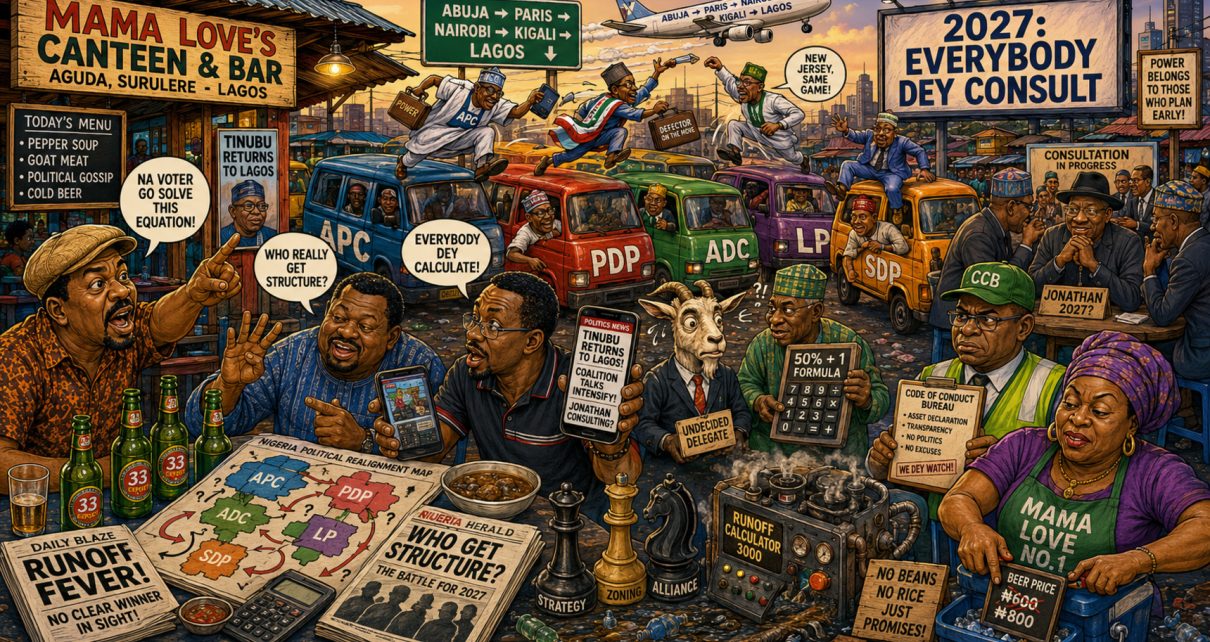
By Friday evening, Mama Love’s Canteen and Bar had transformed into what Chiboy proudly called “Aguda Political Situation Room.”
Lagos itself was tense.
President Bola Tinubu had returned to Lagos after another round of international diplomacy—France, Kenya, Rwanda—landing directly into the storm clouds of APC primaries, opposition calculations, coalition rumours, and political repositioning so intense that even old enemies were suddenly exchanging phone numbers.
The city could smell election season.
And election season in Nigeria is when:
- politicians become spiritual,
- businessmen become ideological,
- and everybody suddenly starts “consulting.”
Chiboy arrived sweating dramatically.
“Syracuse! Politics don turn Avengers: Endgame.”
John nodded gravely.
“Everybody dey align. APC dey calculate. PDP dey repair. ADC dey recruit. LP dey survive. SDP dey wait for frustrated customers.”
The beer parlour erupted.
I adjusted my cap carefully.
“This,” I said, “is no longer ordinary party politics. It is structural realignment.”
And indeed, the political atmosphere had shifted beyond the usual APC-versus-PDP argument.
Now there were:
- coalition talks,
- runoff mathematics,
- zoning battles,
- caretaker committees,
- hidden negotiations,
- institutional positioning,
- and silent betrayals wearing native attire.
Chiboy leaned forward excitedly.
“This NDC-ADC people serious o. Dem dey prepare runoff like World Cup knockout stage.”
He was right.
Under Nigerian electoral law, a candidate needs:
- the majority vote,
- and broad spread requirements.
If nobody secures clear dominance early, a runoff scenario becomes possible.
And suddenly, opposition politics becomes arithmetic.
John scratched his head.
“So all these parties fit fight separately first… then suddenly become best friends?”
“Exactly,” I replied.
That was the strategy being openly discussed by people like Chekwas Okorie and quietly encouraged by activist voices such as Aisha Yesufu.
The idea:
Fragment first. Consolidate later.
A dangerous game.
Because Nigerian politicians switch alliances faster than Lagos weather changes during rainy season.
Chiboy laughed loudly.
“Nigeria politics now na relationship status: ‘It’s complicated.’”
The table collapsed.
But perhaps the most interesting figure floating around the political atmosphere was not Tinubu.
It was former President Goodluck Jonathan.
Or rather:
the possibility of Jonathan.
John lowered his voice theatrically.
“You think GEJ really wan come back?”
I smiled slightly.
“Jonathan is doing what experienced politicians do best,” I said. “Remaining available without fully entering the battlefield.”
And indeed:
- consultations were happening,
- support groups were mobilising,
- South-East conversations were unfolding,
- PDP elders were visiting,
- and constitutional uncertainty had quietly disappeared after the Yenagoa court judgment.
Nobody officially declared anything.
Which, in Nigeria, usually means everything has already started unofficially.
Chiboy shook his head.
“Jonathan dey do soft launch.”
That phrase nearly killed the beer parlour.
But it captured the moment perfectly.
Jonathan was maximising leverage.
By not fully committing, he remained useful to every opposition bloc trying to build coalition arithmetic.
John became reflective.
“The thing wey dey help Jonathan na memory. People remember when dollar never become horror film.”
That observation carried weight.
Nostalgia is becoming a political force.
In periods of inflation and hardship, former administrations often benefit from selective memory enhancement.
Suddenly:
- fuel prices become “manageable,”
- exchange rates become “stable,”
- and governance becomes “better those days.”
History receives emotional editing.
But then Surulere politics entered the room like uninvited thunder.
And once Surulere politics arrives, no conversation remains calm.
Chiboy grinned mischievously.
“Now make we discuss Desmond.”
Ah yes.
The actor.
The lawmaker.
The apology specialist of the week.
After comments from Femi Gbajabiamila suggested political distancing, Desmond Elliot appeared on television offering what Nigerians are still debating:
an apology…
or conditional grammar.
John sat upright dramatically.
“‘I’m sorry IF I offended you.’”
The table exploded instantly.
Because Lagos understands apology mechanics deeply.
“If I offended you” is not confession.
It is diplomatic uncertainty.
Mama Love joined from the kitchen immediately.
“That one no be apology. Na customer complaint form.”
The beer parlour nearly collapsed.
Even Chiboy had to wipe tears.
Still, beneath the humour was political seriousness.
In Lagos politics—especially Surulere politics—structure matters more than sentiment.
Celebrity can open doors.
But survival depends on political machinery.
And when influential sponsors publicly withdraw warmth, the atmosphere changes quickly.
John leaned back slowly.
“You think this na end of road for Desmond?”
I shook my head.
“Nigerian politics does not end careers permanently,” I said. “It only changes waiting rooms.”
That landed heavily.
Because politics here operates like Lagos traffic:
today’s blockage can become tomorrow’s shortcut.
Chiboy nodded thoughtfully.
“One thing sure—everybody dey reposition.”
Exactly.
APC is consolidating.
Opposition parties are calculating.
Smaller parties are preparing for refugee politicians.
The CCB is digitising asset declarations quietly in the background.
And politicians everywhere are suddenly discovering the importance of consultation, humility, and strategic friendship.
John sighed deeply.
“Meanwhile ordinary Nigerian dey calculate garri.”
Silence.
Because eventually, every political conversation in Nigeria returns to economics.
Coalitions are important.
But food prices remain undefeated.
As the evening wound down, Mama Love quietly increased pepper soup prices by ₦200.
Nobody noticed immediately.
Which, perhaps, is how governance often works too.
I adjusted my cap and gave the final reflection.
“In Nigerian politics,” I said, “alliances change, parties realign, and apologies evolve. But the only coalition voters truly respect is the alliance between leadership and results.”
Then I looked around Mama Love’s canteen.
“And until that coalition works,” I added, “every Friday night will continue to sound like emergency political therapy.”
Na so we see am.


