
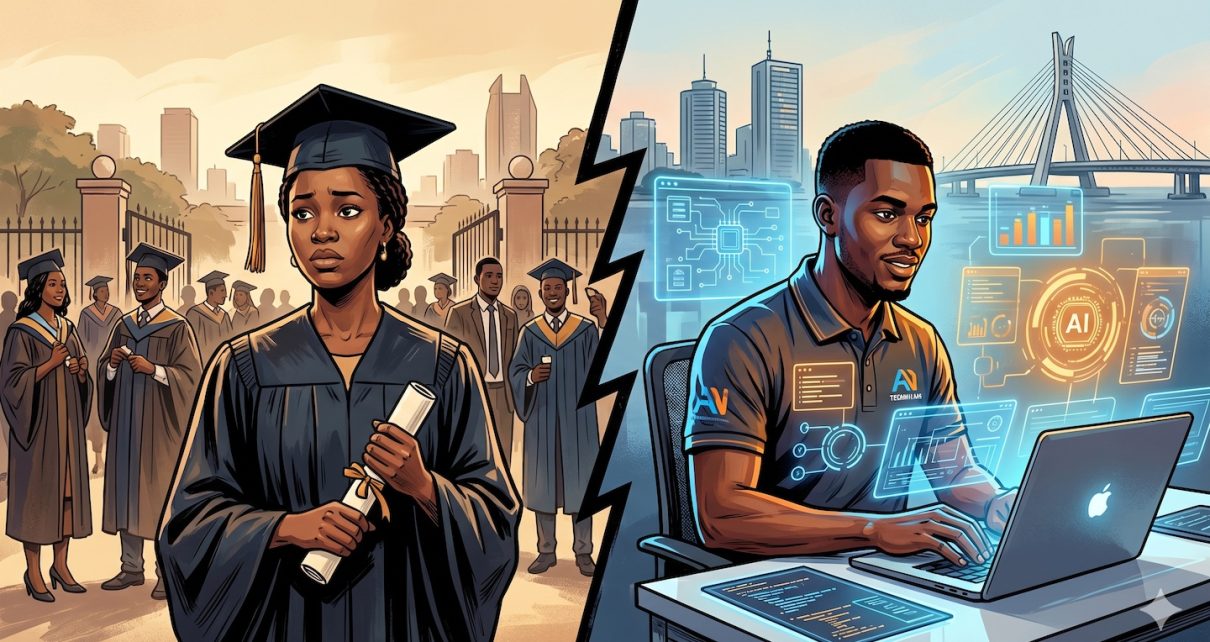
Two hundred thousand graduates a year. A 60 percent skills mismatch. No credible national manpower audit. And a group of teenagers on radio who might have seen it more clearly than most.
A group of young Nigerians debating on radio in Lagos recently made a point that many adults in positions of authority have been slow to admit: that a university degree, in and of itself, may no longer be the golden ticket their parents told them it was. The argument, put plainly, was this — finish secondary school, acquire a skill, and enter the world of work. The degree, they said, should follow purpose — not precede it.
It is a view that, until recently, would have been dismissed as the grievance of those who simply did not make it into university. But the data, and a rapidly shifting global economy, are lending these young voices a credibility that demands serious policy attention.
The World Is Already Moving
Here is the news peg that changes the conversation. A 2026 survey by the Lumina Foundation and Gallup found that 23 percent of major employers in the United States had already removed degree requirements from job roles in the preceding three years, with a further 20 percent in the process of doing so. Globally, 85 percent of employers have now adopted some form of skills-based hiring — evaluating candidates on what they can do, not what certificate they hold.
Companies like Google, Apple, IBM and Accenture have either eliminated or significantly reduced degree requirements for a wide range of roles. The Federal Reserve Bank of New York, while noting that a college degree still yields an average return of about 12.5 percent and that degree holders earn roughly $30,000 more annually than their high-school-only counterparts, is careful to add that the returns depend heavily on the field of study, the institution attended, and the experiences gained during study.
The world is not abandoning higher education. It is demanding that higher education earn its place. Nigeria has yet to have that conversation — at least not honestly, and not at the level of policy.
200,000 Graduates a Year. Then What?
Nigeria produces an estimated 200,000 university graduates annually from a system of over 270 universities — 149 private, 63 state-owned, and 62 federal. It is an impressive output by volume. By outcome, the picture is considerably darker.
A study examining skills among employed Nigerian graduates found an overall skills mismatch rate of 60.6 percent — meaning more than half of working graduates are in roles that do not match their training, or lack the core competencies their employers actually need. The gaps identified are striking: communication, information technology, decision-making, critical thinking, interpersonal skills, entrepreneurial capacity, technical ability, and numeracy. These are not specialised skills. They are the foundations of functional employment.
“In recent years, there has been a growing concern among employers across Nigeria regarding the job-readiness of fresh graduates. The mismatch between academic output and labour market expectations has become more pronounced.” — Joseph Adagbogun, Chief Human Resource Officer, Resource Intermediaries Limited
The National Bureau of Statistics reported in 2022 that 53.4 percent of Nigerian youth — a category that includes graduates — are unemployed. Post-secondary education holders registered a 9 percent unemployment rate in the first quarter of 2024, higher in many analyses than peers who entered trades and technical fields directly from school.
Where Is the National Manpower Audit?
The central policy failure underlying Nigeria’s education crisis is the absence of a credible, current, and enforced national manpower needs framework. What does the Nigerian economy actually need — by sector, by region, by skill type — over the next ten to twenty years? The answer should drive what universities teach, what polytechnics produce, what vocational centres train for, and what the secondary school curriculum prepares students to enter.
Instead, Nigeria has operated largely in reverse: producing graduates according to what institutions can teach, and hoping the economy will absorb them.
The Strategic Nigeria Talent Accelerator Roundtable, co-chaired by the Federal Ministry of Industry, Trade and Investment, the Federal Ministry of Education and the World Economic Forum, convened senior leaders in Lagos in November 2025 to begin mapping a 12-month action plan for skills transformation. The government’s stated goal is to skill five million young Nigerians by 2030. That is an ambitious number. But ambition without a detailed sectoral manpower audit — one that tells us precisely how many data analysts, civil engineers, healthcare technicians, agri-tech operators, and logistics specialists the country needs — risks producing another generation of trained-but-misplaced workers.
The Certificate Culture: A Uniquely Nigerian Dysfunction
In most developed economies, the question is simply: can you do the job? In Nigeria, the anterior question is almost always: what is your certificate? This has produced what many education economists describe as a “credential inflation” cycle — where a position that once required a school certificate now demands an OND, where an OND role now demands a B.Sc., and where even entry-level government posts require degrees that bear no relationship to the work involved.
The result is that the university system has become, in large measure, a social sorting mechanism rather than a skills-production engine. The children on radio are not wrong. They have watched siblings and cousins spend four to six years in university — through strikes, overcrowded halls, and outdated syllabi — only to emerge into a job market that either ignores them or exploits them. They have watched the same-age plumber, the self-taught graphic designer, the electrician who trained under a master craftsman, earn a comfortable living while the graduate circulates CVs.
The HND–B.Sc. Wound That Won’t Heal
Perhaps no single policy failure better illustrates the depth of Nigeria’s credential bias than the Higher National Diploma–Bachelor of Science dichotomy. HND holders — graduates of polytechnics and technical institutions — have for decades been systematically disadvantaged in hiring, promotion, salary progression, and access to postgraduate study, regardless of demonstrated competence.
The Nigerian Association of Technologists in Engineering formally petitioned President Bola Tinubu in February 2026 to abolish the dichotomy, stating that it “had hindered productivity, discouraged technical skills development, and limited the full contribution of technologists to national growth.” The Federal Government announced in January 2026 that polytechnics will be empowered to award degrees — a move education experts have described as a potential turning point for technical and vocational education.
“Discrimination against HND holders significantly undermines the effectiveness of vocational education reforms by perpetuating a preference for university degrees and discouraging polytechnic enrolment. Without policy enforcement, reforms fail to translate into increased enrolment or societal recognition.” — Education policy analysis, Guardian Nigeria, 2026
AI, New Technology, and What Higher Institutions Should Actually Be Producing
The arrival of artificial intelligence as a mainstream workplace tool has sharpened the stakes of this debate considerably. Tasks once performed by entry-level graduates — data sorting, basic research, report drafting, routine correspondence — are being automated. The jobs that remain, and the jobs being created, demand a different kind of intelligence: the ability to prompt, guide, evaluate, and build upon AI tools; to solve problems that machines cannot yet frame; to lead teams, manage complexity, and innovate across disciplines.
This raises a direct challenge to the existing model of the Nigerian university degree. If a four-year programme still teaches graduates to pass examinations rather than apply knowledge, it is not preparing them for the economy that already exists — let alone the one that is emerging. Deloitte’s 2026 Higher Education Trends report identifies AI as the single most disruptive force reshaping the value calculus of a university education globally.
Germany’s dual education model — in which students simultaneously pursue academic and vocational tracks from an early age, with employers embedded directly in the training process — is frequently cited as a benchmark. The principle is sound: education must be designed in partnership with the economy it is meant to serve.
The Harder Questions
Several structural questions remain inadequately addressed in Nigeria’s education policy discourse. Why has no administration produced an enforced, sector-by-sector national skills mapping framework tied to GDP priorities and updated on a rolling basis? Why do employers — including government agencies — continue to require degrees for roles that demonstrably do not need them? Should WAEC and NECO results carry greater professional and employment weight than they currently do? Is the JAMB bottleneck, which filters hundreds of thousands of qualified candidates out of university through cutoff scores, inadvertently creating artificial credential scarcity rather than managing genuine institutional capacity? And what is the role of the private sector — which benefits most directly from skilled labour — in funding and shaping the training pipeline?
These are not rhetorical questions. They are the questions a national manpower commission — if one existed with genuine authority and resources — should be answering continuously.
What Reform Must Look Like
“By empowering our youth to co-create education, we are not merely reforming classrooms; we are safeguarding Nigeria’s future, strengthening national unity, and unlocking the full potential of the next generation.” — Dr. Tunji Alausa, Nigeria’s Minister of Education, January 2026
The architecture of reform is visible. What is less clear is the speed and rigour of implementation — particularly given that Nigeria’s education sector receives between 6.39 and 8.2 percent of the national budget, well below UNESCO’s recommended 15 to 20 percent minimum and far below the 26 percent recommended by Nigeria’s own National Policy on Education.
Reform that is serious would include, at minimum: a published, data-driven national manpower needs audit reviewed every three years; the full statutory elimination of the HND–B.Sc. dichotomy backed by enforcement mechanisms; the elevation of TVET institutions to genuine, respected career pathways with parity in public funding and social recognition; the formal integration of employer partnerships into university and polytechnic curricula; and the recognition of internationally certified micro-credentials — from platforms like Google, AWS, Coursera and Microsoft — as equivalent to, or combinable with, formal qualifications.
The Children Were Not Wrong
The young people on radio were not calling for the end of university education. They were calling for honesty about what it currently delivers — and what it does not. They were asking, in the plainest language, whether the system is working for them or simply processing them.
A country that produces 200,000 graduates a year into a labour market that cannot absorb them, that stigmatises its own technical and vocational institutions, that has no current national account of what its economy actually needs, and that allocates its education budget far below global standards — such a country is not managing an education system. It is managing a credential factory.
The question is not whether Nigerians should go to university. The question is what university — and every level of education that precedes and follows it — should actually be preparing them to do. In the age of artificial intelligence, global skills competition, and a youth population that is both the country’s greatest asset and its most urgent responsibility, the cost of getting this wrong is one Nigeria cannot afford.
The children heard it before many of us did. It is time policy caught up.


