
By Joy Essien
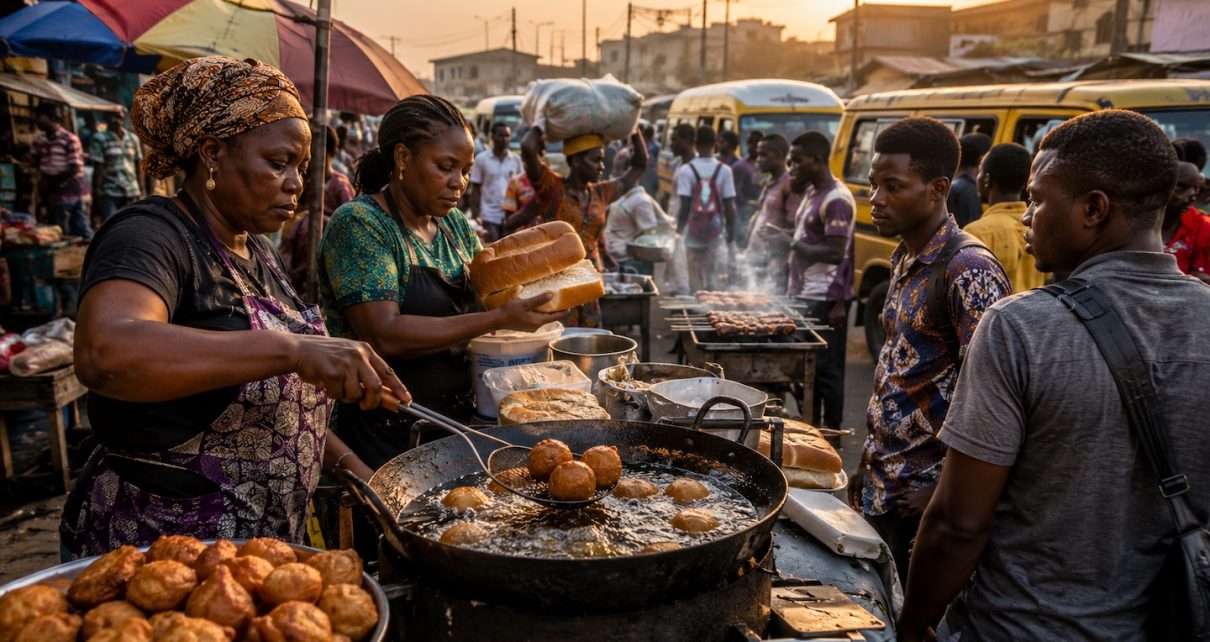
There are places where food is simply consumed, and there are places where food tells a story. In Mushin, every sizzling pan of akara, every smoky curl rising from a suya grill, and every steaming plate of amala carries the rhythm of a neighbourhood in perpetual motion.
To understand Mushin, you must first understand its street food. It is not just about taste or affordability. It is about survival, speed, resilience, and ingenuity. Here, food is woven into the mechanics of daily life, powering traders, transport workers, artisans, and commuters who keep one of Lagos’ busiest commercial arteries alive.
Street food is much more than a quick, affordable meal on the go—it is the living, breathing heartbeat of a city’s economy and culinary identity. It offers an unfiltered look into the local culture, history, and daily rhythms of the people who live there.
If Lagos is the commercial engine of Nigeria, Mushin is the raw, high-octane piston that pumps its blood. It is an area defined by hyper-dense commerce, massive transport hubs, and a relentless, 24-hour hustle.
In an urban ecosystem like Mushin, street food is not a leisure choice or a culinary trend—it is critical infrastructure. It is high-calorie, fast-milled, intensely flavoured fuel designed for a population that is always moving, trading, or commuting.
The street food culture in Mushin offers a fascinating case study in hyper-local logistics and high-volume micro-entrepreneurship.
The Logistics of the Morning Rush: Fueling the Traders
The day in Mushin starts well before dawn, driven by the massive influx of traders, loaders, and buyers heading to landmarks like Ojuwoye Market, Daleko Market (the wholesale hub for rice and grains), and the Ladipo Spare Parts Market.
The Akara and “Burger” Production Lines
By 5:00 AM, giant cast-iron cauldrons of groundnut oil are bubbling on roadside corners. In Mushin, akara (fried bean cakes) is not just a snack; it is a high-speed operation. Vendors slip piping-hot, crispy akara into sliced, stretchy Agege bread, creating the ultimate budget-friendly Lagos “burger” that commuters eat mid-stride or while packed into moving danfos.
Ewa Agoyin Hubs
Because Daleko Market is the epicentre of the grain trade, the quality and volume of ewa agoyin (mash-soft beans with a fiercely dark, caramelised palm oil and pepper sauce) in this axis is unparalleled. It is heavy, rich, sustained energy designed to keep a manual labourer or market porter going for six to eight hours.
The Micro-Economics of the Idi-Oro Fresh Food Hub
A massive factor shaping Mushin’s modern food landscape is the Lagos Fresh Food Hub at Idi-Oro.
Market Impact
This state-backed mega-facility handles billions of naira in transactions, acting as a major food aggregation point.
For local street food vendors, this means unparalleled access to direct farmer-to-market produce. The proximity to this hub creates a fascinating micro-supply chain: street food in Mushin is often fresher and cheaper to produce than in almost any other part of Lagos Mainland because the raw inputs—peppers, onions, palm oil, and tomatoes—bypass multiple layers of middlemen.
The Mid-Day “Buka” and Transient Dining
By midday, the street food culture shifts from grab-and-go snacks to heavy, comforting swallows served in highly efficient bukas tucked under flyovers, beside mechanics’ workshops, and inside market stalls.
The Amala Economy
Joints like Amala Babalola and various unnamed market canteens serve steaming-hot amala pulled straight from large wooden mortars, drenched in viscous ewedu, earthy gbegiri, and fiery omi obe.
The “Point-and-Kill” Red Meat Culture
Driven by the heavy presence of youthful manual labour and local butchery trades, you will find incredibly vibrant meat joints serving offal, ponmo, and beef parts slow-simmered in intensely peppered broths. It is nose-to-tail dining at its most authentic and zero-waste.
The Nocturnal Shift: Suya Under the Neons
When the markets technically close, Mushin does not sleep; it simply changes its rhythm.
The nighttime street food economy is dominated by the smoky haze of charcoal grills.
ARISCO Suya and Corner Grills
Mushin’s nightlife thrives along its major transit veins. The mallams set up their stands, layering thin ribbons of beef, liver, and kidney with heavy blankets of yaji.
The Atmosphere
Eating street food at night in Mushin is a sensory overload. It unfolds against a backdrop of loud music spilling from local bars, the shouts of transport conductors, and the glow of makeshift lights.
The food becomes social glue, drawing together transport workers, traders counting their daily earnings, and residents unwinding after the daytime heat.
The Urban Forensic Takeaway
From an analytical perspective, Mushin’s street food culture is a masterclass in spatial efficiency.
Vendors do not have the luxury of expansive square footage. Instead, they map their businesses around foot-traffic bottlenecks and transit switch-points. It is an economy built on high volume, razor-thin margins, deep communal trust, and an absolute mastery of fast-paced local flavour.
A Visitor’s Guide
Navigating the raw, high-velocity environment of Mushin as a visitor requires deliberate strategy.
This is not a curated food festival or a neighbourhood for leisurely walking tours. It is a dense, high-volume commercial engine where street food is deeply woven into the organised chaos of transit and market trade.
The Strategy of Hyper-Local Anchors
Rather than wandering unfamiliar side streets, structure your culinary route around established commercial landmarks.
- The Daytime Wholesale Epicentre: Fresh Food Hub Mushin in Idi-Oro and Ojuwoye Market
- The Nighttime Transit Arteries: Major, well-lit thoroughfares and active bus terminals
Essential Ground Rules
Go with a Local Guide
A guide who understands the area and local dynamics is invaluable.
Blend into the Hustle
Dress simply, avoid flashy accessories, and keep expensive gadgets discreet.
Cash Is King
Carry small denominations. The street food economy here moves too quickly for large notes and delayed transactions.
Assessing Food Safety and Quality
The Crowd Velocity Test
High turnover means fresh food.
Observe the Heat Level
Prioritise food cooked directly before you at high temperatures.
The Three-Hub Culinary Map
The Idi-Oro Axis
Best for daytime swallows and fresh produce-driven bukas.
Ojuwoye and Daleko Markets
Ideal for the morning akara and ewa agoyin rush.
Mushin Olosha Junction
The evening hotspot for suya and grilled delicacies.
The Local Food Vocabulary
| What You Want | What to Say | Tactical Tip |
|---|---|---|
| Mixed meat cuts | “Give me orisirisi” | Expect a flavourful mix |
| Extra spicy stew | “Add omi obe” | Ask for it separately if cautious |
| Fresh Agege bread | “Is the bread ofege?” | It should feel soft and springy |
| Controlled suya spice | “Put yaji inside paper” | Add spice to taste |
Final Thoughts
To eat your way through Mushin is to witness Lagos in its most unfiltered form.
Beyond the flavours lies a powerful story of adaptation, entrepreneurship, and community. Every vendor, every improvised stall, every carefully balanced tray tells a deeper story of people building livelihoods in motion.
Mushin’s street food culture is not polished for visitors, and that is precisely its charm. It is honest, urgent, and unapologetically alive.
For anyone willing to look beyond the surface, Mushin offers more than a meal. It offers a rare taste of Lagos in its purest, most energetic state—one sizzling pan, one smoky grill, and one unforgettable bite at a time.


