
There are weeks when Lagos debates fuel prices, football, or foreign wars. And then there are weeks when the country is forced to confront something heavier—something that refuses to sit comfortably inside humour.
This was one of those weeks.
News broke of yet another deadly attack in Plateau State. Lives lost. Communities shaken. Familiar headlines, sadly, delivered with unfamiliar numbness.
And then came the President’s visit.
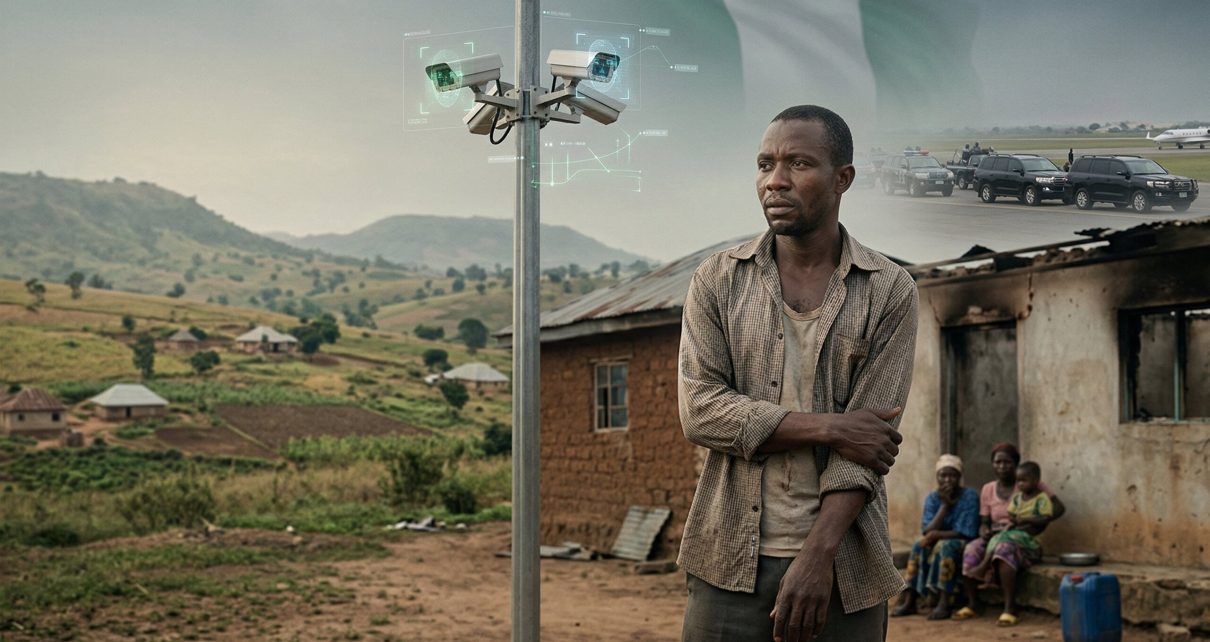
He met victims. He commiserated. He announced a solution—an ambitious one at that: over 5,000 AI-enabled surveillance cameras to monitor and improve security across vulnerable regions.
By evening, the matter had reached Aguda.
Chiboy arrived first, visibly agitated.
“See wetin dey happen for Plateau! Every time, same story—attack, condolence, repeat.”
John shook his head slowly.
“And dem say President go Jos… but na airport dem meet victims.”
I sat down quietly. Some conversations begin loudly. Others carry weight from the start.
The beer parlour, unusually, was not in a joking mood.
Chiboy continued, his voice rising.
“Why airport? Why not go meet them for where dem dey suffer?”
There is something symbolic about location. Where a leader stands often matters as much as what he says.
John added, more softly:
“If person house burn, you no go greet am for gate. You go enter inside see the ashes.”
That line settled heavily on the table.
Leadership, in moments of crisis, is not only about policy. It is about presence. And presence, Nigerians believe, must feel real.
Still, the announcement of the surveillance system quickly became the centre of debate.
Five thousand AI-enabled cameras.
A technological solution to a deeply human problem.
Chiboy, predictably, leaned forward with authority.
“As IT person, make I talk am—camera no bad. But camera no be soldier.”
John nodded.
“Camera go record crime. But who go stop am?”
That was the central tension.
Technology can observe. It can detect. It can even predict patterns. But it cannot replace boots on the ground, intelligence gathering, or trust between communities.
I intervened.
“The idea,” I said, “is that surveillance improves response time and accountability.”
Chiboy shook his head immediately.
“Response time ke? If road no good, network no stable, who wan respond?”
John added:
“And if dem see am live-live, na camera go run go arrest?”
The beer parlour murmured again.
There is a certain practical realism in Lagos thinking. Solutions are measured not by how impressive they sound, but by how they survive contact with Nigerian conditions.
Electricity is unreliable. Connectivity is inconsistent. Maintenance culture is… aspirational.
Five thousand cameras raise as many questions as they answer.
Who will maintain them?
Who will monitor them?
Who will act on what they see?
Chiboy, warming to his theme, pressed further.
“AI camera for Plateau… but village no get light. You see the mismatch?”
Indeed.
Technology thrives in systems that support it. Without infrastructure, it becomes decoration.
John leaned back, arms folded.
“This country like solution wey sound big. But small-small things wey matter, we dey ignore am.”
It is a familiar pattern. Grand announcements often coexist with unresolved basics.
Still, it would be unfair to dismiss the effort entirely.
Surveillance has worked in many parts of the world. It has reduced crime, improved coordination, and strengthened security frameworks.
But context matters.
Nigeria’s security challenges are not merely technical. They are historical, social, economic, and political. They involve land disputes, ethnic tensions, weak institutions, and fragile trust.
No camera, however intelligent, can fully interpret that complexity.
As the debate intensified, emotions rose again.
Chiboy struck the table lightly.
“Make government start from basics—intelligence, community trust, quick response. Camera fit follow later.”
John nodded.
“And make leaders dey show face properly. People need to feel say dem no dey alone.”
That point returned us to the beginning.
Presence.
Symbolism.
Empathy.
In times of crisis, citizens are not only asking, “What is being done?” They are asking, “Do you see us?”
And perhaps that is the irony.
We are deploying thousands of cameras so the state can see more clearly. Yet many citizens still feel unseen.
As we stood up to leave, the beer parlour fell into that rare Lagos silence—the one that comes when humour has reached its limit.
Then Chiboy spoke quietly.
“Camera fit see everything… but e no fit feel anything.”
I adjusted my cap and gave the final word.
“Technology can support security,” I said. “But it cannot replace responsibility. If we treat a human crisis like a technical glitch, we may end up with clearer footage—and the same tragedy.”
Because in the end, security is not just about watching.
It is about protecting.
Na so we see am.


