
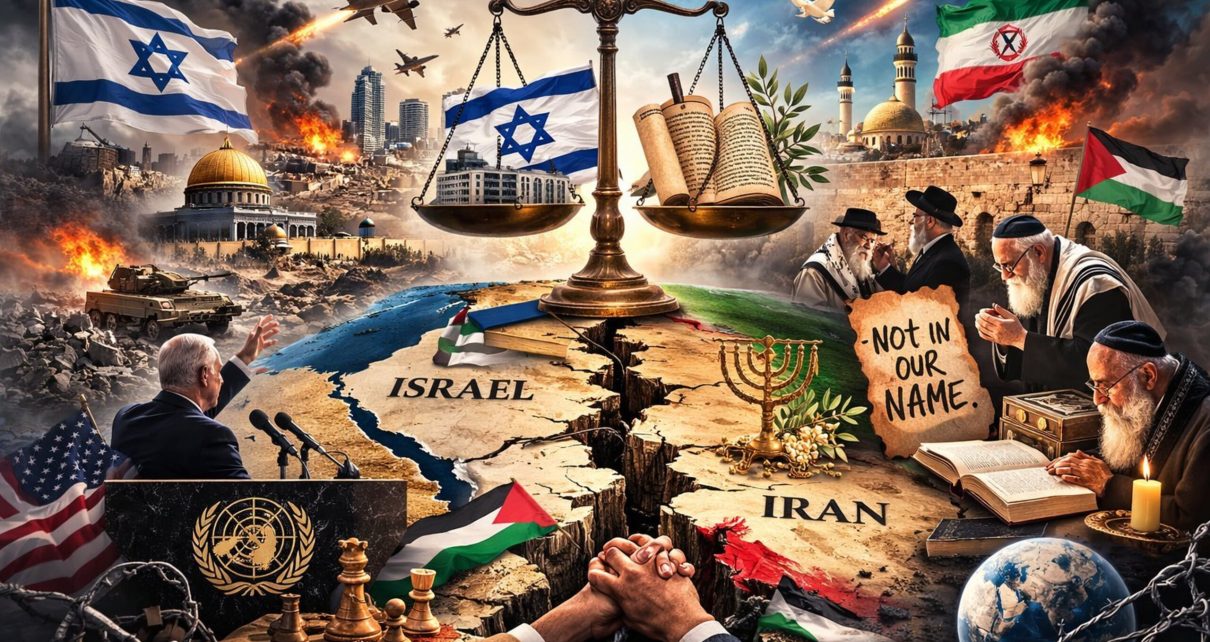

The ongoing US/Israel vs Iran war will go down in history as one landmark event that has re-educated the world about how the politics of identity can be used as a baton to beat history, religion and geography on the head.
Inequity, as carefully distinguished from inequality, is finely embroidered into the fabric of world interrelationships. For example, the world generally acknowledges that Iran does not have a nuclear weapon, whereas Israel does. In the ongoing conflict, Iran was first attacked by Israel, not the other way round. This is not to say that Iran always smells of roses. It carries its own baggage of misdeeds. In the current crisis, however, Israel and America are the aggressors, even if they try to spin it otherwise.
Having acknowledged that Iran is not necessarily a saint, it is significant that it is a signatory to the nuclear non-proliferation treaty (NNPT), while Israel isn’t. Iran opens its facilities to nuclear inspectors. Israel doesn’t. One recalls that in 1981, a UN resolution asked Israel to place its nuclear facilities under the International Atomic Energy Agency (IAEA). Israel refused. Somehow, the world seems to have resigned itself to accepting that Israel is one of the more equal animals in the global animal farm.
Re-Education
The world has always known that the philosophy of Zionism and strict Jewish orthodoxy are parallel lines that can never meet. The current needless war has brought the issue to the fore again, with some otherwise media-shy personages storming social media with their dissent. “Not in our name,” they say.
The strict orthodox Jew does not want to be confused with the political Zionists. In a world where generalisations are routinely employed to demonise whole ethnicities, the distinction between the two is quite important in forming an educated opinion about the driving forces behind the current festival of missiles in the Middle East.
Israel is a country that comprises Jews (73.5%), Arabs (about 21.5%) and others (5%). A Jew belongs to a global ethnic community with shared religious, cultural and ancestral roots, while an Israeli is a citizen of the modern State of Israel, regardless of his/her religion or ethnic background. Every person of Jewish heritage who so desires is allowed to become a citizen of the nation of Israel.
It is clear, therefore, that more than half of the world’s 15.7 million Jews are not Israeli citizens. A Jewish person born in the US is an American Jew, just as a Jewish person born in Paris is a French Jew. There are Jews who are nationals of other countries all over Europe and other parts of the world.
‘Chosen Race’?
Many people have taken interest in finding out more about Jews, not only because of Israel’s seeming warlike disposition, but also because of the historical/biblical narratives associated with the name. Some religious zealots confuse the biblical Israelites with today’s Israelis, believing that the promises made to Abraham can somehow be consummated through Netanyahu.
Such people make no distinction between Israel of the Old Testament and the contraption called by the same name after its creation in 1948. For them, every Jew is a member of the “chosen race”, and Israel will always be Israel, whether in the days of the Old Testament, today, or in the future.
It is intriguing and fascinating to compare the stance of some Christian zealots (who believe that Israel can do no wrong) with the fundamental anti-Zionism of strict orthodox Jews who continue to insist that the Jewish people are in a divinely decreed exile. These religious Jews cite a passage in the Talmud (the “Three Oaths”), which they interpret as a prohibition against Jews retaking the promised land by force before the Messiah arrives.
The three oaths in question are the following:
First: The Jewish people shall not “scale the wall” (ascend to the Land of Israel en masse by force).
Second: The Jewish people shall not rebel against the nations of the world while in exile.
Third: In exchange, the nations of the world shall not oppress the Jewish people “too much”.
The strict adherents of Judaism consider these binding religious injunctions. They contend that the Jewish exile was a divine decree and that ending it through human effort—like political lobbying, war, or building a state—is tantamount to trying to force the Messiah to come before God is ready. In Judaism, the Messiah is expected to arrive within 6,000 years of creation, a deadline corresponding to the Gregorian year 2240—or earlier—if humanity or the Jewish people are deemed worthy.
Anti-Zionist Jews believe that by establishing the state of Israel in 1948, the Zionist movement violated the first two oaths and that there will eventually be dire consequences for that. It can be seen that deeply religious adherents of Judaism cannot reconcile self-help with God’s stated injunction on how the return to the promised land would be achieved. They oppose the forceful takeover of Palestinian land.
Christians in the Middle East
The Middle East has the distinction of being the birthplace of three major world religions—Judaism, Christianity and Islam. Over the years, the boundaries and dominant faiths of some of the major historical cities have changed, due mainly to wars of conquest. Still, it is remarkable that many of the Islamic states in the region have a larger population of Christians than Israel.
As of late 2025, the Christian population in Israel is approximately 184,000–185,000, comprising about 1.9% of the total population. The Christian community is primarily Arab.
By comparison, the Christian population in Syria ranges between 300,000 and 700,000 due to the massive exodus caused by war and persecution. Estimates of the Christian population in Iran range from 300,000 to over 1 million, depending on who is counting. Persian-language Christian services are banned. The most recent available data shows the UAE is roughly 76% Muslim, with the remainder being a mix of Christians, Hindus, Buddhists and other faiths. There are about 250,000–400,000 Christians in Jordan.
Current estimates of the population of Christians in Lebanon are around 2.24 million, approximately 33% of the population. The Catholic Maronite Church alone numbers about 1 million. In Qatar, there are about 240,000 Christians, almost all of whom are expatriates. Citizens make up only about 10% of the country’s population because the vast majority of the country’s total population (about 88–89%) are foreign workers.
From the above, it can be seen that the tendency to reduce the war narrative of the current Gulf crisis to one of competing faiths, or a fulfilment of some ancient prophecies, is misguided. Mankind can tolerate inequality. Fingers are not equal. But humanity will always resist inequity, no matter how cleverly disguised.
The more information one has about the competing interests at play, the better. Beneficiaries of religious lionisation may force-feed devout adherents, and whoever else may care, with a diet of religion; all the same, they don’t wait for God to fulfil His alleged promises in the holy books. They help Him to help them. Only God knows how many more crimes will be committed in His name before humanity wisens up.
Nuptial Bliss
Congratulations to Mr & Mrs Adesore and Omobolanle Omisore on tying the nuptial knot over the weekend in Abuja. Best wishes for a fruitful and blissful married life.


