
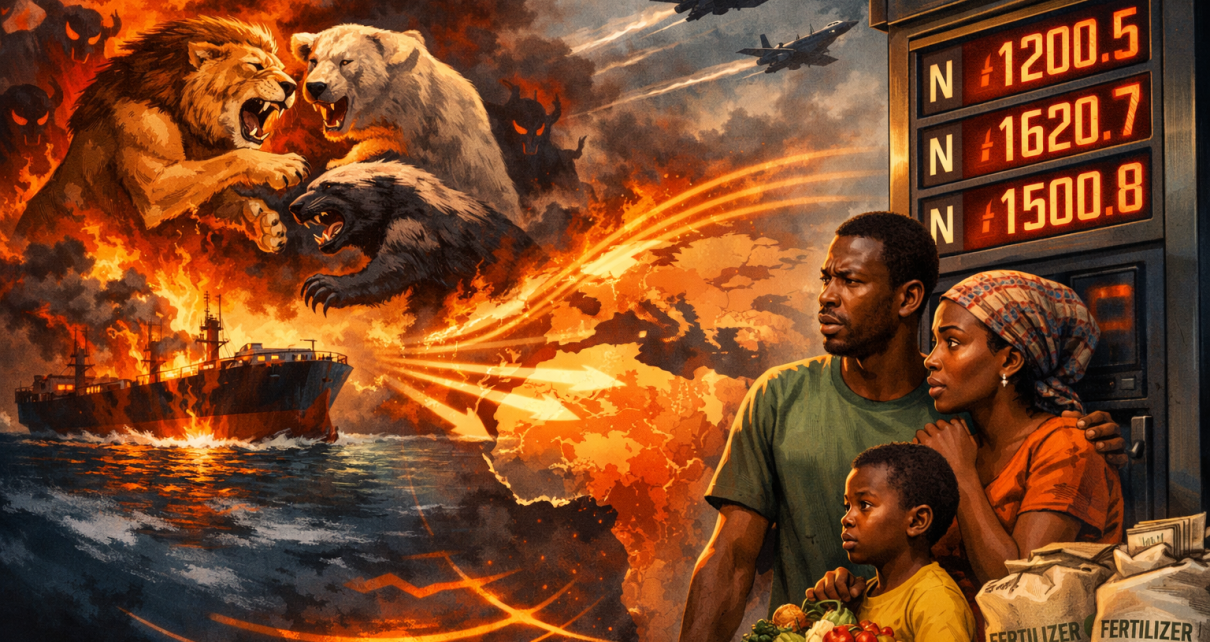

Africa does not have a dog in the fight going on in the Middle East. “Operation Epic Fury” is a war between a tag team of a lion and a polar bear on the one hand and a honey badger and its army of unseen Tasmanian devils on the other. What we have learnt so far is that the rules of warfare are being re-written before our very eyes. We have also seen that the world is more interconnected and nations more interdependent than the superpowers are prepared to admit.
Whichever way the hostilities end, the point has been made that one can only predict the beginning of a war; the variables that determine its duration and outcome are legion. Moreover, we have seen that asymmetry has two sides—in relation to armaments (where the god of war sides with superior firepower) and in the case of staying power (a situation in which the inferior opponent is primed to fight to the last man).
Avoidable
Many of us thought (naively, it has turned out) that the war was avoidable, especially as Iran and the US were engaged in talks brokered by Oman. But what happened? While American diplomats were sitting across from Iranian diplomats in Geneva, the US military buildup was happening simultaneously with the peace talks. Iran’s Foreign Minister, Abbas Araghchi, said publicly that even if his country’s supreme leader, Khamenei, were killed, the government would not fall.
The United States sat at the negotiating table and watched Iran agree to zero stockpiling and full IAEA verification — and still went ahead to launch the largest air campaign in the Middle East in a generation. In response, Iran is now targeting the infrastructure that keeps the entire Gulf region alive. And it has activated its proxies in the region. Believing that there is nothing more to negotiate, Iran is poised to fight to the bitter end unless, perhaps, the rest of the world is able to assure it that it would never come under attack in the future again (which is a tall order).
Iran cannot militarily defeat a combination of the US and Israel, but it can make it impossible for the two allies to sustain an expensive, long-drawn war that negatively affects the world economy because of the strategic location of Iran.
According to Jiang Xueqin, a historian and geopolitical theorist who runs a YouTube channel called Predictive History, “Iran sees the conflict as a calculated opportunity to unify its fractured population under a nationalist banner, to expel American influence from the region permanently, and to bleed the United States financially and militarily until Washington has no choice but to leave. Iran does not need to win on the battlefield. Iran needs the United States to stay long enough that the cost of staying becomes politically and financially impossible.”
Environment
In the midst of all this, the environment is taking a bashing which may take generations to recover from. The conflict has generated a major regional environmental crisis with implications for other parts of the planet. In addition to the destruction of physical assets, the war has triggered a series of transboundary ecological disasters, including but not limited to the following:
Atmospheric pollution and “black rain” caused by strikes on oil storage facilities in Shahran and Sohanak, releasing massive plumes of soot, sulphur dioxide, and nitrogen oxides.
Dispersal of carcinogenic compounds like benzene and PFAS into the air, raising fears of an increase in cancer rates and chronic lung disease for decades.
Resource diversion: Billions of dollars previously earmarked for “green” transitions in the Gulf are being diverted to defence and reconstruction.
Marine and coastal despoliation.
Agricultural impact: Contaminated “black rain” and toxic runoff have permeated Iranian farmland, posing a long-term threat to food security and contaminating groundwater layers.
Global climate and policy repercussions: Carbon spike — military operations are estimated to contribute roughly 5.5% of global emissions.
Desalination crisis: Over 100 million people in the region depend on desalination for drinking water. If desalination plants are taken out, a serious humanitarian crisis will ensue.
Oil slicks: Torpedo attacks on vessels, such as the Iranian frigate Dena, off the coast of Sri Lanka, have created 20 km-long oil slicks. In the Gulf, strikes on tankers and port infrastructure at Bandar Abbas have leaked hundreds of thousands of barrels into the sea.
Acoustic pollution: Intense naval activity and high-decibel military sonar (reaching up to 235 dB) are disrupting marine life.
Soil and groundwater contamination.
Relapse into coal: Disruptions to Middle Eastern gas and oil have forced countries like India to pivot back to coal, undermining global net-zero commitments.
The reaction of African countries has varied from selective neutrality (see no evil, speak no evil, and hear no evil) and outright condemnation of Iranian retaliation targeting Gulf states with US military bases, while remaining silent on the assassination of the 86-year-old Iranian leader, to South Africa’s outright condemnation of the US/Israel’s “anticipatory self-defence”.
The war has triggered a “balance-of-payments” crisis for many African states. With oil prices hovering between $100 and $120 per barrel, the pump price of petrol is getting beyond the reach of many people. In Nigeria, even with Dangote refinery, petrol prices have spiked to over N1,200/N1,300 per litre. The government is making more money from oil exports while the pockets of the citizens are being picked at the pumps.
Countries like Senegal, Zambia, and Eritrea are at high risk of depleting foreign exchange reserves due to rising import bills. With the Strait of Hormuz functionally impaired, one-third of the global fertiliser trade is at risk, forcing countries like South Africa and Morocco to scramble for non-Gulf supplies to prevent a 2027 food crisis.
Triple Threats
This is not our war in Africa. Our people shouldn’t be having appointments with avoidable death on account of the ongoing Gulf war. The African Union (AU) has wisely shifted its focus to the hundreds of thousands of African migrant workers in the Gulf and demanded “safe passage” and protection for these nationals as Iranian drones target regional aviation hubs.
Operation Epic Fury has fundamentally altered Nigeria’s economic trajectory for the first half of the year. As of mid-March 2026, petrol pump prices have already jumped from approximately N774 to between N1,200 and N1,500 per litre in major cities like Lagos and Abuja. Diesel (AGO) spiked to N1,620 per litre. This is particularly damaging because diesel powers the trucks that move food and the generators that power our industries. Analysts warn that if the Strait of Hormuz remains shut, petrol could hit N2,000 per litre by July 2026.
The war is hitting Nigerian agriculture through fuel costs, fertiliser scarcity, and the upcoming lean season (June–August). Food prices are projected to rise by another 30–35% by June. With the Middle East being a primary source of urea and phosphate, the disruption of Gulf shipping has sent fertiliser prices soaring. Many smallholder farmers may be forced to plant without adequate inputs, which will lead to a smaller harvest in late 2026.
Experts estimate that if the war continues for another six months, 20–25 million Nigerians will need food assistance by August 2026.
The fervent prayer on all Nigerian lips now is that the oil windfall will be prudently managed to achieve the greatest good for the greatest number of Nigerians.
So help us God!


