
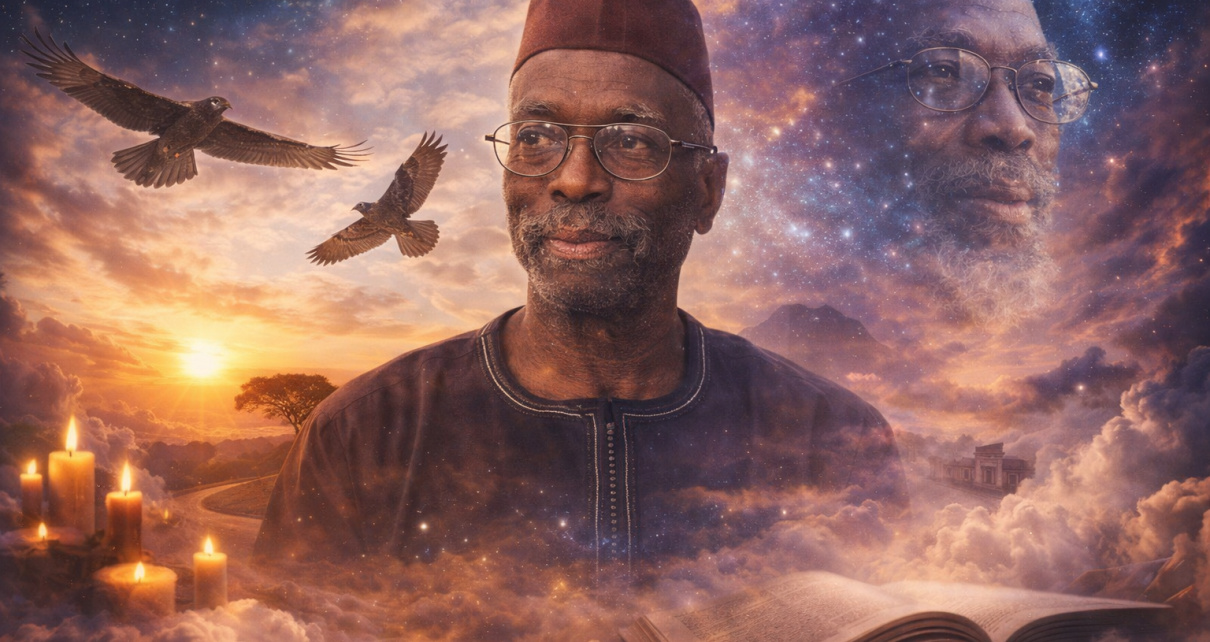
A life is not important except in the impact it has on other lives.
— Jackie Robinson

There could only have been one BJ in any academic environment. Biodun Jeyifo! Bee-Jay! Like a hawk flying high above the environment, he had a bird’s-eye view of goings-on among mortals—our daily struggles to make meaning of our sojourn. He elected to do this through the field of literature.
He was a book that could not be judged by its cover. If you did, you were doomed to regret it. His lean stature belied his titanic intellect and fiery oratory. Yet he was as simple as your next-door neighbour.
Impact
It was just like the self-effacing BJ to slip away just when we were welcoming him to the conclave of the elders. When he clocked 80, I thought that was just a precursor to what to expect in the next decade. The BJ that many of us knew, loved and trusted at the University of Ife, the BJ that is so well profiled in Yemi Ogunbiyi’s The Road Never Forgets, was the stuff of which centenarians were made. Or so it seemed. The funeral train of mourners, from Ibadan to Ife, Harvard to Cornell, and from Africa to the rest of the world, tells the story of a life of enduring intellectual impact.
BJ, as president of the Academic Staff Union of Universities (ASUU), was one of the first lecturers I approached when the students’ union was trying to process the admission papers of Segun Okeowo, the national president of the National Union of Nigerian Students (NUNS). The federal government had declared that no Nigerian university should offer admission to any of the NUNS leaders rusticated on account of the “Ali Must Go” protests for the democratisation of education in Nigeria. BJ and ASUU opposed the government ban. So did the students’ union.
BJ helped to reach out to other lecturers, including Prof. Soyinka, to quickly register Okeowo for their courses. The federal government was confronted with the fact that Okeowo had already been admitted at Ife before a rogue instruction of the education ministry (with all the imprimatur of the rump of military apologists in the new civilian government) banning him from all Nigerian universities was received. The authorities demanded an undertaking from the students’ union that Okeowo would not be involved in politics in Ife—an ordinary A4 paper which I was glad to sign as the union’s president.
Memories
If I had attended BJ’s 80th birthday, which was held last month, I would have taken him down memory lane and retold the story of how instrumental he was in strengthening my resolve at a particularly tempestuous moment for the students’ union of the University of Ife.
I had finished serving my tenure as president of the students’ union and was looking forward to graduation when law and order broke down on campus. The rumpus was caused by the ritual beheading of a student, Bukola Arogundade, in Ife town, allegedly by unknown traditionalists during the celebration of the Olojo Festival. (Rumours were rife on campus to the effect that only strangers or non-indigenes could be used as sacrifices to the gods during the annual festival. As with such rumours, you never knew what to believe.)
Protesting students poured into town. However, at the end of the tragic day, four more students lay dead: Paul Alonge, an Associateship student in Education; Wemimo Akinbolu, a 23-year-old Part III Arts student; Fatimo Adebimpe, a 22-year-old Part II Education student; and Bukola Arogundade, a Part III student.
The turmoil spread to the governance structure of the students’ union; the falcon and falconer were broadcasting on different wavelengths. The student leadership was suspended by the Students’ Representative Council (SRC). The campus was ready to burn.
It was at that stage that the vice-chancellor, Prof. Cyril Onwumechili, reached out to me through BJ and ASUU, requesting me to help navigate a path out of the crisis as examinations were imminent. Seeing trusted faces like BJ, Jingo (Fashina), Yemi Ogunbiyi and other progressive lecturers at the crucial meeting held well after midnight was quite reassuring.
I was requested to come out of retirement to restore normalcy so that examinations could be held and the university calendar saved. It would be a full-time assignment. I would have to shelve my own final examination until a later date. I didn’t mind helping out, but I required some guarantees too. I was not prepared to spend one minute extra to graduate. I wasn’t exactly a spring chicken when I enrolled.
BJ said I should feel free to state my terms.
I requested a full complement of the university’s logistical support (including ceremonial robing) for the burial of the fallen heroes. I reiterated my support for the proposed institution of an independent tribunal (backed by ASUU). I insisted on a written approval from the presidency that I, together with any member of my executive who joined me in stabilising the polity and facilitating the work of the independent tribunal, would still be allowed to embark on the National Youth Service Corps in July even though we were technically not yet graduates. We would return in September/October to take our final papers so that we could graduate with our mates in December.
Historic Bargain
We delivered, and the government kept its part of the bargain. That was how I went on national service before graduating. My secretary-general, Greg Obong-Oshotse, joined me in the task. The other members of my former executive could not take the risk because their courses were designed in the “Almighty June” format, which meant that if they missed the exams, they would have to spend an additional academic year.
The federal government sealed the deal with a letter assuring me that I had been granted presidential approval to allow me to go on national service before taking my final papers.
The point is that it is not every lecturer who can walk up to a student leader and request him to put his academic prospects on the line in order to sort out one “aluta” or the other. The fact that BJ evoked trust—the fact that his stern exterior was just a shield protecting his humane brand of talakawa radicalism—and then the fact that BJ was an onion with various layers—the more you peeled, the fleshier it got—made his advocacy irresistible.
BJ was special. Between 1984 and 2006, he showed the world his brand of literary criticism, cultural theory and social activism. He made the great works of Wole Soyinka and their oracular underpinnings digestible by cracking the palm nut of the Soyinkean worldview with the hammer of dialectical analysis instead of resorting to magisterial name-calling disguised as literary criticism. His standpoint is so authentic that he is credited with shifting African literary criticism from traditional colonial frameworks to more rigorous, radical, and Marxist-informed perspectives.
Even as dust returns to Mother Dust, BJ will always be BJ. Teacher. Friend. Oracle. He was the frontline horse that set the pace for other stallions. He was “Iwalesin” personified. Two birds cannot be named Hawk. “Eye meji ki i j’asa!” Fare thee well!


