
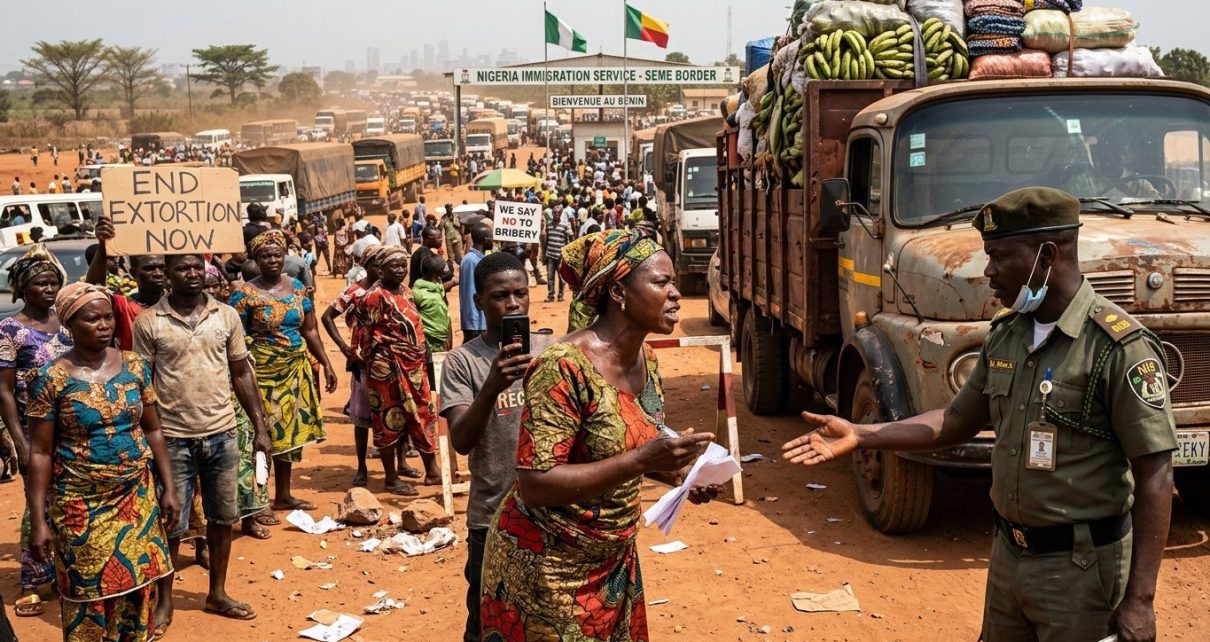
On Friday, April 10, 2026, Nigeria Immigration Service (NIS) Comptroller-General Kemi Nandap suspended comptrollers at the Lagos-Seme border commands in direct response to viral videos exposing officers’ extortion of traders and travelers, igniting public fury and prompting a formal probe.
The Lagos-Seme border, Nigeria’s pulsating gateway to West Africa, has erupted into scandal once again. Over the past week, social media exploded with graphic videos and eyewitness accounts of Nigeria Immigration Service (NIS) officers allegedly shaking down cross-border traders for bribes ranging from N10,000 to N200,000. These clips, shared widely on platforms like X (formerly Twitter) and Instagram, depicted uniformed personnel setting up unauthorized checkpoints, delaying goods-laden trucks, and harassing petty merchants—acts that not only violate NIS ethics but also throttle the lifeblood of informal trade sustaining thousands in Lagos and beyond. This catalyst, unfolding amid Nigeria’s fragile economic recovery, has forced a swift institutional reaction, underscoring deeper rot in border governance.
Strategic Hotspot Under Siege
The Lagos-Seme corridor is no stranger to controversy. Stretching from Badagry in Lagos State to the Republic of Benin, it handles over 70% of Nigeria’s informal cross-border commerce, ferrying everything from frozen poultry to second-hand electronics. Daily, thousands of traders—many women from Lagos markets like Idumota and Alaba—navigate this route, their livelihoods hinging on frictionless passage. Yet, for decades, it has been a notorious pressure cooker for corruption allegations across agencies like Customs, Police, and Immigration.
Historical precedents abound. In 2019-2020, President Muhammadu Buhari ordered a full closure to curb smuggling, only for the border to reopen amid complaints of revenue losses exceeding N50 billion monthly. Post-reopening, reports of “sorting” fees persisted, with officers reportedly demanding cuts for “facilitating” clearances. The current flare-up echoes these patterns: videos show officers in olive-green uniforms rifling through traders’ wares, barking orders like “Oya, drop something!”—a colloquialism for payoffs. Public outrage peaked as clips amassed millions of views, tagging NIS handles and amplifying calls for reform. In Lagos Metropolitan, where Surulere residents and commuters feel ripple effects via inflated goods prices, this hits close to home.
The Viral Catalyst and Escalation
What ignited this firestorm? It began innocuously enough: a trader’s phone footage from April 4, capturing an officer pocketing cash from a Benin-bound minivan. By April 8, similar videos flooded timelines, corroborated by audio clips of demands for “area money” or “protocol fees.” Traders recounted horror stories—one recounted paying N150,000 to release plantain consignments, another described a 12-hour ordeal for a single passport stamp. These weren’t isolated; they formed a pattern of racketeering, with officers allegedly operating in rings that shared spoils.
The digital deluge drew swift elite attention. Influencers, civil society groups like BudgIT, and even Lagos State lawmakers reposted content, framing it as sabotage to President Tinubu’s economic agenda. By April 9, #SemeBorderExtortion trended nationwide, pressuring NIS headquarters in Abuja.
Comptroller-General’s Decisive Response
Enter Kemi Nandap, whose tenure has pivoted toward modernization. On April 10, she issued a blistering statement: “Such despicable acts are an abomination to our service charter and will not stand.” Citing zero tolerance for misconduct, she ordered immediate suspensions of the Comptrollers at Seme, Badagry, and Celina commands—key flashpoints—to “pave way for unfettered investigation”. No names were disclosed publicly, preserving probe integrity, but sources indicate at least three senior officers are affected.
This isn’t performative. Nandap activated a multi-pronged response: a high-powered panel to identify every implicated personnel, from ranks to file; forensic review of viral evidence; and public appeals for tips. Citizens are directed to 24-hour hotlines—09121900655, 09121556359, 09121477092—or NIS socials (@nigimmigration) for anonymous reports. “We reclaim our borders for honest service,” she affirmed, aligning with federal anti-corruption thrusts.
Root Causes: Systemic Vulnerabilities Exposed
Beyond headlines, this scandal unmasks structural frailties. First, cash-heavy operations: Border fees, though digitized on paper, revert to envelopes in practice, fueled by weak banking penetration among traders. Second, oversight gaps: High traffic (over 5,000 daily crossings) overwhelms staffing, breeding impunity. Third, inter-agency turf wars—Customs and Police often collude, diluting accountability.
Economically, the toll is stark. Extortion inflates import costs by 20-30%, per trader guilds, squeezing Lagos consumers amid 34% inflation. Politically, it erodes trust: A 2025 NOI Polls survey showed only 28% confidence in border agencies, now likely lower. For West African integration under AfCFTA, such barriers mock ambitions, deterring Benin-Nigeria trade pegged at $500 million annually.
Comparatively, Nandap’s precedent—suspending officers in a 2025 Kano probe—suggests pattern recognition. Yet, critics like SERAP argue probes fizzle without prosecutions, citing a 40% conviction rate in EFCC border cases.
Implications for Lagos and National Security
In Lagos Metropolitan, the fallout reverberates. Surulere’s markets see price hikes on staples like rice and fabrics, as traders pass costs downstream. Security-wise, extortion diverts focus from real threats: smuggling arms or narcotics, which intelligence links to banditry in Northwest states. If unaddressed, it could embolden copycats at Apapa ports or Idiroko borders.
Broader, this tests Tinubu’s reforms. His administration’s digital passport push and e-border systems aim to sanitize, but ground realities lag. Public trust hinges on outcomes: Will suspended comptrollers face dismissal or jail? Transparency here could catalyze change.
Pathways Forward: Reforms Over Reactions
Short-term, NIS must expedite the probe, releasing interim findings by April 20 to sustain momentum. Publish redacted videos with officer IDs for deterrence. Long-term, integrate tech: Biometric scanners, blockchain fee tracking, and AI-monitored CCTV could slash human discretion.
Inter-agency fusion centers, modeled on US CBP, merit piloting at Seme. Train 500 officers yearly on ethics, tying promotions to clean audits. Legislatively, amend the Immigration Act for harsher penalties—current fines (N10,000 max) mock offenses. Partner with Lagos State for mobile courts at borders, fast-tracking convictions.
Civically, empower traders via apps for real-time abuse reporting, linked to NIS dashboards. Fund this through AfCFTA grants, framing it as trade facilitation.
Restoring Faith at the Gateway
The Lagos-Seme scandal, pegged to Nandap’s April 10 suspensions, spotlights a winnable war on border corruption. Swift action has bought goodwill, but victory demands prosecution, tech, and political will. For Lagosians navigating inflated markets and delayed dreams, this is personal: A secure border isn’t luxury—it’s economic oxygen. As probes unfold, Nigeria watches whether rhetoric yields reform, or if Seme remains a synonym for sleaze.


