
A missionary’s voice cuts through the haze of Nigeria’s economic despair. “And a lot of Nigerians do not know… if you go back to the 1974 Kissinger Report… it says explicitly there, that the Nigerian people must not be given access to their resources—that they must be kept for the rich nations,” declares Prof. Kent Hodge in an interview. He weaves a damning thread from there to the 1980s: “They privatised our companies and sold off our companies to foreign interests, deindustrialised our nation… Back in the 1970s, almost everything we consumed was made in Nigeria… systematically destroyed by foreign powers.” The IMF, he insists, bears “personal responsibility” for today’s crises—a turnaround possible “in a couple of years.”
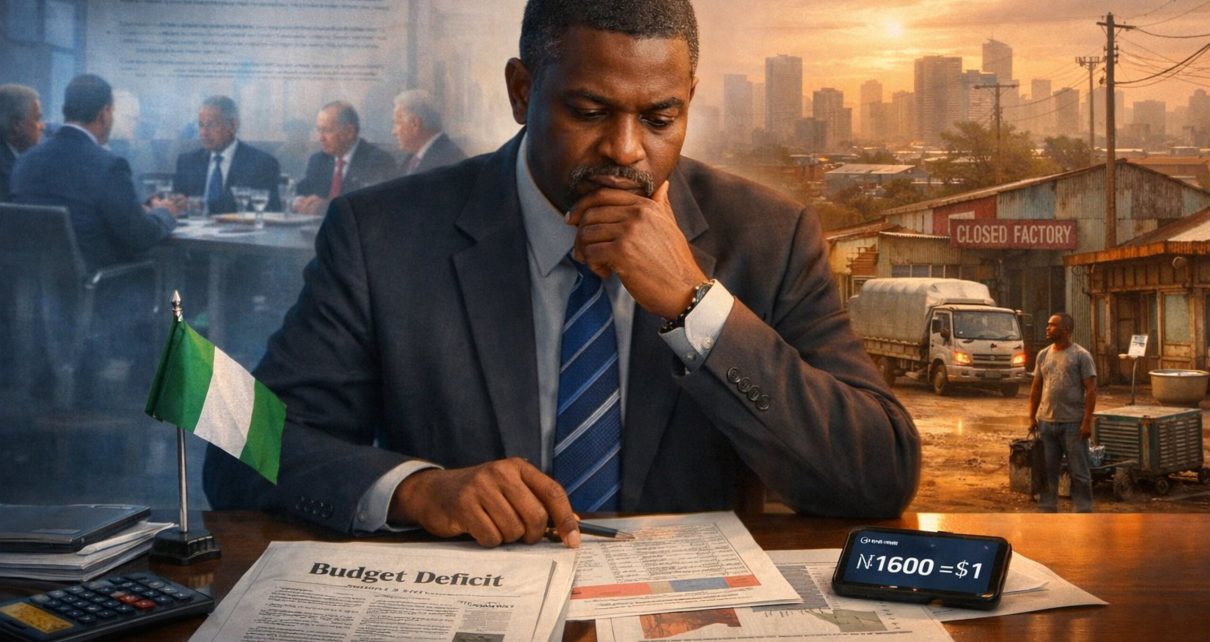
It is a 2024 interview that has resurfaced in 2026 and gone viral. Hodge’s narrative lands like a thunderclap in Surulere markets and Abuja salons, where frustration simmers amid 30% inflation, a Naira tethered at ₦1,600 to the dollar, and factories gathering dust. It offers the seductive comfort of villains abroad—Washington schemers and multilateral technocrats engineering Nigeria’s fall from industrial promise to import dependency. Yet this story, while tapping real historical pressures, flattens a far messier truth. The Kissinger report and IMF structural adjustments were pivotal jolts, but Nigeria’s quagmire flows from a deeper current: chronic governance bloat, oil-fuelled patronage, and policy whiplash that turned external influence into self-inflicted wounds. Today, a $6 billion loan signals an approaching fiscal cliff by 2030—unless bold internal reforms finally break the cycle.
The Kissinger Report: Anxiety Masquerading as Conspiracy
Prof. Hodge’s sharpest claim hinges on National Security Study Memorandum 200 (NSSM 200), a declassified 1974 U.S. National Security Council document overseen by Henry Kissinger. Born in the shadow of the 1973 OPEC oil embargo—which quadrupled global prices from $3 to $12 per barrel—NSSM 200 assessed how rapid population growth in 13 developing nations, including Nigeria, might threaten American access to strategic resources like oil, minerals, and farmland. Nigeria loomed large: its population neared 80 million, expanding at 2.5% annually, atop vast oil reserves discovered just two decades earlier.
The report’s language chills with its Cold War calculus. It warned that demographic surges could spark instability, resource nationalism, or Soviet inroads, framing Third World growth as a “major threat to global political and economic stability.” Nigeria’s oil wealth and fertile soils made it ground zero. Hodge interprets this as an explicit blueprint to deny Nigerians their riches—”kept for the rich nations.” But the document says no such thing. It explicitly rejects coercive measures, advocating voluntary family planning programs funded through USAID to ease population pressures on exports. The subtext was realpolitik: unchecked growth might hinder commodity flows to industrial powers. What followed in Nigeria were modest U.S.-backed clinics in the late 1970s, often clashing with cultural norms favouring large families.
No matter how this may be painted though, Kissinger’s report spoke more to influence than iron control. Here was the deal. By 1974, Nigeria’s own oil boom was already distorting its path. Revenues exploded from ₦335 million in 1970 to ₦11.3 billion by 1979, flooding the economy with petrodollars. This triggered classic Dutch Disease: agriculture withered as imports surged, slashing food self-sufficiency from 80% in the 1960s to under 50%. Kissinger’s memo thus mirrored external fears Nigeria was creating for itself.
The 1970s Mirage: A Nation Making Things, Squandering Foundations
Hodge evokes a lost golden age: “almost everything we consumed was made in Nigeria.” Elders recall it vividly—Kaduna’s 25 textile mills spinning local cotton into cloth for millions; Lagos’ Volkswagen and Kaduna’s Peugeot plants assembling 10,000 vehicles yearly; Kano’s towering groundnut pyramids symbolising northern exports; eastern palm oil and western cocoa feeding factories and foreign markets. The Ajaokuta Steel Complex, launched in 1974 with Soviet backing, promised 5.2 million tons of output annually. GDP growth averaged 6.5% from 1970 to 1979; manufacturing contributed 8% to GDP; per capita income peaked at $1,200 in 1980 dollars.
This wasn’t fantasy. If anything, it felt more like possibility—a post-colonial nation bending resources inward. But beneath hummed profound vulnerabilities. Oil revenues swallowed 85% of federal budgets by 1978, birthing a rentier state hooked on crude. General Yakubu Gowon’s 1974 “Udoji awards” tripled civil service wages without tying them to productivity, ballooning the bureaucracy to half a million. State behemoths like the Nigerian National Petroleum Corporation (established 1977) hemorrhaged billions through ghost contracts and corruption. The 1967-1970 Biafran War had already cost $2 billion in reconstruction, often funnelled into vanity projects rather than sustainable infrastructure. When the 1980-1986 oil glut crashed prices from $40 to $10 per barrel, revenues plunged 70%—exposing non-oil exports mired at just 2% of GDP. The 1970s boom wasn’t destroyed from without; its cracks invited the collapse.
IMF Reforms: Austerity’s Brutal Cure, Mangled by Local Hands
The 1980s debt crisis—ballooning from $5 billion in 1980 to $19 billion by 1985—ushered in the International Monetary Fund’s Structural Adjustment Programme (SAP), adopted under military ruler Ibrahim Babangida in 1986. Tied to a $5.4 billion bailout, SAP demanded Naira devaluation, trade liberalisation, and privatisation of over 300 state firms. The currency cratered 80% against the dollar by 1987, making imports cheaper than local production. Textiles collapsed from 50 mills to 10 by 1995; auto assembly lines went silent; unemployment tripled to 20%. Inflation spiked to 40%, and privatisation fire-sales enriched cronies more than investors.
Economist Sam Aluko warned presciently in 1986 that these policies would “liquidate indigenous industries” and entrench dependency. In agreement, Hodge sees deliberate sabotage—”sold off our companies to foreign interests.” IMF architects countered that Nigeria’s pre-SAP economy was a distorted mess: import licences captured by elites, subsidies warping markets, oil dependency leaving the rest hollow. Validity aside, execution faltered catastrophically. Babangida diluted reforms amid coup intrigue; successor Sani Abacha reversed course, restoring subsidies that swelled debt to $36 billion by 1999. Foreign buyers snapped bargains, but domestic predation claimed the lion’s share. External prescriptions became alibis for internal chaos.
The Persistent Quagmire: Governance Bloat and the 2030 Fiscal Cliff
Hodge promises a quick reversal, but Nigeria’s mire deepens through homegrown pathologies that amplify history’s scars. Oil patronage evolved into constitutional extravagance (no thanks to the 1999 Nigerian charter): 36 states each demanding ministerial quotas (Section 147), 469 National Assembly seats, 774 local governments—all FAAC-addicted, with states generating little own-revenue. The 2026 budget lays bare the trap: ₦15.52 trillion for debt servicing (five times combined education and health spending), ₦15.25 trillion in recurrent costs for a bloated payroll. Public debt exceeds ₦149 trillion; poverty engulfs 141 million (63% of the population).
President Tinubu’s March 2026 $6 billion loan request ($5 billion from Abu Dhabi, $1 billion from Citibank) to cover a ₦23.85 trillion deficit isn’t infrastructure rocket fuel—it’s a desperate bridge to a “fiscal cliff” by 2030. Projections warn revenues will fail debt obligations, spooking lenders and eroding sovereignty. Recent reforms—fuel subsidy removal, FX unification—shocked the poor (poverty leaping from 40% to 63%, food inflation soaring via transport and generator dependencies). Yet structural rigidities starve response: overlapping agencies defy Oronsaye merger directives; ex-officials draw lavish pensions; lawmakers earn more than counterparts in larger economies.
This isn’t mere IMF echo—it’s extractive institutions in overdrive, as political economists like Daron Acemoglu describe: elites capturing rents, policies flip-flopping across regimes. Compare Botswana, which parlayed diamonds into growth through accountability; Nigeria’s oil curse endures.
A Roadmap Out: Ten Deliberate Cuts Toward Renewal
Escape demands unglamorous surgery on the state itself. Recent analyses outline a pragmatic map: cap the cabinet at 18-24 ministers, ending state quotas; shrink the National Assembly toward unicameralism; rationalise 36 states and 774 local councils; free local governments from gubernatorial strangleholds; complete Oronsaye agency mergers; eliminate regulatory overlaps; devolve policing and infrastructure; scrap ex-officials’ pensions; tie legislative seats to tax generation; impose sunset clauses on obsolete bodies.
Fiscal space unlocked could scale power from 4,000 MW to 20,000 MW, enforce the 2023 Petroleum Industry Act for refining, and ignite agro-exports—echoing South Korea’s textiles-to-tech ascent or Vietnam’s FDI export machine. Nigeria’s youth bulge (70% under 30) hungers for this scaffolding.
Prof. Hodge’s story humanises real grievances—Kissinger-era anxieties and IMF hammers bent Nigeria off course. But the full reckoning points inward: from 1970s profligacy through SAP fumbles to 2026’s patronage abyss. The 2030 cliff isn’t scripted in Washington memos; it’s authored in Abuja’s unchecked chambers. Renewal flows not from blame abroad, but choices owned at home—deliberate, sustained, Nigerian.
Sources
– Prof. Kent Hodge interview transcription (user-provided).
– NSSM 200 (declassified, Federation of American Scientists).
– World Bank Nigeria reports (1980-2024); CBN Annual Reports; NBS data.
– Falola & Heaton, A History of Nigeria (2008).
– IMF Nigeria SAP documents (1986).
– Lagos Metropolitan series: “Fiscal Cliff & $6B Loan” (Apr 2026); “Cost of Nigeria” Parts 1-3 (Mar 2026).
– Sam Aluko, Nigerian Economic Society proceedings (1986-87).


