
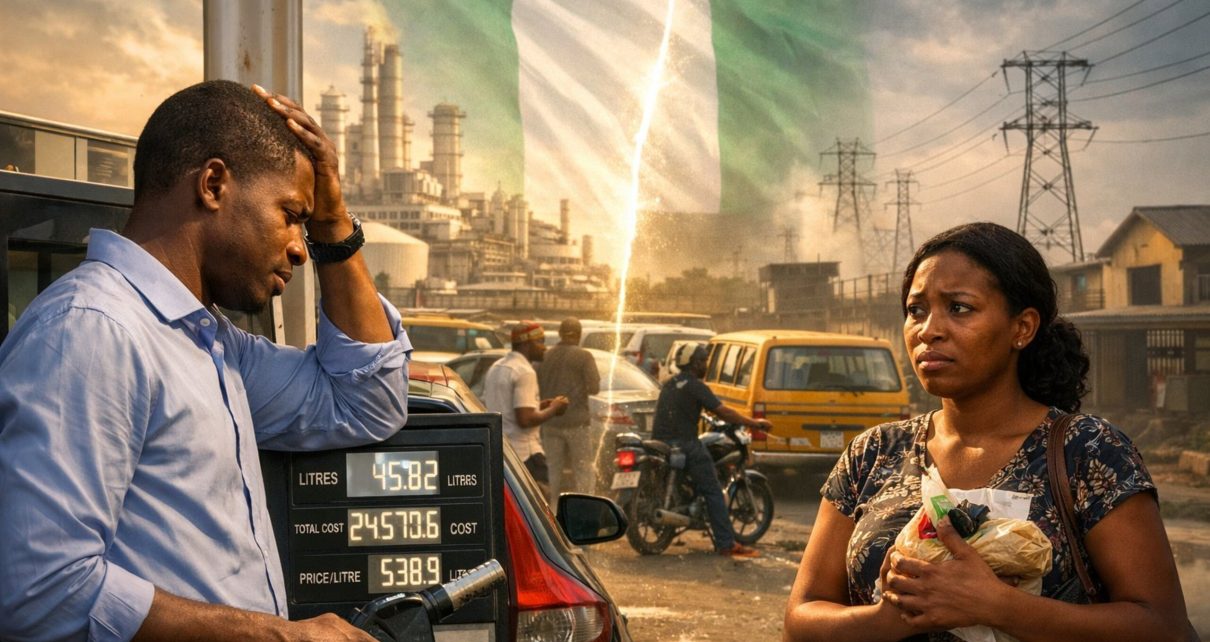

At this stage of Nigeria’s development, and considering the financial stress Nigerians are currently undergoing, perhaps the government may want to consider radical suggestions on how to make the burden lighter for the people.
It is wrong, in my view, to routinely compare Nigeria with other countries, as politicians often do. When you complain that workers are now spending 50 per cent of their wages on transportation alone, they are quick to tell you that transportation is more expensive in London, as if they were paying London wages or providing the same facilities as the UK. They argue that petrol costs $1.13 per litre in the US (equivalent to N1,566), as if all other variables are comparable.
If I want to be charitable in my assessment of the ruling elite, I would say maybe it does not occur to them that, eventually, they will be the ultimate beneficiaries when their happy constituents reciprocate their good gesture with massive votes.
Hope Almost Aborted
It is scandalous that a people living by the riverside are compelled to wash their faces with saliva. A country sitting on 37.5 billion barrels of crude oil is importing the liquid gold from America for refining. One had thought that the opacity permeating the petroleum industry was a thing of the past. However, the confounding story we hear is that Nigerian modular refineries and the massive Dangote Refinery depend on imported crude to meet their requirements.
In a typical Nigerian hop-step-and-jump, Nigeria has allegedly pledged most of its 1.5 million bpd production to creditors and therefore doesn’t have enough to give to local refineries. Meanwhile, in 2024, the country launched a naira-for-crude scheme, which many analysts hailed as progressive. Through the scheme, Nigerian refineries could buy crude in naira instead of having to first shop for US dollars, thereby complicating the perennial foreign exchange problem.
When Dangote Refinery came on stream, we all thought here at last was the solution to our problem. But the refinery ran into headwinds shortly after commissioning. The government-owned NNPC Ltd., which was supposed to superintend the official regulatory easing of the much-awaited refinery into the market, behaved like the major stumbling block. Had Aliko Dangote been just any other ordinary Nigerian, his refinery would have been successfully sabotaged by now.
The ongoing Gulf War has added to worldwide economic misery. Thank God for little mercies, Dangote Refinery has been able to meet the needs of Nigerians and indeed of many other African countries. In the pre-Dangote days, Nigerians would have had to spend most of the day at petrol stations, and commerce would have been at a standstill. The fact that the huge refinery is thriving under the Tinubu administration, in spite of the roadblocks aforesaid, is a credit to the government.
Radical Change
If I may, I suggest that Bola Ahmed Tinubu make a clear departure from the prevailing philosophy of rabid capitalism, which puts money-making before the people’s welfare. I am a ‘veteran illiterate’ in petroleum engineering, but I suspect that all you need to make the kind of suggestion I’m making now is a good heart and a functional brain. There is no better sector to make Nigerians feel their government’s benevolence than in the energy area. Where there is a will, there must be a way.
In terms of petroleum products, the government should launch an accelerated programme to double the production of crude from 1.5 million bpd to 3 million bpd, no matter what it takes. That done, the government will be in a position to allocate a specific quantity at 50 per cent of the going rate for local consumption. If crude oil is selling for $120 per barrel in the international market, the allocation to be set aside for local refining will be priced in naira at 50% of the prevailing exchange rate. At today’s rate of N1,390 per dollar, that translates to crude selling to the local refineries in naira at N695. Production costs and a pre-agreed profit margin will then be added to ensure that Nigerians can buy petrol at a more affordable rate.
The spin-offs derivable from this suggested regime are legion, and they are all positive. Transport fares will drop, merchants of foodstuffs and other agricultural products will spend less to transport their goods to the markets, and every other endeavour relying on petroleum products will benefit from the scheme. Consumers will be the ultimate beneficiaries. And the kind of goodwill that this will fetch the government is stratospheric.
There are currently nine functional refineries in Nigeria with a total capacity of 975,000 barrels per day (bpd):
Dangote Refinery: Lagos (650,000 bpd)
Port Harcourt Refinery (Old): Rivers State (60,000 bpd)
Warri Refinery and Petrochemical Company: Delta State (125,000 bpd)
Aradel (Niger Delta) Refinery: Rivers State (11,000 bpd)
Waltersmith Refinery: Imo State (5,000 bpd)
OPAC Refinery: Delta State (10,000 bpd)
Duport Midstream: Edo State (2,500 bpd)
Edo Refinery and Petrochemical Company: Edo State (1,000 bpd)
Kaduna Refinery: Kaduna State (undergoing rehabilitation)
Generally, a 42-gallon (approx. 159-litre) barrel of crude oil produces roughly 19 to 20 gallons (about 72–76 litres) of motor gasoline (petrol) in US refineries. The remaining volume is converted into diesel, jet fuel, and other petroleum products. Dangote is more efficient. The 650,000-barrel-per-day Dangote Refinery is designed to produce over 53 million to 75 million litres of petrol (Premium Motor Spirit) daily. Annually, it has the capacity to produce 10.5 million metric tonnes.
The other critical handmaiden of the energy mix that is causing restiveness in the polity is power. There is no successful country anywhere in the world whose economy runs on private generators. The same kind of concession advocated in the case of petrol, diesel, kerosene, and aviation fuel is also recommended in the case of gas supply to the thermal power plants that produce about 75%–80% of on-grid electricity.
When gas is delivered to the turbines at a discount, the issue of the current woolly government subsidy in the sector will be settled. At the moment, Nigerians can’t understand how the federal government can be said to be owing Gencos subsidy sums running into trillions when Nigerians are in perpetual darkness. It doesn’t add up. Perhaps when the current ‘spooky’ subsidy regime is tweaked, we can have a clearer picture and, hopefully, more electricity.
Legislation
If Bola Ahmed Tinubu agrees to go ahead with these suggestions, he should encourage the National Assembly to pass a law stipulating a stiff penalty for anyone caught smuggling petroleum products to neighbouring countries. All smugglers of petroleum products must unfailingly wind up in jail.
Our philosophy of governance has to change. It is the duty of government to ensure that Nigerian citizens benefit from the resources of their country. My generation benefitted a lot from Nigeria. That is why we always feel that we owe Nigeria so much. Patriotism comes with our territory. Every nation subsidises one thing or the other for its citizens.
The Man, Tinubu
If any president can take these suggested measures, Tinubu is the man. He has demonstrated already that he has the courage to try new ideas instead of cowering behind old, tired anti-people policies. Tinubu has been a senator, governor, and president. There isn’t much more any mortal can ask of his country and his creator. What remains is an enduring legacy. I make bold to say that if he hearkens to this call, his middle name will be ‘Hero’.


