
There was a time football ended at the final whistle. You either won or you lost, and Lagos moved on—arguing, of course, but within reasonable limits. Those days now feel like folklore.
These days, football refuses to end. It continues in conference rooms, appeals panels, and legal submissions—long after the goals have been scored and the celebrations have faded.
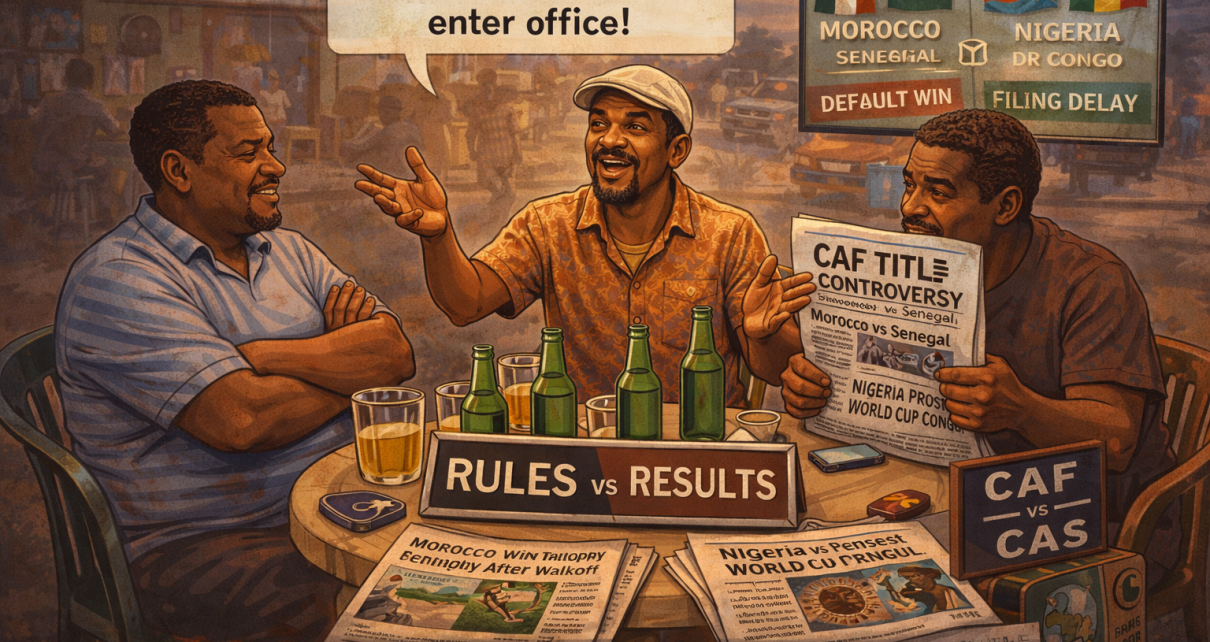
That was how the Morocco–Senegal matter, and Nigeria’s own misadventure with DR Congo, landed on our table in Aguda.
I had barely arranged my thoughts when Chiboy burst in with his usual urgency.
“Syracuse! You don hear? Morocco don collect AFCON by default!”
John nearly dropped his bottle.
“By default ke? Dem play final or dem play email?”
The beer parlour erupted.
I raised my hand, attempting to restore order.
“The issue,” I began, “is that Senegal walked off the pitch during the final—”
Chiboy cut in immediately.
“Walk-off? For final? Na protest or na parade?”
It is difficult to explain procedural rules in a beer parlour without sounding like you are defending the referee personally.
I continued.
“They protested a late penalty decision. But under CAF regulations, leaving the pitch without permission is considered forfeiture.”
John leaned forward, eyes wide.
“So dem lose cup because dem vex?”
“In essence,” I replied, “yes.”
There was a moment of silence.
Then Chiboy delivered the verdict.
“Football no be anger management class.”
The table laughed, but uneasily.
There was something unsettling about the idea that a tournament could be decided not by skill, but by compliance with procedural discipline.
Morocco, who had lost on the pitch, were now champions on paper.
Senegal, who had celebrated victory, were now litigants.
Football, it seemed, had developed a second half—played in offices.
John shook his head.
“So if you score goal but break rule, dem go cancel your happiness?”
“That,” I said carefully, “is precisely the point of regulations.”
But regulations, like most things in Nigeria, are only appreciated when they favour you.
Before the table could settle, Chiboy pivoted sharply.
“And Nigeria own nko? DR Congo matter?”
Ah yes. Our own contribution to the growing tradition of administrative football.
I explained that Nigeria’s protest had been dismissed—not necessarily because it lacked merit, but because it was submitted late.
Two hours for notification. Twenty-four hours for formal complaint. A fee required.
Nigeria, in its characteristic style, arrived approximately two weeks later.
John laughed so hard he nearly spilled his drink.
“So we no lose because dem better pass us—we lose because we no sabi deadline?”
There are few things Lagos respects less than a missed deadline, except perhaps a missed penalty.
Chiboy shook his head slowly.
“This one pain me pass. Even if case strong, you no fit submit am like assignment after exam.”
That, perhaps, was the most honest summary of the situation.
If Morocco’s case was about rules overriding results, Nigeria’s case was about procedure overriding protest.
In both instances, the scoreboard had been challenged—not by performance, but by interpretation.
The beer parlour grew reflective.
John spoke quietly.
“So now, football no just be who score pass. Na who sabi rule pass.”
Exactly.
We are witnessing a shift in African football—one where the rulebook is beginning to rival the referee in importance.
Games are no longer decided solely on grass. They are reviewed, contested, and occasionally rewritten.
Chiboy leaned forward.
“But this thing go tire fans. Match finish January, winner go change March.”
Indeed.
There is something profoundly unsatisfying about delayed outcomes. Victory loses its immediacy. Defeat loses its finality. Everything becomes provisional.
The fan, who once celebrated instinctively, must now wait cautiously.
John summarised the emotional cost.
“So joy now get expiry date.”
Well said.
Both cases—Morocco/Senegal and Nigeria/DR Congo—reflect a deeper tension in modern football.
On one hand, rules must be enforced. Without them, chaos reigns.
On the other, excessive reliance on technicalities risks undermining the spirit of the game.
Football thrives on clarity. Ninety minutes. Final whistle. Result.
But increasingly, we are dealing with:
Ninety minutes. Final whistle. Appeal. Counter-appeal. Legal review. Revised result.
Chiboy shook his head.
“Next thing, VAR go carry lawyer join.”
The table laughed again.
As we prepared to leave, John delivered the final reflection.
“If football continue like this, one day we go watch match finish, go sleep, wake up, new winner go appear.”
Nobody disagreed.
Because in this new era, football is no longer just a game.
It is a process.
Na so we see am.
- Na so we see am is a weekly satirical column that uses beer-parlour conversations to reflect on any trending issue—from politics and football to global events—capturing how everyday Lagosians interpret the news with humour, scepticism, and street wisdom.


