
A Return Framed by Politics, Defined by Economics
President Bola Tinubu’s return to Lagos at 1.15 a.m. on Friday, March 20, after his UK state visit was politically choreographed around Eid-el-Fitr, but economically the bigger story travelled back with him in paperwork, signatures and financing guarantees. Before leaving London, Tinubu witnessed the sealing of a £746 million agreement for the refurbishment of the Lagos Port Complex in Apapa and the Tin Can Island Port Complex — two of the most strategically important, and chronically stressed, pieces of infrastructure in Nigeria’s commercial capital.
Beyond Windsor: Why Lagosians Should Care
The symbolism of the visit mattered. This was the first state visit by a Nigerian leader to the UK in 37 years; the last such visit on the British royal record was by President Ibrahim Babangida in May 1989.
But for Lagosians, the real significance is less Windsor pageantry than wharf-side practicality. The question is not whether the red carpet was rolled out in Britain. It is whether trucks will spend less time choking Apapa, whether import costs will ease, and whether Lagos can finally begin to run its ports like a 21st-century maritime city rather than a 20th-century bottleneck.
Getting the Numbers Right
A quick correction is necessary because the public conversation is already getting fuzzy. The deal announced in London was £746 million, not $1.51 billion. Reuters, using contemporaneous exchange rates, put it at about $990.32 million. The Nigerian presidency sometimes rounded the figure to £747 million, but the British and Reuters reporting consistently describe it as £746 million.
That distinction matters because this is not just a diplomatic communique.
What Exactly Was Signed
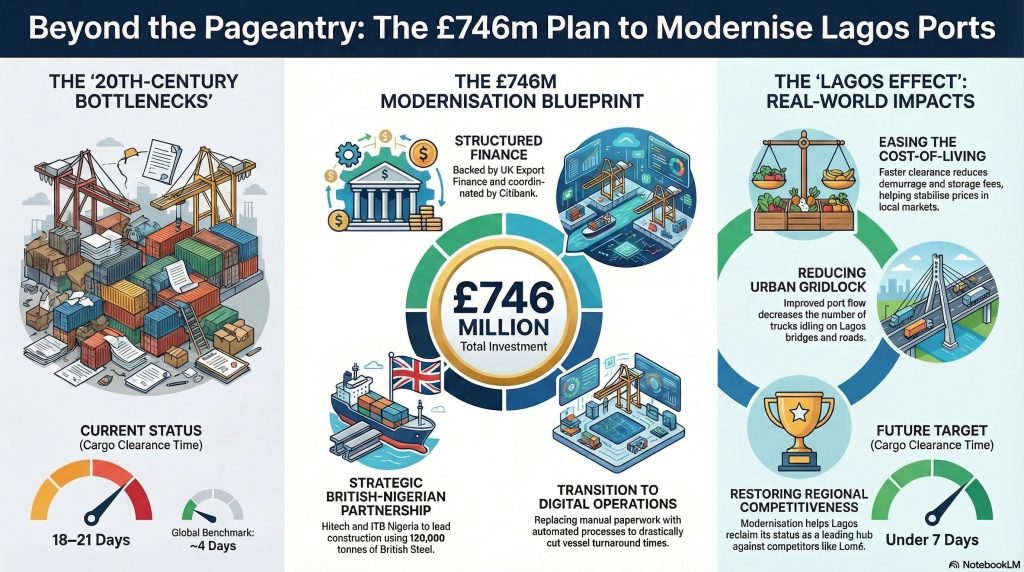
This is a structured export finance facility backed by UK Export Finance, coordinated by Citibank, N.A. London Branch, and tied to actual project delivery at Apapa and Tin Can.
At least £236 million of supplier contracts are expected to go to British firms, including a £70 million order for British Steel. British Steel is to supply 120,000 tonnes of steel billets to Nigerian construction companies Hitech Nigeria and ITB Nigeria, which the UK government specifically identified as construction partners on the project.
The Core Question: What Does Lagos Gain?
So, what exactly is Lagos getting out of this?
At the simplest level, Lagos is getting a chance to fix its oldest economic contradiction: Nigeria’s richest city has long depended on ports that are central to trade but notorious for delay, congestion, paperwork, poor predictability and excessive cost.
Official UK and Nigerian statements say the port overhaul is meant to:
- modernise physical infrastructure
- introduce digital and automated processes
- cut vessel turnaround times
- reduce cargo dwell time
- lower demurrage
- improve transparency
The Hidden Tax of Port Inefficiency
That language may sound technocratic, but its urban meaning is very concrete.
Every extra day a container sits at port generates cost. Every truck waiting for access occupies road space. Every delay feeds rent-seeking opportunities. Every broken link in the port chain becomes a hidden tax on Lagos residents, whether they are buying cement in Mushin, electronics in Alaba, food ingredients in Idumota or building materials in Ajah.
A port problem in Apapa rarely stays in Apapa; it radiates across the wider city economy.
When the Ports Seize Up
This is why the phrase “clogged arteries” is not merely rhetorical.
Lagos knows from experience what happens when the ports seize up. The worst years of Apapa gridlock did not just inconvenience drivers; they distorted business costs, paralysed neighbourhoods, damaged roads, delayed emergency movement and pushed haulage unpredictability into almost every supply chain connected to the city.
Even after reforms such as the Ètò electronic call-up system, the port corridor has remained a place where improvement is real but fragility persists. The Nigerian Ports Authority’s own digital reforms were launched because the old order had become economically intolerable.
Not Starting From Zero
In other words, the new UK-backed deal does not begin from zero. It sits on top of an existing reform arc.
The NPA has already been pushing:
- truck scheduling reform
- electronic barrier systems
- broader port digitalisation
In September 2025, NPA leadership said the Port Community System would be launched in the first quarter of 2026. Back in 2021, the authority had also declared an ambition for Nigerian ports to become fully digital by 2025.
The London agreement now gives that reform story a harder infrastructure and financing backbone.
First Test: Traffic
For Lagos residents, the first test of success will be traffic.
If port operations become faster and more predictable, fewer trucks should need to hover endlessly in holding patterns around Apapa and Tin Can.
That does not mean Lagos magically wakes up to empty bridges next month. Truck congestion is also shaped by:
- road quality
- enforcement
- tank farm activity
- customs procedures
- urban freight behaviour
But a port that clears cargo faster creates less pressure on the roads feeding it.
Second Test: Prices
The second test is prices.
Nigeria’s current cargo clearance times remain far above what competitors consider normal. Average clearance can still range between 18 and 21 days, while the government’s target is under seven days. Globally, the benchmark is closer to four days.
When dwell times stretch that far:
- storage charges rise
- delay penalties accumulate
- financing costs increase
And all of these are passed downstream.
Why This Is a Cost-of-Living Story
This is why the port deal, if executed well, is indirectly a cost-of-living story.
The ports are not just maritime sites; they are price-making institutions.
Faster clearance can:
- reduce demurrage
- lower uncertainty
- free up working capital
This should help stabilise prices of imported goods in Lagos markets.
It will not end inflation—but it could remove one stubborn layer of cost.
Third Test: Regional Competitiveness
The third test is competitiveness.
Lagos is not operating in a vacuum. West African ports have become more competitive, with Lomé emerging as a leading hub.
The implication is clear:
Lagos can no longer rely on size alone.
Port users compare:
- time
- cost
- predictability
- ease of doing business
To dominate regional trade, Lagos must become not just bigger—but better.
From Slogan to Strategy: The Blue Economy
This is where the “blue economy” becomes more than policy language.
Modern ports attract:
- logistics technology
- marine services
- freight finance
- legal services
- warehousing
- insurance
In Lagos, this means the benefits extend beyond dockworkers into a broader professional ecosystem.
Jobs: Immediate and Long-Term
There is also a labour story embedded in the deal.
While British firms benefit, local companies—Hitech Nigeria and ITB Nigeria—will execute major parts of the project.
This creates:
- immediate construction and engineering jobs
- technical training opportunities
Longer term, a modern port ecosystem could drive demand for:
- logistics managers
- software integrators
- customs specialists
- maritime lawyers
- transport planners
A Signal of Confidence
The politics of confidence matter.
UK Export Finance backing means the UK government is underwriting risk. Citi’s involvement signals global financial participation.
For Lagos, this sends a clear message:
International institutions are willing to invest again in Nigeria’s trade infrastructure.
A Wider Economic Corridor
This deal also fits into a broader warming of UK–Nigeria relations.
- Trade has risen to £8.1 billion
- Growth is over 11% year-on-year
- The Enhanced Trade and Investment Partnership is expanding cooperation
The port project is part of a larger economic alignment—not an isolated event.
The Scepticism Lagos Has Earned
Still, Lagosians have earned the right to be sceptical.
Port reform in Nigeria has often stumbled on:
- institutional friction
- overlapping agencies
- weak enforcement
Infrastructure alone is not enough.
A modern quay without modern coordination will still underperform.
Where the Truth Will Be Measured
The true story of this deal will not be told in announcements.
It will be measured in:
- cargo clearance times
- truck queues
- container dwell days
- freight costs
Over the next 12 to 24 months, Lagosians will know whether this is transformation—or another promise.
A Bet on Lagos’ Economic Engine
Yet the deal matters because it targets something foundational.
Lagos cannot sustainably:
- lower business costs
- improve mobility
- strengthen its regional position
while its ports remain slow and fragmented.
The state visit delivered optics.
But the real outcome is a bet on Lagos’ most overworked economic machine.
If Apapa and Tin Can move from delay to efficiency, Lagos will feel it—not in photographs from Windsor, but in clearer roads, faster trade, and a gradual easing of the pressure on everyday living.
What to Watch
| Area | What Changes | What Lagosians Should Watch |
| Traffic | Faster cargo flow | Fewer trucks, reduced gridlock |
| Prices | Lower demurrage | Stabilisation of goods prices |
| Jobs | Local construction roles | Hiring in engineering & logistics |
| Efficiency | Digital systems | Shorter clearance times |
| Competitiveness | Modern ports | Shift from Cotonou/Lomé to Lagos |


