
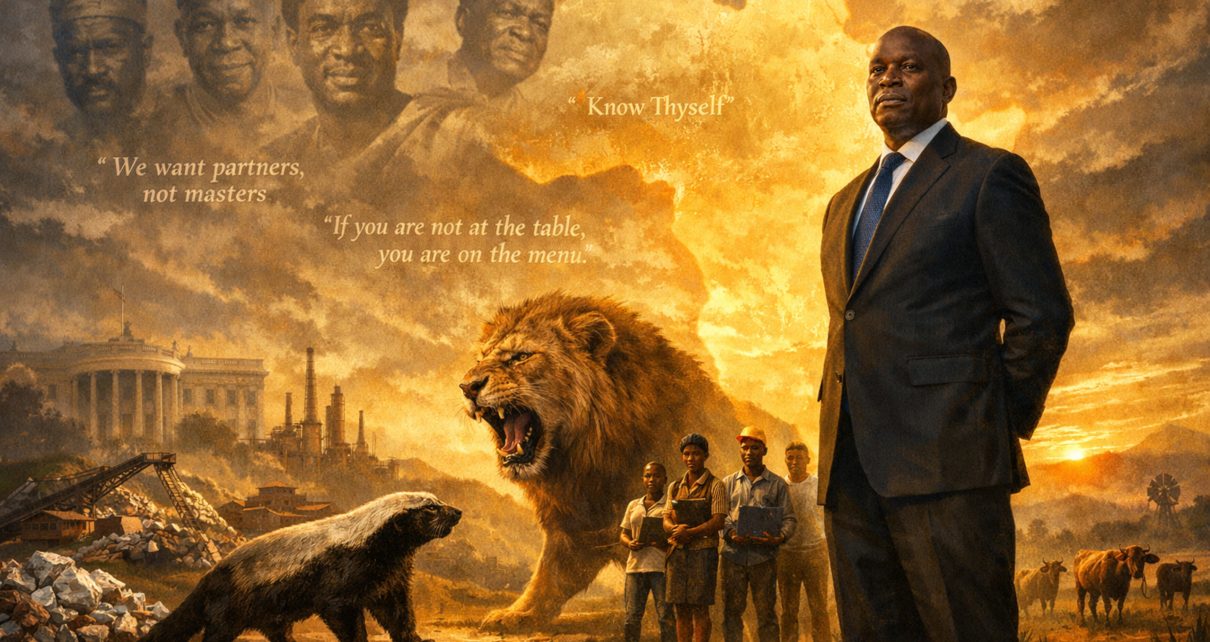

Fifty-six-year-old President Duma Gideon Boko of Botswana made the headlines recently when he declined the invitation of President Trump to visit the White House. There is no quarrel between Trump and Boko. The relationship between the US and Botswana is also cordial. Boko is only living true to the Yoruba proverb which says that a man who has stepped on a thorn ought to be the one seeking the owner of a blade, not the other way round.
President Boko reportedly argued that, “If there is any business or official engagement to discuss, it should take place in Botswana, not abroad. Botswana is tired of travelling abroad for deals that concern its own resources. If there is genuine interest in our resources, come to Botswana so we can talk business. Let us respect the basic principle of commerce: buyers should go to the sellers. If the situation is reversed, then the buyer’s interest is not truly valuable.”
Small But Big
I am not surprised that Botswana has given the rest of Africa some kolanuts of wisdom to chew. I had nursed some admiration for the relatively small country of 2.56 million people since 2018 when I was privileged to visit en route to Zimbabwe during a futile journey to interview the ousted Zimbabwean leader, Robert Mugabe (that is a story for another day).
The population of Botswana is young, with a median age in the mid-20s. The country covers a total land area of approximately 581,730 square kilometres (roughly 224,606 square miles). Contrast that with Nigeria, which has a landmass of 923,768 square kilometres (roughly 356,669 square miles) and a rumoured population of 250 million people!
Many Nigerians will recall that a Nigerian jurist, Justice Timothy Akinola Aguda (1923 – 5 September 2001), was the first indigenous African to assume the position of Chief Justice of Botswana and also later served on the Courts of Appeal in Swaziland and Lesotho.
Back to my 2018 visit. One of the first shocks I had in Gaborone was the exchange rate of the national currency, the Botswana Pula (BWP), which exchanged at roughly 5 BWP to 1 USD. The current exchange rate is BWP 13.14 to $1. In Nigerian terms, 1 BWP exchanges for ₦103.16.
Botswana is the world’s second-largest diamond exporter. Other exports include copper ore, insulated wire, carbonates, and frozen bovine meat. The cattle population generally outnumbers the human population, with the government aiming to reach 5 million cattle by 2030.
When a lion gets used to looking down on other members of the animal kingdom, who is to tell it that the middle name of the honey badger is trouble in the form of incredible tenacity, thick skin, and willingness to confront much larger predators? The fact that it looks like a grass-cutter (Thryonomyidae family) does not make it a variant of your regular bushmeat. The honey badger would gladly punch above its weight if it had to. Reason: it takes responsibility for its actions.
Africa, Arise!
I have always argued that one of the reasons the developed world treats Africa like a ‘shithole’ is that African leaders don’t respect themselves. They sell their countries cheap, stealing money meant for national development and stashing their loot in Western havens. How can a foreigner who knows where you hid all your loot have any respect for you? Until recently, when the Oval Office became a staging ground for raw intimidation and undiplomatic insults, African leaders used to lobby to be invited to the White House. Now President Boko has demonstrated the spirit of the new Africa: We want partners, not ‘colo-masters’!
This brings me to the question of leadership in Africa. The simplest working definition that continues to inspire me is that proffered by John Quincy Adams. “If your actions inspire others to dream more, learn more, do more and become more,” he says, “you are a leader.”
If all countries in Africa adopt that as a working definition of leadership and earnestly pursue the quest for the emergence of such leaders, the continent will begin to regain its mojo. At times, I wonder what happened to us. This used to be a land of heroes: Nkrumah, Nyerere, Mandela, Awolowo, Murtala Muhammed, Toure, Okpara, Chaka, Jaja, Kaunda, Sankara…
Invasion Of Idiots
As in ancient Greece, our steps were guided by philosophy, the mother of all disciplines. One of the tragedies of contemporary technological advancement is that society is gliding away from thinking and diving headlong into all-pervasive social media, where intellectual Lilliputians call the shots.
I think the analysis made by Umberto Eco, author of The Name of the Rose, is significant for our era because it validates Socrates’ recommendation to would-be leaders—“Know Thyself”—and be intellectually humble. According to the Greek philosopher, great leaders possess self-awareness of their own ignorance and limitations, fostering a culture of continuous learning. As Kayode Olusunmade, a leadership development expert, puts it, “To lead others, lead self first.”
Eco thinks that social media is a major culprit in the current crisis of mediocre leadership worldwide. He argues that social media should not be dominating public discourse ahead of the ‘old school’ process of exercising the brain and profiting from the wisdom of the ages. Social media, he says, gives legions of idiots the right to speak when they once only spoke at a bar after a glass of wine, without harming the community. Back then, they were quickly ignored. Now they have the same right to speak as a Nobel Prize winner. He calls it “the invasion of the idiots”!
New Leaders
We can no longer afford to treat the contemporary tools of modern development as playthings. It’s time to get serious. And the very first thing to do is get the right kind of leadership that can competently handle the challenges facing us. Mark Carney has already warned us that if we are not at the table, we are on the menu. Recent happenings in the West have also shown that there is a nostalgia for the days of the slave trade and a huge appetite for a return to colonialism and imperialism.
We cannot confront these challenges with analogue and avaricious leadership. The generation of the Nkrumahs lit the decolonisation torch. The kind of leadership required in Africa at this time is one that will confront our daunting challenges headlong. As Samuel Esson Jonah, a Ghanaian businessman, international corporate leader and chancellor of the University of Cape Coast, recently noted in a must-read op-ed article in AFRICA BRIEFING, our continent needs to act as one, speak with one voice and negotiate partnerships on our terms.
Imperatives: Shift from donor dependency to self-financed development. Reform fiscal policies to manage debt, invest in sustainable agriculture aligned with the Comprehensive Africa Agriculture Development Programme (CAADP), and leverage our vast resources for value addition rather than raw export. Address security through pan-African cooperation, strengthening the African Union’s Peace and Security Architecture to tackle insurgencies and conflicts holistically.
Empower our youth and institutions: Confront governance crises head-on. Engage the rising tide of Gen Z protests not as threats, but as calls for accountability. Strengthen institutions to combat corruption, inequality, and democratic backsliding, ensuring our youth see a future on this continent.
A fortnight ago, I celebrated General Murtala Muhammed for his commitment to the liberation struggle in Africa. Will the new Murtala Muhammeds and Nkrumahs and Nyereres all over Africa please stand up!


