
The APC National Convention at Eagle Square was, by all official accounts, a carefully choreographed political exercise—large in scale, deliberate in outcome, and clearly aligned with the party’s forward strategy toward 2027. Yet, as is often the case in Nigeria, the formal narrative tells only part of the story. The fuller interpretation emerges in informal spaces, where events are broken down with candour, humour, and a certain lived realism.
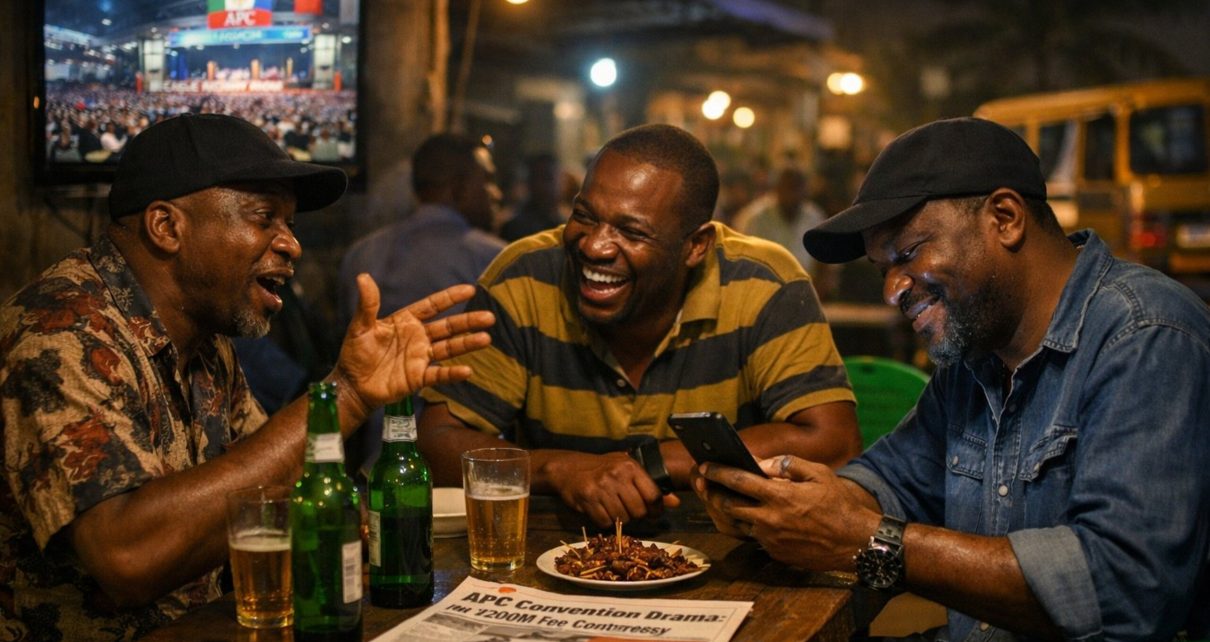
This evening in Surulere, I found myself once again at the beer parlour with John and Chiboy. As expected, the convention quickly became the subject of dissection—layer by layer, claim by claim, until what remained was something far more revealing than the official communiqués.
“Na wa o,” I began, easing into the conversation. “Over 8,000 delegates gather, but before dem gather, dem don already gree wetin dem go gree. Na consensus without suspense.”
John did not look up from his phone. “My brother, this one pass agreement. Na arrangee before arrival. If you come with different mind, na your mind go adjust sharp sharp.”
Chiboy leaned forward, clearly amused. “So wetin dem call voting now? Na just confirm-ation. You no dey choose—you dey acknowledge.”
Their remarks, though delivered lightly, pointed to a serious observation. The convention’s reliance on consensus may have reduced friction, but it also appeared to limit genuine contestation. In theory, consensus builds unity; in practice, it can sometimes preclude choice.
The logistics of the event also drew attention. With thousands of delegates, governors, and federal officials descending on Abuja, the Federal Government directed civil servants to work remotely.
“Abuja that day no be capital again,” John said. “Na APC village. Everywhere lock.”
Chiboy shook his head. “Traffic no join party—traffic na chairman. With all those convoy, road just surrender.”
I added, “That one no be convention, na convoy-vention. If you no get siren, better siddon for house.”
Behind the humour lay a clear reality: the sheer weight of political mobilisation can temporarily reorder the functioning of a city.
We then turned to President Bola Ahmed Tinubu’s keynote address, particularly his defence of the Electoral Act 2026. The President described the law as a “pillar of sovereignty,” insisting it had undergone rigorous legislative scrutiny.
John frowned slightly. “Dem say the law pass through scrutiny. But na who scrutinise the scrutiny?”
Chiboy responded immediately. “Pillar ke? That pillar tall well well. Ordinary Nigerian no fit climb am see wetin dey top.”
I considered their points. “No be say the law no get value. But for this country, law na one thing, implementation na another thing entirely. If trust no dey, even the best law go struggle to convince.”
The President’s economic claims also entered the conversation, particularly the reported drop in inflation.
“My pocket never receive that update,” Chiboy said bluntly. “As dem reduce inflation, expenses still dey increase.”
John added, “Statistics dey speak grammar. Market dey speak reality.”
I concluded, “If economic progress no reach kitchen table, e go remain theory. People dey measure policy with food price, not percentage.”
From there, the discussion shifted to the now-familiar rhetoric of continuity. Statements by leading figures in the National Assembly suggested that the current administration’s work requires more time.
“Dem talk say we never see the best,” John observed. “I just hope say the best no dey always on the way but never reach.”
Chiboy nodded. “Because for Naija, ‘coming soon’ fit mean ‘no be now’.”
I added, “Continuity fit be good if e deliver results. But democracy suppose allow competition. If outcome already look settled, then the process go begin lose meaning.”
The most animated exchange, however, came with the controversy over the alleged ₦200 million nomination fee. Though officially debunked, the rumour had already done its work in the public imagination.
“I hear ₦200 million, I check my account,” John said. “My account check me back.”
Chiboy burst out laughing. “That one no be form, na financial screening. If you no rich, you no reach.”
I weighed in more cautiously. “Even if that figure no correct, the big matter still dey. Politics for Nigeria don become cash and carry. If na dat kin money dem day take contest, then road don close, and voice of the people don quench be dat.”
Their banter distilled a serious concern: the monetisation of political participation continues to shape who can realistically aspire to leadership.
As the conversation slowed and the drinks ran low, I reflected on everything we had discussed—the consensus arrangements, the legislative debates, the economic claims, the continuity messaging, and the persistent question of access.
For me, the convention was both a demonstration of political organisation and a reminder of systemic limitations. It showed a party determined to present unity and direction, but it also highlighted the ongoing tension between structure and openness in Nigeria’s democracy.
I raised my glass slightly, more to myself than to anyone else.
For this country, democracy no just dey for podium or policy paper. E dey for how people understand am, question am, and sometimes laugh about am. Because when matter serious pass explanation, na naff go carry the truth come outside.
My people, na so we see am.


