
Nigeria’s 63% Poverty Surge: Reform, Inflation and the New Hardship Economy
As poverty in Nigeria climbs toward 63%, affecting about 141 million people, economists debate whether President Bola Tinubu’s reforms are the cause of the crisis—or the painful medicine needed to stabilise Africa’s largest economy.
A Nation Where Poverty Now Touches Most Households
Nigeria entered 2026 facing a stark reality: roughly six out of every ten citizens now live below the poverty line, according to projections by the World Bank and other development institutions. That translates to about 139–141 million Nigerians, making the country home to one of the largest concentrations of poor people in the world.
The figure represents a dramatic shift from earlier years. In 2019, about 81 million Nigerians were classified as poor, roughly 40% of the population. By 2025 the number had risen to about 139 million, driven by inflation, weak economic growth and structural vulnerabilities.
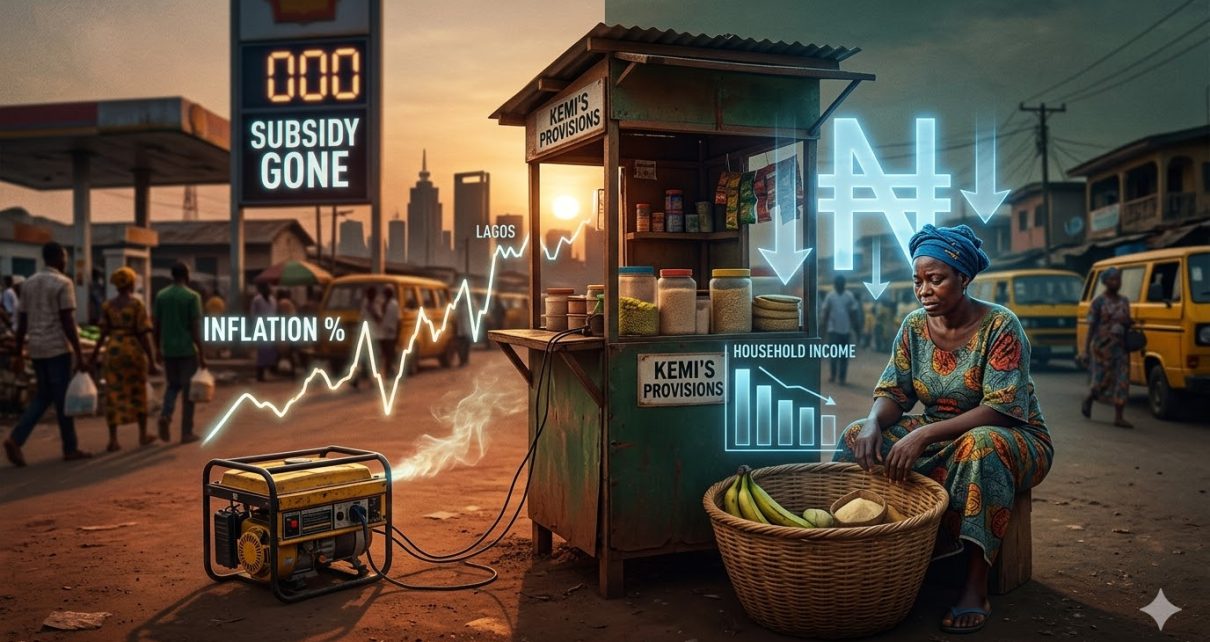
For many Nigerians, especially in cities like Lagos, the poverty surge is no longer an abstract statistic. It is felt in rising transport fares, shrinking food baskets, and the quiet closure of small businesses struggling with diesel-powered operations.
But how did Africa’s largest economy reach this point?
The “Reform Shock” That Reshaped the Economy
The immediate turning point came in May 2023, when President Bola Ahmed Tinubu announced the end of Nigeria’s decades-old petrol subsidy.
“Subsidy is gone,” he declared in his inauguration speech.
The policy shift was dramatic. For years, the government had spent trillions of naira annually subsidising petrol prices. The subsidy removal was widely praised by economists as necessary to restore fiscal discipline.
Yet the immediate economic consequences were severe.
Petrol prices tripled in some cases. Transport costs surged across the country. Because nearly every sector of Nigeria’s economy—from farming to retail distribution—depends heavily on road transport and generator power, the effect rippled quickly through the entire system.
Within months, inflation surged. For millions of Nigerians living near the poverty line, even modest price increases pushed households into outright deprivation.
Currency Unification and the Import Shock
The second major policy shift was the unification of Nigeria’s multiple exchange rates.
For years. Nigeria operated a complex foreign exchange system with different official and parallel market rates. In 2023, the government and the Central Bank of Nigeria moved toward a unified rate in order to attract investment and improve transparency.
But the adjustment triggered a sharp depreciation of the naira.
The consequence was imported inflation. Nigeria imports large quantities of refined petroleum products, medicines, industrial equipment, and even some food items. As the naira weakened, the cost of these goods soared.
Economists say this combination—fuel subsidy removal plus currency devaluation—created what many analysts now call Nigeria’s “reform shock.”
To policymakers, the changes were meant to stabilise public finances and restore investor confidence. But for households, they translated into higher living costs almost overnight.
Food Inflation: The Crisis Inside the Crisis
For the average Nigerian household, food is the largest expense.
According to development economists, low-income families spend up to 70% of their income on food.
This makes food inflation particularly devastating.
Two factors have worsened the situation.
First, higher fuel prices increased the cost of transporting produce from northern farming regions to southern markets like Lagos. Tomatoes, onions, grains and yams now cost significantly more to move across the country.
Second, insecurity continues to disrupt agricultural production. Banditry, kidnapping and farmer-herder conflicts in parts of the Middle Belt and Northeast have forced many farmers to abandon their fields.
The result is a persistent supply shortage that keeps prices high even when exchange rates stabilise.
Food prices in Nigeria have increased dramatically in recent years, with some analysts estimating that the cost of a basic food basket has multiplied several times since 2019.
For urban families already struggling with rent and transport costs, food inflation has become the final tipping point.
The Poverty Gap Widens
The crisis is not only about the number of people classified as poor.
It is also about how poor they have become.
Economists refer to this as the poverty gap—the distance between the average poor household and the poverty line.
Recent policy discussions suggest that Nigeria’s poverty gap has widened significantly in the last few years. This means that those who were already poor have fallen even deeper into hardship.
In practical terms, more households now struggle to afford basic necessities such as nutritious food, healthcare, electricity and education.
In rural areas, the situation is particularly dire. Some estimates indicate that over 75% of rural Nigerians now live below the poverty line, compared with about 41% in urban areas.
But the crisis is no longer confined to rural communities.
Urban poverty is rising fast, particularly among informal workers and small traders in cities such as Lagos, Ibadan and Kano.
Lagos and the “Generator Economy”
In Lagos, the country’s commercial capital, the crisis takes on a distinct form.
Businesses already dealing with unstable electricity supply must rely on diesel generators. With diesel prices often exceeding ₦1,600 per litre, operational costs have skyrocketed.
This has created what economists call the “generator economy trap.”
Restaurants, hair salons, cybercafés and small manufacturing workshops now spend a large share of their revenue on fuel. Many pass the cost to customers. Others simply shut down.
The result is fewer jobs, lower incomes and rising urban poverty.
Are Tinubu’s Policies Responsible?
The central question in Nigeria’s economic debate today is whether the current poverty surge is primarily the result of President Tinubu’s policies.
The answer, economists say, is complex.
On one hand, the reforms clearly contributed to the short-term shock.
The removal of fuel subsidies and currency devaluation immediately increased the cost of living. These changes directly pushed millions of households into poverty.
On the other hand, many analysts argue that the reforms merely exposed structural weaknesses that had accumulated for years.
Nigeria’s economy had long relied on unsustainable subsidies, heavy import dependence and limited industrial productivity.
Even before the reforms, poverty was rising. Between 2019 and 2023, consumption levels were already declining and millions were slipping below the poverty line due to inflation and slow economic growth.
In this sense, Tinubu’s policies did not create the crisis alone—but they accelerated the adjustment.
Social Protection: A Partial Cushion
Recognising the hardship, the federal government introduced several mitigation measures.
These include expanded cash transfer programmes aimed at vulnerable households.
Economists say such interventions have prevented an even worse outcome. Without social protection programmes, some estimates suggest the poverty rate could have climbed even higher.
However, implementation challenges remain.
Cash transfers have reached only a fraction of the population in need, and delays in distribution have limited their impact.
For millions of Nigerians, relief has arrived slowly—or not at all.
Is There a Silver Lining?
Despite the grim statistics, some economists believe Nigeria may be approaching the “peak of the pain.”
Several factors could improve conditions in the coming years.
First, domestic fuel production is increasing, especially with the launch of large-scale refining capacity. If local refining expands successfully, petrol prices may gradually stabilize.
Second, exchange rate stability could help businesses plan and invest more confidently.
Third, improved agricultural security and infrastructure could ease food inflation.
The World Bank and other institutions project that Nigeria’s poverty rate could begin to decline slightly after 2026 if these conditions hold.
But the recovery will likely be slow.
The Real Test Ahead
Nigeria’s economic reforms were designed to stabilise the country’s finances and restore long-term growth.
Early indicators show some progress. Government revenue has improved, foreign reserves have strengthened and economic growth is slowly recovering.
Yet economists say the true test is not macroeconomic stability—it is whether ordinary Nigerians feel the benefits.
Until food prices fall, electricity improves and jobs expand, the poverty debate will remain central to Nigeria’s political and economic future.
For millions of families across the country, the question is not whether reforms were necessary.
It is whether the promised prosperity will arrive before hardship becomes permanent.


