
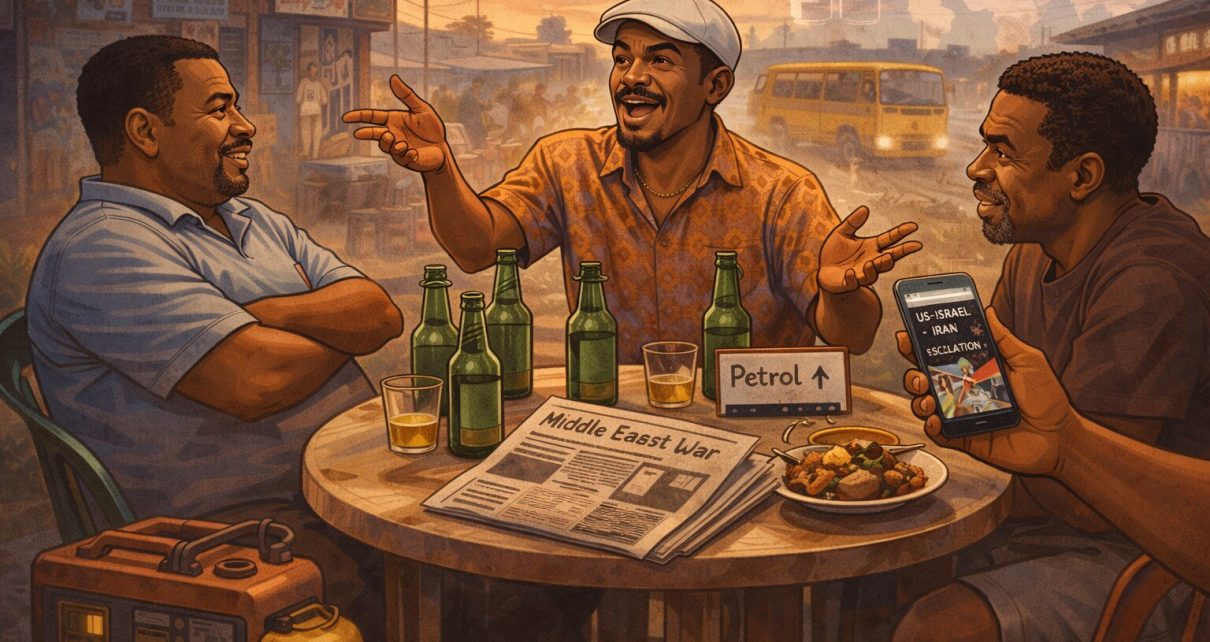
Wars have a curious way of travelling. They begin as distant headlines—maps on television screens, analysts in dark suits explaining geopolitics—and somehow end up in the most ordinary places: a fuel queue in Mushin, a market stall in Mile 12, or a beer parlour in Aguda.
That was how the matter of the United States, Israel and Iran found its way to our table one humid evening.
Chiboy arrived first, scrolling endlessly on his phone with the seriousness of a man monitoring global affairs from a plastic chair.
John was already seated, studying a bottle as if it were a financial instrument.
I cleared my throat and announced that the conflict in the Middle East could soon affect Lagos in ways most people had not considered.
Chiboy looked up immediately.
“Abeg, Syracuse, no start. War dey Middle East. You dey Surulere. Why you dey cry more than the bereaved?”
The beer parlour erupted in laughter. It is one of Lagos’ favourite accusations: that someone is worrying about a matter that does not concern him.
But distance, I explained, is deceptive.
Wars today do not move by geography alone. They move through markets, shipping lanes, and prices.
John raised his eyebrow.
“So Iran go increase price of pepper soup for Aguda?”
The laughter returned.
Chiboy leaned back comfortably.
“Guy, relax. No be every global problem concern Lagos. Make dem fight their fight.”
The confidence of Lagos men in dismissing international affairs is impressive. We assume that anything happening outside our immediate traffic radius must be theoretical.
Yet the reality is less convenient.
Oil markets react instantly to war in the Gulf region. When supply is threatened, prices rise. When oil prices rise, the consequences travel swiftly—especially in a country like Nigeria, where energy costs influence nearly everything else.
I attempted to explain this calmly.
“If oil price rise, petrol go rise. If petrol rise, transport go rise. When transport rise, food go follow rise.”
John waved a dismissive hand.
“Transport fare no need Iran before e go rise.”
That was, admittedly, a strong counterargument.
Chiboy shook his head.
“Syracuse, you dey behave like professor of suffering. Lagos people don survive worse things.”
The table murmured in agreement.
Survival is indeed Lagos’ most developed skill. But survival does not mean insulation. It merely means adaptation.
Consider shipping routes, I said. Much of the world’s oil moves through narrow waterways in the Middle East. When conflict threatens those routes, insurance costs rise, shipping costs increase, and the price of imported goods eventually follows.
Chiboy sighed theatrically.
“Next you go tell me say my phone charger go cost more because of Iran.”
I looked at him seriously.
“Not immediately,” I said. “But eventually.”
That is the difficulty with global economics. The connection between cause and effect is rarely visible in a straight line. Instead, it arrives gradually—like Lagos traffic creeping forward one reluctant metre at a time.
John leaned forward now.
“But Nigeria be oil country. If oil price rise, we suppose make more money.”
That observation, which has been repeated across Nigeria for decades, carries both hope and irony.
Yes, higher oil prices can increase government revenue. But Nigeria also imports refined fuel and many finished goods. The same global price increases that improve national income can also raise domestic costs.
In other words, prosperity at the macroeconomic level does not always translate neatly to relief at the beer parlour.
Chiboy was unconvinced.
“All this your analysis no go change my rent.”
I nodded.
“No,” I replied. “But it may change the cost of the generator that keeps your lights on.”
That landed more effectively than any macroeconomic lecture.
Electricity in Lagos has a way of making geopolitics feel personal.
John scratched his head thoughtfully.
“So you mean say war fit increase fuel, transport, food… everything?”
I spread my hands.
“That is the unfortunate efficiency of global markets.”
Chiboy still resisted.
“But Nigeria don dey face inflation before this war.”
True. But global shocks rarely arrive alone. They tend to sit on existing problems and make themselves comfortable.
Wars raise energy costs. Energy costs push up transport. Transport pushes up food prices. And food prices eventually push up everyone’s blood pressure.
John sighed.
“So even if war far away, bill still reach here.”
Exactly.
Conflicts thousands of kilometres away often arrive quietly in Lagos—not as explosions, but as adjustments in price lists.
By the time the connection becomes obvious, the consequences have already settled in.
Chiboy shook his head slowly.
“Still, you dey overthink am.”
Perhaps.
But Lagos has taught me that ignoring distant storms rarely prevents the rain.
As we prepared to leave, John offered the final reflection of the evening.
“If this war increase beer price, then we go protest.”
The beer parlour agreed unanimously.
In Lagos, geopolitical awareness has its limits.
Still, the lesson remained simple: the world has become so interconnected that a conflict in the Middle East can eventually ripple through markets, supply chains, and energy prices until it reaches the most ordinary corners of the city.
Even a plastic table in Aguda.
Na so we see am.


