As demolition fallout deepens, Lagos faces a difficult question: redevelopment, compensation, or the survival of a centuries-old water community.
The current tensions in Makoko did not begin this week.
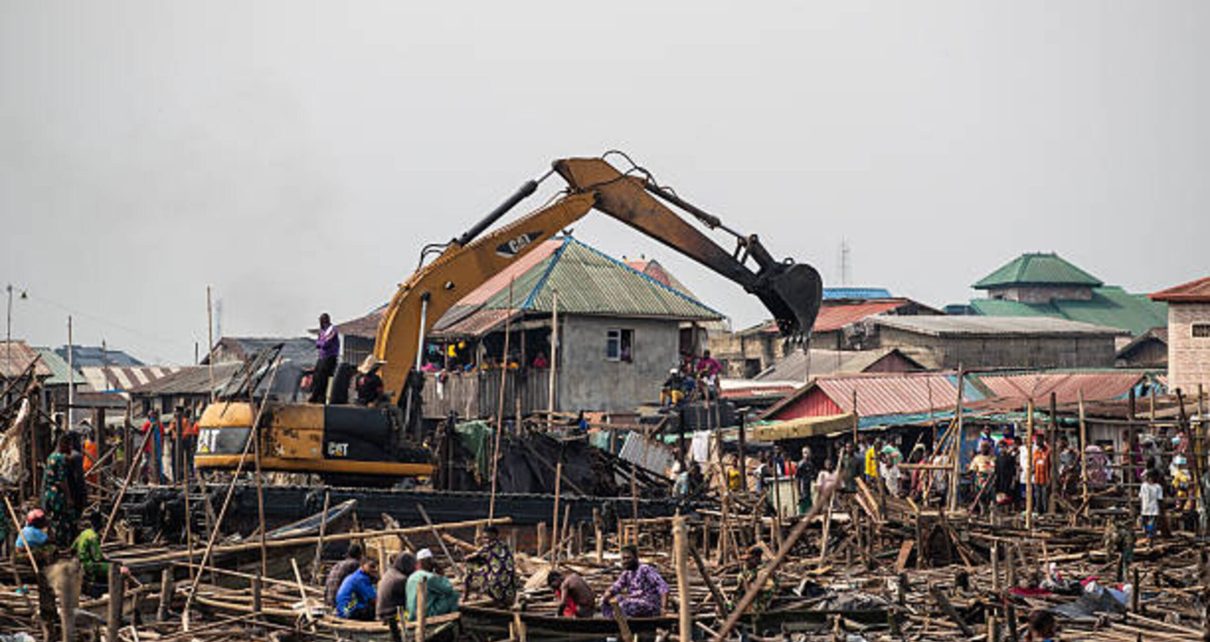
The dispute traces back to late December 2025, when Lagos State enforcement teams began demolishing stilt houses along sections of the lagoon-facing settlement.
Authorities said the operation was necessary for public safety. Officials argued that many structures had been built dangerously close to high-tension power lines and the approaches to the Third Mainland Bridge, posing risks to residents and infrastructure.
But residents say the demolitions went far beyond the official safety corridor.
Community leaders and civil society organisations such as CEE-HOPE (Centre for Children’s Health Education, Orientation and Protection) claim the original government plan referenced a 50-metre safety buffer. Instead, they allege that demolition teams pushed hundreds of metres into the community, affecting homes deep inside Makoko.
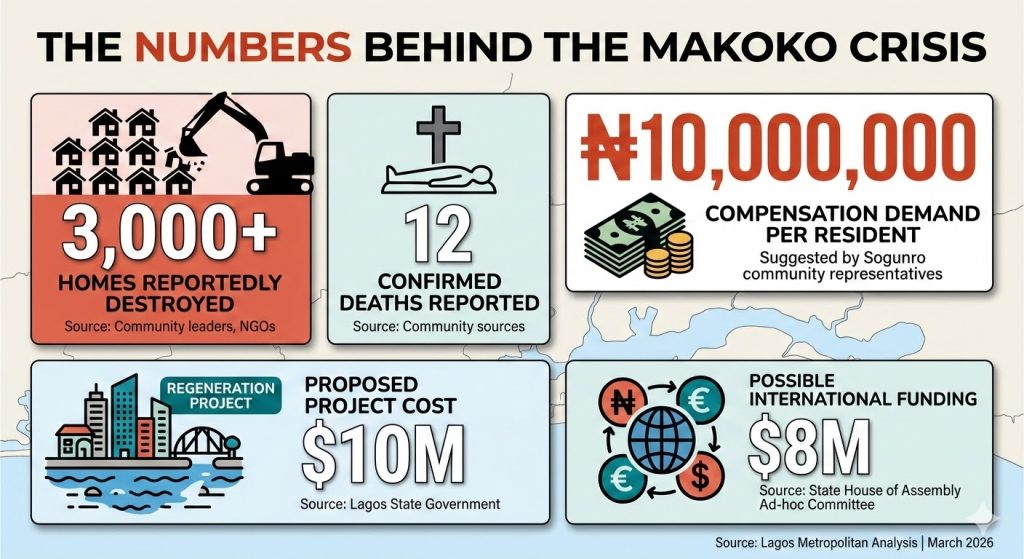
According to community estimates, more than 3,000 homes were destroyed, leaving thousands displaced.
Activists also reported at least 12 deaths, including infants, during the chaotic early phase of the demolition exercise — figures that have not been independently verified by state authorities.
For many residents, the episode marked the beginning of what some are now calling the “Makoko Crisis of 2026.”
The Divide: Relocation vs Cash Compensation
The latest turning point came after the conclusion of an ad-hoc investigative committee of the Lagos State House of Assembly, led by Majority Leader Hon. Noheem Adams.
Rather than resolving tensions, the committee’s consultations revealed a deep divide among the affected communities themselves.
Two competing visions of justice have emerged.
Makoko Core Community: Fight for Water-Based Relocation
The traditional leadership of Makoko, represented by Baale Emmanuel Shemade, is demanding permanent relocation to another water-based settlement.
Their argument is rooted in culture and livelihood.
Makoko’s population is largely drawn from the Egun fishing community, whose lives revolve around the lagoon. Fishing, canoe transport, and aquatic trade form the backbone of the local economy.
For them, relocation to land-based housing estates would effectively destroy their way of life.
As community leaders put it during the hearings, “We are fishermen; we cannot live in a forest.”
Sogunro Community: Cash Compensation
Another affected cluster, the Sogunro community, has taken a very different position.
Represented by Bola Ayande, residents there are demanding ₦10 million per affected person as compensation.
Their reasoning is pragmatic.
In Makoko’s informal architecture, building even a modest bamboo stilt house can cost around ₦4 million due to rising construction materials and labour costs.
Residents argue that anything less would make it impossible to rebuild elsewhere.
For them, compensation represents a financial exit strategy from a settlement they fear may soon disappear anyway.
The Negotiation Problem
For lawmakers trying to mediate the dispute, these positions have created a major obstacle.
Hon. Noheem Adams expressed frustration during the committee process, noting that earlier consultations suggested communities were leaning toward financial compensation.
The new shift toward territorial relocation demands has complicated negotiations and slowed the search for a unified resolution.
Without a common position among residents, the state government may find it difficult to design a compensation or relocation framework acceptable to all parties.
The Shadow of the “Water City” Project
Behind the dispute lies a larger and more ambitious plan.
In February 2026, Lagos officials announced the Makoko Regeneration Project, a proposed $10 million redevelopment initiative aimed at transforming the waterfront settlement into what planners describe as an “internationally compliant water city.”
According to Dr. Olajide Babatunde, Special Adviser to the Governor on E-GIS and Urban Development, the project could attract up to $8 million in international funding, potentially involving development partners and UN-backed urban resilience programmes.
The vision includes:
- structured floating communities
- improved sanitation systems
- regulated housing
- tourism and waterfront development
If implemented, the project could turn Makoko into a model for lagoon-based urban living in Africa.
But it has also intensified anxiety within the existing community.
Fear of Exclusion
For many residents, the redevelopment proposal raises a troubling possibility.
Some fear the “Water City” concept could ultimately replace rather than upgrade the existing community.
Residents of Sogunro appear to suspect they may not be included in the final redevelopment plan, which may explain the strong push for financial compensation.
Makoko’s traditional leadership, on the other hand, views relocation demands as a fight for territorial survival.
If fishermen accept cash compensation and move inland, they worry the Egun lagoon culture that defines Makoko could disappear within a generation.
The Rebuilding Risk
A new and potentially dangerous development emerged during the committee’s final deliberations.
Officials from the Lagos State Building Control Agency (LASBCA) disclosed that some displaced residents have already begun rebuilding houses on the demolished sites.
The situation creates a volatile cycle.
If negotiations stall while rebuilding continues, authorities may feel compelled to launch a second round of demolitions, escalating tensions further.
In a rare moment of agreement, several community leaders acknowledged the risk and indicated that any new structures built in restricted zones should be removed.
This effectively gives the government legal cover to enforce further demolitions if necessary.
The Urban Reality
Makoko occupies a unique place in Lagos.
Often described as the “Venice of Africa,” the settlement is a vast network of stilt houses, canoe routes, and floating markets stretching along the Lagos Lagoon.
While it has become internationally famous — attracting journalists, researchers, and tourists — it also represents one of the city’s most complex urban planning dilemmas.
Makoko exists at the intersection of:
- informality and tradition
- poverty and cultural heritage
- urban development and displacement
Any attempt to formalise the community inevitably raises questions about who benefits and who gets pushed out.
What It Means for Lagos
Redevelopment vs Displacement
Makoko’s regeneration could become a model for waterfront urban planning — or a case study in community displacement.
Rising Compensation Expectations
The ₦10 million demand could influence compensation negotiations in other demolition disputes across Lagos.
Legal Battles Ahead
If residents continue rebuilding, further demolitions may trigger lawsuits and protests.
Pressure on the Assembly
The Lagos State House of Assembly may need to quickly propose a settlement framework before tensions escalate.
The Uncertainty
The ₦10 million demand from Sogunro may be a classic negotiation tactic — a high opening bid in a desperate situation.
But the real story in Makoko is not money.
It is uncertainty.
For generations, Makoko has survived as a water-based community built on fishing, family networks, and lagoon life.
If redevelopment moves too fast without trust, the dream of a modern Makoko Water City could end up being built on the ruins of the very community that made the place famous.
And once a fishing culture leaves the water, it rarely finds its way back.


