

Starting a business in Lagos can be exciting, but it can also be overwhelming. The city is one of Africa’s most vibrant commercial hubs, with millions of potential customers and thousands of competing businesses. From the markets of Balogun and Alaba to the tech corridors of Yaba and Lekki, entrepreneurs are constantly launching new ideas and fighting for market share.
In such a competitive environment, having a business plan is not optional — it is essential.
A business plan is like your roadmap in Lagos traffic. Without a clear route, you could waste time, fuel, and energy moving in circles. A well-prepared business plan helps you navigate the competition, understand your customers, and anticipate challenges before they arise.
It outlines your goals, target audience, strategy, and financial projections, giving your business a clear direction. In a fast-moving market like Lagos, a strong business plan helps you stand out, make informed decisions, and avoid costly mistakes.
Most importantly, if you intend to seek investors, bank loans, or partnerships, a business plan is usually the first document people will ask to see. It shows that you understand your market and have a clear strategy for success.
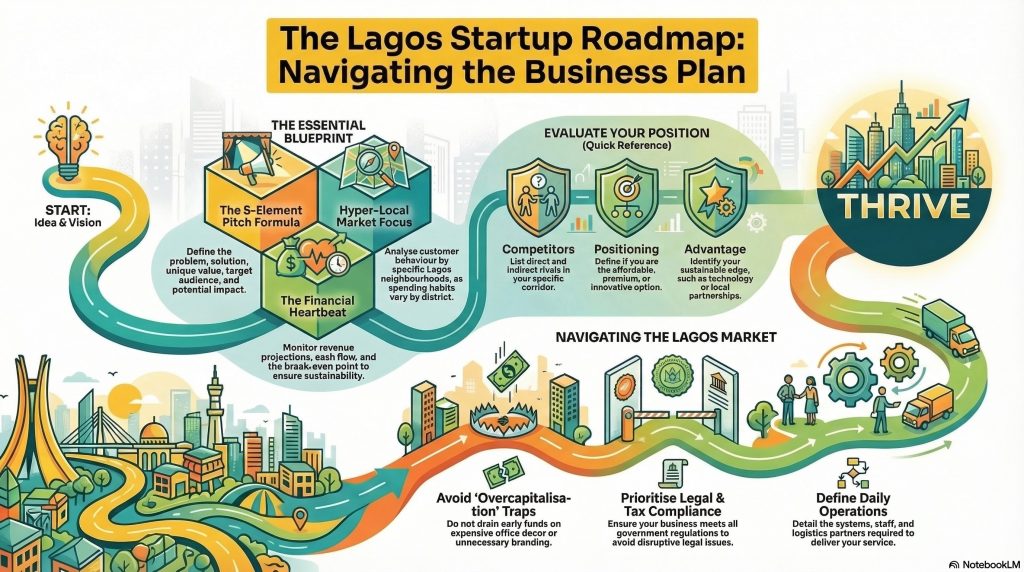
Below are the key components every Lagos startup should include in a solid business plan.
Executive Summary
The executive summary is the first section of your business plan, but it is often written last. Think of it as the “elevator pitch” for your business. It summarizes your entire idea in a few clear paragraphs.
Investors, partners, or lenders often decide whether to continue reading your plan based on this section. That is why it must be concise, clear, and compelling.
Explaining a business idea clearly is all about simplicity and focus.
A useful formula for explaining your business idea includes five elements:
1. Problem Statement:
What problem are you solving? Every successful business solves a real problem. For example, Lagos commuters struggle with traffic congestion, while many households struggle to find reliable domestic services.
2. Solution:
How does your business solve that problem? This is where you explain the product or service you provide.
3. Unique Value:
What sets your business apart from competitors? It could be price, technology, convenience, or quality.
4. Target Audience:
Who are your customers? Be specific.
5. Potential Impact:
How will the business create value and generate revenue?
For example:
“Our mobile app connects Nigerian farmers directly with urban buyers, solving logistics and middleman issues. Farmers earn better prices while buyers receive fresh produce at competitive rates. The platform includes real-time pricing, delivery tracking, and secure payments, targeting small-scale farmers and local food businesses.”
A strong executive summary should make readers understand your business idea within a minute.
Who Are the Customers?
One of the biggest mistakes entrepreneurs make is trying to sell to everyone.
Every successful business has a clearly defined target market. Your customers might be school children, working professionals, housewives, retirees, students, or travelers. The key is to understand their needs and preferences.
In Lagos, customer behaviour varies widely across neighborhoods. The spending habits of customers in Ikoyi may differ significantly from those in Agege or Ajegunle.
Your business plan should therefore answer questions like:
- Who exactly are your customers?
- Where do they live or work?
- What problems are they trying to solve?
- How much are they willing to pay?
Understanding your customers allows you to design products, pricing, and marketing strategies that actually work.
For example, a startup selling affordable school supplies might focus on parents in densely populated areas like Alimosho or Mushin, while a luxury skincare brand might target professionals in Victoria Island and Lekki.
Product or Service Description
This section explains exactly what you are offering to the market.
When writing a product or service description, aim for clarity. Investors or readers should quickly understand what you sell and why it matters.
A good product description should answer four questions:
- What is the product or service?
- What problem does it solve?
- Who is it designed for?
- What makes it unique?
For example:
“Our mobile platform connects Nigerian farmers directly with urban buyers, eliminating multiple middlemen. Farmers gain access to fair prices and wider markets, while buyers receive fresh produce delivered directly from farms. Key features include real-time pricing, delivery tracking, and secure digital payments. The platform targets small-scale farmers, restaurants, and grocery retailers.”
You can also include additional details such as:
- Product features
- Technology used
- Development stage
- Future improvements
This section helps readers understand the value of your business offering.
Competitive Landscape
No business exists in isolation. Every entrepreneur operates in a marketplace where other companies already offer similar products or services.
The competitive landscape section helps you analyze those competitors and explain how your business stands out.
Your analysis should include:
1. Identifying Competitors
List your direct and indirect competitors.
2. Strengths and Weaknesses
What do competitors do well? Where do they fall short?
3. Market Positioning
How does your business position itself differently?
4. Competitive Advantage
What gives your business a sustainable edge?
For example:
“Main competitors include Jumia and Konga. Their strengths include strong logistics networks and large product catalogs. However, they often charge high fees and have limited focus on small local artisans. Our platform focuses specifically on Nigerian artisans, offering curated products, better profit margins, and stronger community engagement. Our competitive advantage lies in local partnerships and cultural authenticity.”
Understanding your competitors allows you to identify opportunities and gaps in the market.
Marketing Strategy
Even the best product will fail if people do not know about it.
Your marketing strategy explains how you will reach and engage your target audience. It answers one simple question: How will customers discover your business?
A marketing strategy usually includes:
Target Audience
Who are you trying to reach? Consider demographics, income levels, lifestyle, and behavior.
Positioning
How do you want customers to perceive your business? Are you the affordable option, the premium option, or the innovative option?
Marketing Channels
Where will you reach your customers? Possible channels include:
- Social media
- Online advertising
- Email newsletters
- Events and exhibitions
- Partnerships
- Traditional advertising
Marketing Tactics
These are the specific actions you will take. Examples include influencer marketing, product demonstrations, referral programs, or promotional discounts.
Metrics for Success
How will you measure your results? Examples include website traffic, sales conversions, customer acquisition cost, and customer retention.
Example for an e-commerce platform:
- Target audience: Nigerian artisans and global buyers interested in unique crafts.
- Positioning: Connecting culture with commerce.
- Channels: Instagram, online marketplaces, local exhibitions, and partnerships with artisan groups.
- Tactics: Influencer campaigns, targeted ads, storytelling content about artisans.
- Metrics: Website traffic, sales conversions, and repeat customers.
Operations Plan
An operations plan explains how the business will function on a daily basis.
It describes the systems, people, and processes required to deliver your product or service.
Key areas to include are:
Key Activities
What activities must take place to run the business successfully? These might include production, logistics, customer service, and marketing.
Resources Needed
What assets are required? These could include staff, equipment, technology platforms, office space, or vehicles.
Partnerships
Which suppliers or partners will support your operations?
Processes and Systems
How will you manage workflows, inventory, and customer service?
For example:
“Key activities include product listing, order processing, delivery coordination, and customer support. Resources include an e-commerce website, payment gateway integration, and delivery partners. Partnerships include artisan suppliers and logistics companies. Operations will be supported by order tracking systems and a dedicated customer service team.”
A strong operations plan demonstrates that your idea is practical and executable.
Financial Plan
The financial plan is often described as the heartbeat of the business plan. It shows whether the business can realistically make money.
A financial plan typically includes:
Revenue Projections
How much money you expect to earn over time.
Expense Budgeting
All the costs involved in running the business, including rent, salaries, marketing, and utilities.
Cash Flow Forecast
How money moves in and out of the business.
Funding Requirements
How much money you need to start or expand.
Break-Even Analysis
The point at which your revenue equals your costs.
A realistic financial plan helps entrepreneurs avoid surprises and manage resources wisely.
Common Mistakes Lagos Startups Make
Despite good intentions, many Lagos startups struggle because of avoidable mistakes.
Some common pitfalls include:
Poor Financial Management
Many businesses fail because they do not track income and expenses properly.
Inadequate Market Research
Launching a business based purely on assumptions can lead to poor product-market fit.
Overcapitalization
Spending too much on office decor, branding, or unnecessary equipment can drain early funds.
Ignoring Legal and Tax Compliance
Failure to comply with government regulations or tax requirements can create serious problems.
Underpricing Products
Setting prices too low may attract customers initially but can destroy profitability.
Lack of Emergency Funds
Unexpected costs can disrupt operations if there are no reserves.
Poor Cash Flow Management
Many businesses collapse not because they are unprofitable, but because they run out of cash.
Final Thoughts
Launching a successful business in Lagos requires more than enthusiasm and a good idea. It requires planning, discipline, and a clear understanding of the market.
A well-prepared business plan helps entrepreneurs think strategically, manage resources wisely, and build sustainable businesses.
To avoid common startup mistakes, entrepreneurs should:
- Create a detailed budget
- Track all expenses carefully
- Understand their break-even point
- Conduct proper market research
- Seek professional advice when needed
Diversifying income streams and maintaining accurate financial records can also improve long-term stability.
Before launching your startup, ask yourself a few important questions:
- Have you conducted sufficient market research?
- Do you clearly understand your customers?
- Is your pricing strategy sustainable?
- Do you have a realistic financial plan?
Answering these questions honestly can save you time, money, and frustration.
In a city as dynamic and competitive as Lagos, a well-thought-out business plan could be the difference between struggling to survive and building a thriving enterprise.


