
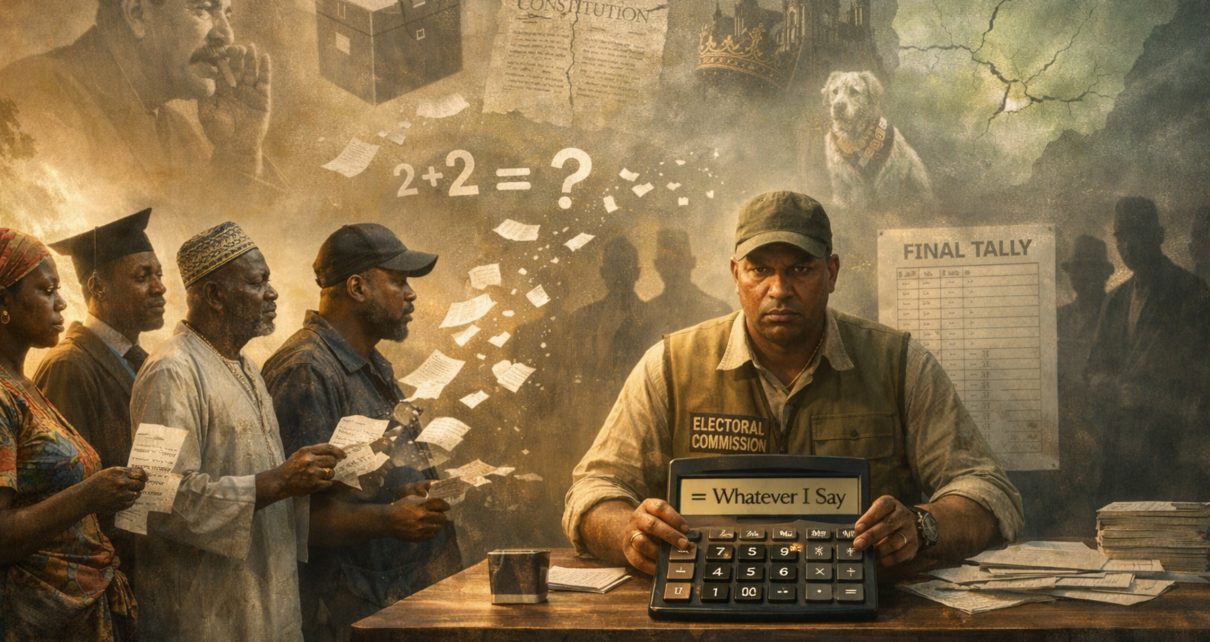

We have recently witnessed spirited protests and media contestations on the electoral bill then in the works and now signed into law by President Bola Tinubu. If you immerse yourself too deeply in the emotive tragicomedy, you may miss the tragedy of how politics has torn the fabric of brotherhood down the middle, or the comedy of electoral mathematics in which two plus two equals whatever some electoral officer says it is.
The Good Book says that there is nothing new under the sun. Whatever is, had been before. It was Joseph Stalin who famously said, “The people who cast the votes decide nothing. The people who count the votes decide everything.” Following up on that theme, the American writer, humorist, and essayist Mark Twain declared, “If voting made any difference, they wouldn’t let us do it.”
Looking through history, there is nothing unprecedented about our peculiar electoral processes. Politicians all over the world—with possibly a few exceptions—could be avaricious, self-centred, and as worthy of trust as a woman of easy virtue. We want the best for our land, but we shouldn’t beat ourselves up too much in the illusion that any particular issue is of apocalyptic significance. There is nothing new under the sun!
Happenings in some other parts of the ‘developed’ world have shown us that our politicians may not be worse than their counterparts elsewhere. As much as we like to celebrate Western democracy, we have seen how, in some climes, it has aided racism, dehumanisation, genocide, and the ascendancy to power of certified idiots. That aberration did not start today. In a society governed passively by free markets and free elections, says US journalist and author Matt Taibbi:
Organised greed always defeats disorganised democracy.
Kidnapping the Dead
Duke Henry of Bavaria was not a Nigerian. In 1022, he made what could very well be the most drastic attempt to gain political power anywhere in the world. After the death of Emperor Otto III, Henry abducted his corpse and also kidnapped the archbishop who had the spiritual duty of swearing in a new leader. Eventually, Duke Henry was crowned King of Germany and went on to become the Holy Roman Emperor.
Remember, during President Yar’Adua’s illness, there was an attempt by some Nigerian politicians who were benefiting from the situation to physically prevent those outside the power loop from having access to the comatose president. In those twilight days, when no outsider could vouch for the consciousness of the former leader, budgets were signed, presidential directives were given, and billions of dollars were spent based on indeterminate authorisation.
Holy Electors
When politics enters holy places, the odds can be foreboding. Take the case of the Catholic Church when Pope Clement IV died in 1268. The cardinal electors spent two indecisive years at a complete standstill. They couldn’t put aside their political differences to cast the required vote unanimously. Two whole years! The frustrated people of Viterbo, who had become tired of watching the futile drama, reportedly trapped the indecisive cardinals in their locked chambers, removed the roof, and delivered only bread and water.
Even then, the obstinate cardinals held on for another year. After a year of captivity and the death of three cardinals, the remaining men finally agreed unanimously to elect Pope Gregory X in 1271. Three years later, he formed the papal conclave to ensure that future papal elections would be systematised and stress-free.
In 2003, when President Obasanjo reportedly scored 1.36 million out of 1.5 million votes cast in the presidential election in Ogun State (a whopping 91%), some of us counselled those who were convulsing with rage to take things easy lest they blow a fuse and trigger an avoidable cardiac accident. When you’re confronted with electoral magic, the standard political pregnancy could yield a set of decuplets!
But give dishonour to whom dishonour is due. In the 1927 presidential elections in Liberia, 15,000 eligible Liberians registered to vote. Liberia is Africa’s first and oldest modern republic. It was founded by freed Black slaves coming from America in the 1800s. Incumbent President Charles D.B. King won in a landslide of 234,000 votes while his opponent scored 9,000. The dimension of the electoral rigging was so staggering that the Guinness Book of World Records recorded it as the most quantitatively fraudulent election in recorded history!
But not to worry. Elections continue to bring out our weird peccadilloes, whether as office seekers, voters, or electoral administrators.
Dead Man Elected
In the United States, voters in rural Nevada elected a dead brothel owner to the state assembly in 2018. Before the vote, several political pundits had argued that by dying three weeks before the election, Dennis Hof, the self-proclaimed “Trump of Pahrump,” may have actually improved his chances. Ordinarily, as a Republican, Hof had a good chance of winning, but his untimely death gave some political cover to hypocritical religious conservatives who would have had reservations about electing a pimp. Now that he was dead, conservatives could vote for their fellow party man with a ‘clear conscience’. If this had happened in an African country, some ‘analysts’ would have seen it as a sign of backwardness.
When comedian Jon Gnarr formed the Best Party in 2010 in his bid to win a city council seat in Reykjavik, Iceland, his slogan sounded like something taken straight out of a beer parlour: “We promise to stop corruption by participating in it openly.” The people had a good laugh. Who but a clown would hope to kill corruption by openly participating in corruption? Well, the joke was on the people. Not only did Gnarr win the election, gaining control of council seats for his party, but he also became Reykjavik’s mayor!
Canine Mayor
From Cormorant, Minnesota, came the story of electoral victory for man’s best friend. The city, being so small, had never had a mayor. In 2014, however, townspeople decided to hold an election for their first-ever mayor. Guess what—a seven-year-old Great Pyrenees dog named Duke won in a landslide. The dog defeated Richard Sherbrook, a long-time resident. And, wonder of wonders, even Sherbrook himself voted for the dog! By the time the final tally of votes came in, Duke had won nine out of a ‘colossal’ twelve votes!
It is fashionable to label politicians as conmen, but how do you describe the voting public who appear determined to cast their votes only for the candidate with the most absurd promises? A clown played on this curious fault line in Brazil and breasted the tape to victory. When Tiririca, the Brazilian clown, ran for São Paulo federal deputy in 2010, he campaigned on one big question: “Does anyone really know what happens behind closed governmental doors?”
The candidate said the people deserved to know what went on behind the hallowed government doors and that if he was voted into office as federal deputy, he would find out for them. He had a ready-made answer for any electoral fence-sitter: “It can’t get any worse.” Tiririca won with more than double the votes of the second-placed candidate!
In Nigeria, the recent contestations over the 2026 Electoral Act are comparable to a situation where a child is crying in front of its mother. The child knows why it is crying; the mother knows why she will do anything to make the child stop crying—except give it what it wants!


