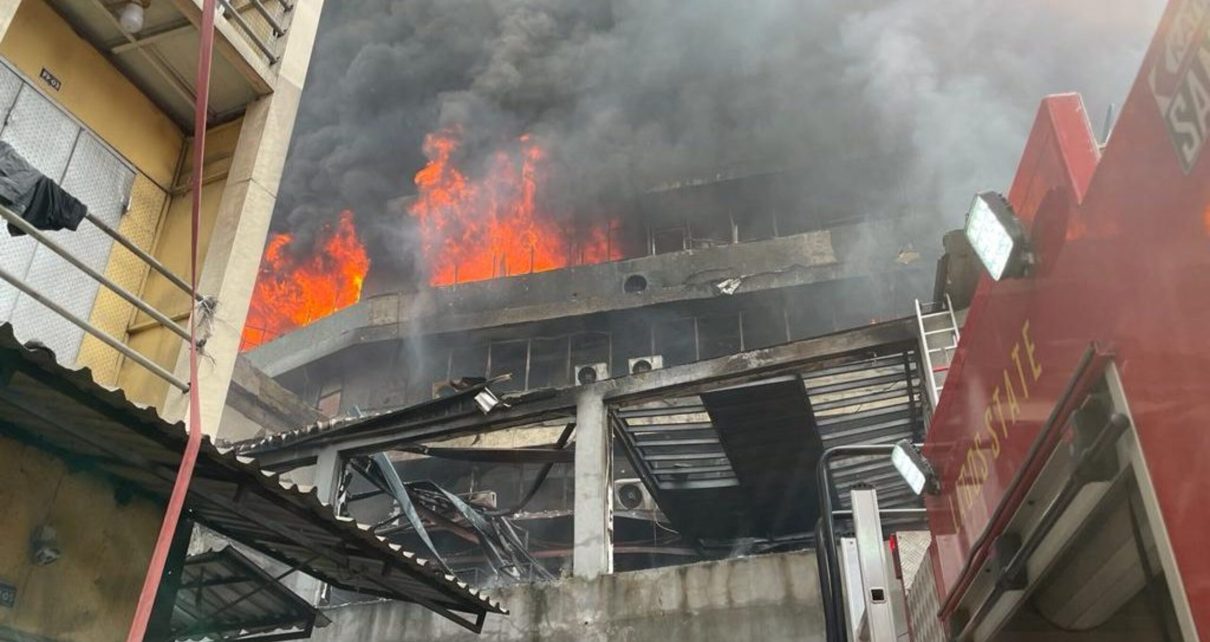
For decades, the phrase “strange fire” has been a part of the Lagos commercial lexicon. However, as 2026 unfolds, a series of devastating infernos in major trading hubs—Balogun, Arena (Oshodi), and Ikotun—has shifted the conversation from tragic accidents to a brewing storm of suspicion and political tension.
The Ndigboamaka Progressive Markets Association (NPMA), representing 58 major markets, has officially sent an SOS to the Federal Government. While the call is for financial palliatives, the subtext is far more volatile: a growing belief among traders that these fires are not merely “unsafe acts” but a calculated tool of urban “cleansing” and political intimidation.
The Incident Cluster: A Timeline of Ruin
| Date | Location | Reported Cause | Official Casualties | Status |
| Dec 24, 2025 | Great Nigeria House, Balogun | “Electrical/Generator” | 8 Deaths | Demolished Feb 2026 |
| Dec 29, 2025 | Arena Market, Oshodi | Under Investigation | 10 Container Shops Razed | Sealed |
| Jan 1, 2026 | Ikotun Shopping Complex | Electrical Surge | 24 Shops Razed | Partially Cleared |
The Narrative of Sabotage: Fact or Friction?
The frequency of these fires—three major markets razed within a seven-day window during the festive peak—has fueled allegations of deliberate arson.
- The Collusion Theory: Voices within the trading community, particularly from the Southeast, have pointed to the speed at which the Lagos State Building Control Agency (LASBCA) moves to demolish and “redevelop” sites after a fire as evidence of a “fire-to-demolition” pipeline. Critics argue that fires provide a convenient legal pretext for the state to bypass lengthy court processes for evictions.
- Government Rebuttal: The Lagos State Government has hit back hard. Wale Ajetunmobi, a senior aide to Governor Sanwo-Olu, recently described these allegations as a “senseless ethnic agenda.” He noted that the Great Nigeria Insurance (GNI) Building is owned by the Oodu’a Group—a Yoruba-owned corporation—arguing it would be illogical for the state to sabotage its own indigenous assets.+1
The “Unsafe Act” Reality
Official investigations by the Lagos State Fire and Rescue Service attribute 95% of fires to human negligence.
“Traders are placing industrial generators on the 4th and 5th floors, storing flammable chemicals in unventilated warehouses, and tapping electricity illegally behind transformers,” said Controller-General Margaret Adeseye.
However, traders counter that the state’s failure to provide modern infrastructure or adequate firefighting equipment (eyewitnesses at Balogun alleged that the first trucks arrived without sufficient water or cranes) constitutes a form of “passive collusion” through negligence.
Analysis: The Post-Fire “Urban Renewal” Gamble
The real tension lies in what happens after the embers cool.
- Regeneration vs. Displacement: Governor Sanwo-Olu has announced a “comprehensive regeneration” of the Balogun area. For the state, this is a necessary move to modernize a chaotic business district. For the traders, “regeneration” is often code for luxury plazas they will never be able to afford.
- The SOS to Abuja: By bypassing Alausa (Lagos State) and appealing directly to the Federal Government, the NPMA is making a clear statement: they no longer trust the state government to be an impartial arbiter of their welfare.
The fires in Lagos are no longer just a public safety issue; they are a litmus test for the city’s social cohesion. Whether the cause is a faulty generator or a hidden hand, the result is an increasingly alienated merchant class that views the state’s bulldozers with more fear than its firefighters.


