
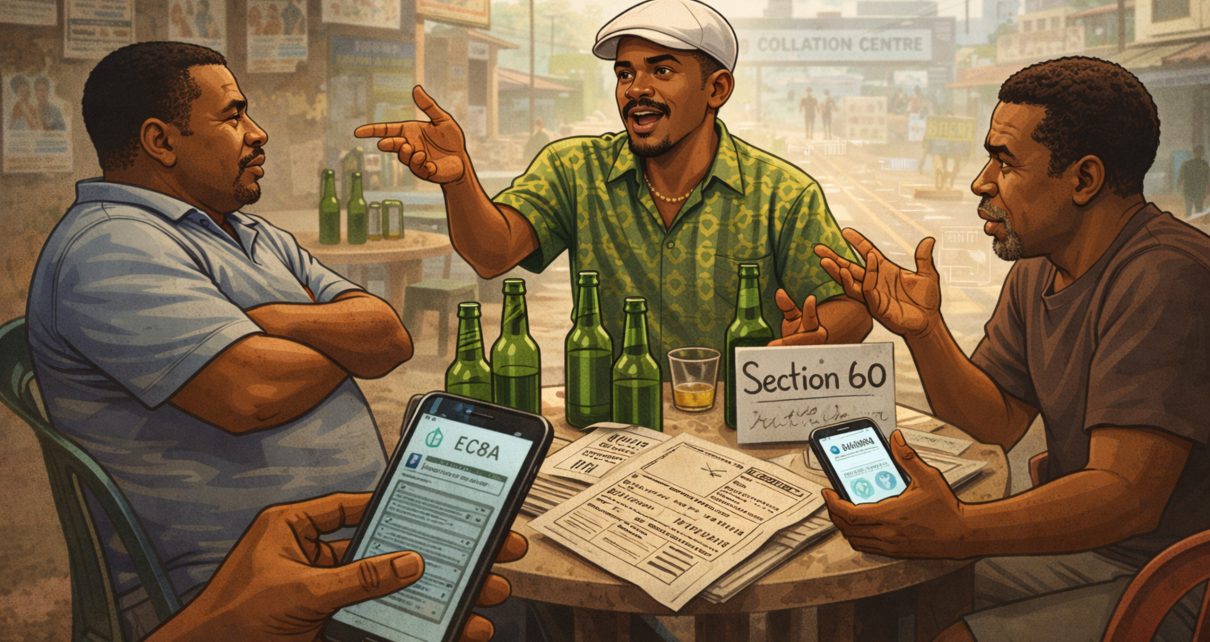
Aguda does not wait for official briefings before forming opinions. Once the topic enters a beer parlour, it leaves with a verdict. That was how Section 60 of the Electoral Act arrived at our table—between two bottles and one exaggerated sense of civic responsibility.
I had barely sat down when Chiboy cleared his throat like a man about to defend a dissertation.
“Make una calm down first. The matter no be magic. Section 60 just talk say results go record for polling unit, sign am, then transmit am as INEC prescribe. Manual still dey important.”
John shook his head slowly.
“You see? Na that ‘as INEC prescribe’ dey worry me. That one na window.”
Chiboy adjusted his seat, already irritated.
“No be window. Na flexibility. Technology fit fail. Network fit go. You no fit make electronic transmission the only legal authority for village wey no get signal.”
I leaned forward, steepling my fingers like a retired statesman.
Flexibility is a beautiful word in Lagos. It has excused everything from late rent to missing documents. In politics, flexibility sometimes means “we will decide later.”
“Chiboy,” I said calmly, “if result upload immediately from polling unit, who go change am?”
He replied without blinking.
“If manual sheet no agree with upload, agents go raise alarm. Court go rely on signed EC8A. That one na physical evidence.”
John laughed.
“Court? You wan use five years prove say dem rig you?”
The beer parlour murmured in agreement. In Lagos, justice delayed is not an abstract concept; it is a calendar.
Chiboy persisted.
“Electronic transmission increase transparency. People fit monitor in real time. But you no fit remove manual completely. Hackers dey. Server fit crash.”
I nodded thoughtfully, then delivered what I believed was the decisive argument.
“My brother, fraud no need crash server. Fraud need small ambiguity. If law no clear say upload na final authority, somebody go interpret am creatively.”
John snapped his fingers.
“Na that creativity dey fear me.”
There is something about Nigerians and clauses. We have seen too many “may” where there should have been “shall.” Too many procedural gaps where someone ambitious can squeeze through.
Chiboy, now fully in lecturer mode, raised his voice slightly.
“Listen. Even if electronic transmission become mandatory, fraudsters fit still manipulate before upload. Or manipulate manual before upload. The problem no be paper or server. Na integrity.”
That word always lands awkwardly.
Integrity is popular in speeches and scarce in practice.
I leaned back and delivered my philosophy.
“Integrity good. But law suppose reduce temptation. You no write law assuming angels. You write law assuming human beings.”
John thumped the table lightly.
“Correct!”
Chiboy sighed.
“So wetin una want? Make electronic upload override manual completely?”
I paused. The beer parlour quieted slightly.
This was the heart of it.
“I want clarity,” I said. “If polling unit result upload immediately and citizens see am, and that upload legally binding, manipulation for collation centre reduce.”
Chiboy shook his head.
“You dey assume network perfect. You dey assume no cyber attack. You dey assume INEC infrastructure strong.”
John waved his hand dismissively.
“We don dey assume things since independence.”
The table erupted in laughter.
The truth is, both arguments had merit. Technology can expose fraud. Technology can also conceal it. Paper can be forged. Servers can be compromised. The real fear is not transmission—it is discretion.
Section 60, as currently worded, gives operational authority to the Commission. That flexibility protects against technological failure. But it also leaves room for interpretation. And in Nigeria, interpretation has historically been athletic.
Chiboy made one last effort.
“If you make electronic result supreme, and system glitch, election collapse. You no fit disenfranchise village because server blink.”
I responded slowly.
“If you no make electronic transmission decisive, collation centre become theatre.”
John added quietly:
“Na for collation centre drama dey start.”
That line hung in the air.
Every Nigerian election has two phases: counting and convincing. The counting happens quickly. The convincing takes years.
The debate over Section 60 is not about whether paper is better than pixels. It is about which stage of the process holds final authority. Polling unit transparency has improved. The anxiety now lives between upload and collation.
As we prepared to leave, Chiboy muttered:
“Fraud fit happen with or without amendment.”
I adjusted my cap.
“True. But clarity reduce opportunity.”
In the end, the beer parlour did what it always does—reached a dramatic conclusion without legislative power. But beneath the satire lay a serious concern: laws must be written not for the best among us, but for the most ambitious among us.
Because in this country, technology does not remove politics. It simply changes the battlefield.
Na so we see am.
- Na so we see am is a weekly column that listens to Lagos the way Lagos speaks—half joking, half serious, always observant. Through the eyes of Syracuse of Aguda, readers are invited into beer parlours, bus stops, street corners, and everyday conversations where exaggeration, humour, and hard truth sit on the same plastic chair. The views expressed are intentionally conversational and satirical, reflecting the rhythms of the city rather than official positions. Sometimes it is just talk. Sometimes it is news. Na so we see am.


